

Prefer to Listen? Play this quick summary instead!
Fifty workers had already died from injuries in Australian workplaces by 21 May 2026, based on preliminary fatality data from Safe Work Australia. This number reflects real people, families, teams, and worksites affected by serious harm.
This early 2026 data shows a clear pattern. Workplace deaths in Australia remain concentrated in high-risk industries such as transport, agriculture, mining, and construction. Vehicle incidents are also the leading cause of fatal workplace injuries so far this year.
For workers, employers, WHS managers, health professionals, insurers, and return-to-work coordinators, these workplace injury statistics help identify where prevention, early reporting, and rehabilitation support need the strongest focus.
How Is This Data Collected?
Safe Work Australia tracks preliminary worker fatalities using initial media reports throughout the year. These figures provide an early view of fatal workplace incidents before final annual data is confirmed.
The figures are updated regularly. They are usually lower than the final annual count because some fatalities are confirmed later through additional sources.
This makes Safe Work Australia fatalities data useful for early risk awareness. It should not be treated as a final yearly total. It should be read as an early signal of where serious workplace harm is occurring.
💡 Important clarification: this data excludes deaths from disease, natural causes, and suicide. For a complete and interactive report, head on to the official Preliminary fatalities (2026) page.
Which Industries Have the Most Workplace Deaths in 2026?
The early 2026 data shows that fatal workplace incidents are not evenly spread across all sectors. Some industries carry a much higher level of physical risk because of vehicles, mobile plants, machinery, livestock, remote work, heights, and heavy materials.
The table below shows the industries with the highest number of worker deaths recorded so far in 2026, based on the supplied Safe Work Australia preliminary fatality data.
Workplace Fatalities by Industry: 2026 Year-to-Date Comparison
| Industry | YTD Deaths 2026 | 2025 | 5-Year Avg |
|---|---|---|---|
| Transport, postal and warehousing | 24 | 65 | 58 |
| Agriculture, forestry and fishing | 10 | 30 | 40 |
| Mining | 6 | 6 | 7 |
| Construction | 5 | 20 | 31 |
| Public administration and safety | 3 | 9 | 9 |
| Electricity, gas, water, and waste services | 1 | 5 | 4 |
| Other services | 1 | 7 | 5 |
The 5-year average for worker fatalities across Australia was 191 deaths per year from 2020 to 2024. Safe Work Australia also reported 188 traumatic worker fatalities in 2024.
These numbers reinforce a consistent message. High risk industries in Australia include transport, agriculture, mining, and construction because workers in these fields often face hazards that can lead to severe injury or death.
Transport Remains the Highest Risk Industry
The transport industry workplace risk profile includes road crashes, loading areas, reversing vehicles, fatigue, mobile plant, and traffic management failures. These risks can affect drivers, operators, warehouse workers, delivery workers, and logistics staff.
For injured transport workers, recovery may involve more than physical healing. It may require graded duties, driving capacity reviews, ergonomic changes, psychological support, and clear communication between the worker, GP, employer, insurer, and rehabilitation provider.
For employers, transport safety should be managed as a system. Vehicle maintenance, scheduling, fatigue management, loading procedures, and site traffic controls all matter.
Agriculture and Mining Continue to Show High Risk
The agriculture workplace deaths in Australia reflects a persistent concern. Agriculture often involves tractors, quad bikes, livestock, machinery, chemicals, manual handling, and isolated work.
Mining also carries serious risks. Heavy plant, vehicle movement, fatigue, ground conditions, and high-risk operational systems can all contribute to severe injury.
Both sectors need strong controls for mobile plant, machinery, vehicle movement, fatigue, and emergency response.
When injury does occur, early assessment is important. Workers in agriculture and mining may have physically demanding jobs. A safe return to work often needs clear functional information, staged duties, and strong communication with treating professionals.
Construction Remains a Long-Term High-Risk Industry
The longer-term average shows construction as one of Australia’s high-risk sectors even though the number is lower than transport, agriculture, and mining at this point in the year. This makes construction fatalities in Australia a continuing WHS priority.
Construction workers face risks from heights, falling objects, electricity, mobile plants, excavation, manual handling, and shifting site conditions. Construction workers may also experience cumulative injuries. These include back injuries, shoulder injuries, knee injuries, and hand injuries. These injuries can affect work capacity for months or years if they are not managed early.
A strong return-to-work plan should reflect the actual demands of the worker’s role. It should also account for site realities. Suitable duties need to be safe, practical, and consistent with medical restrictions.
What Are the Most Common Causes of Workplace Death?
The supplied Safe Work Australia preliminary data shows that vehicle incidents remain the leading cause of fatal workplace injury in 2026.
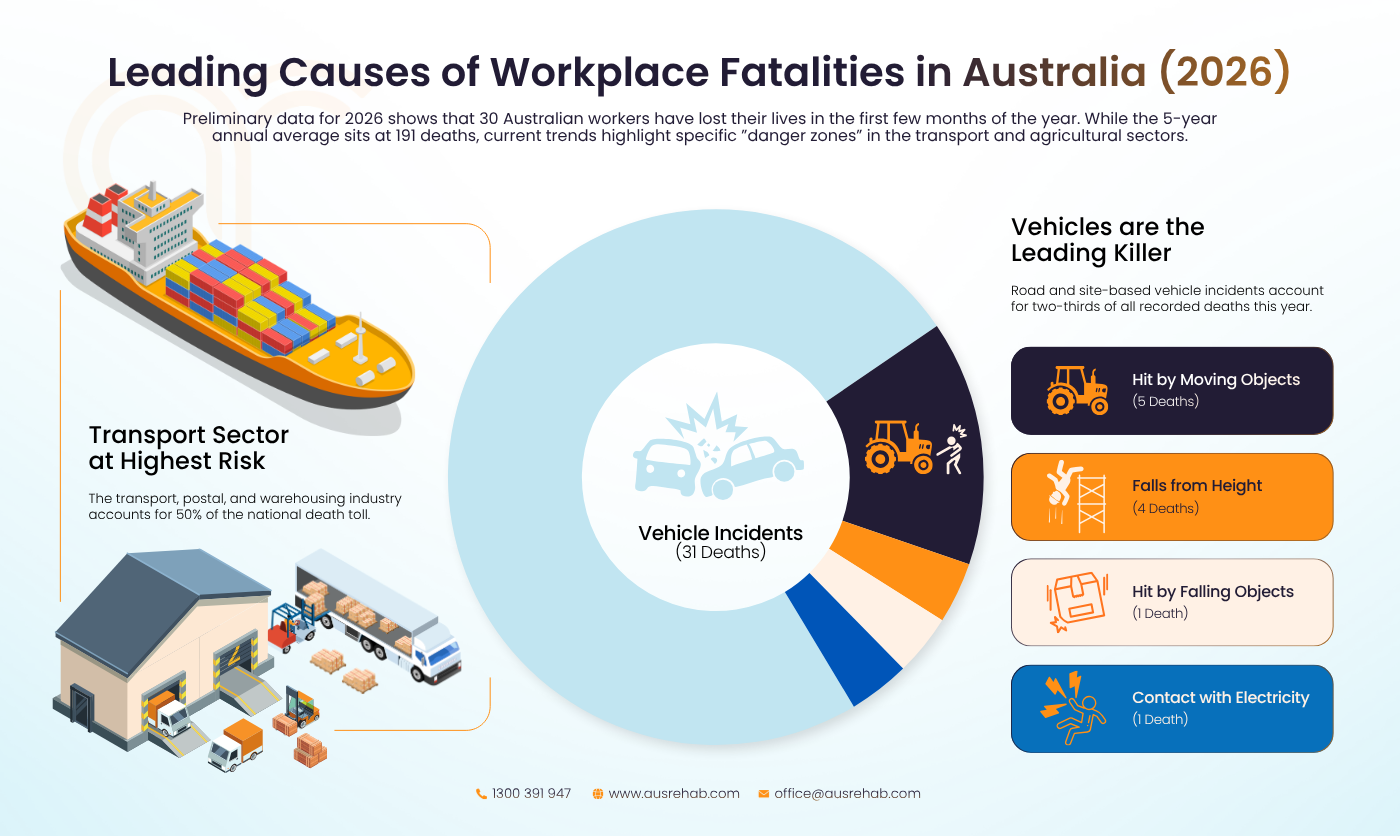
The infographic above shows that common causes of workplace death are often linked to high-energy hazards. Vehicles, moving objects, heights, falling materials, and electricity can all cause serious injuries in seconds.
Vehicle Incidents Are the Leading Cause
Vehicle incidents caused 31 of the 50 worker deaths recorded in the supplied early 2026 data. That makes workplace vehicle incidents in Australia the most urgent fatality pattern in the current data.
Vehicle-related incidents can include road crashes, rollovers, mobile plant collisions, reversing incidents, loading zone incidents, and workers being struck by vehicles.
There are several practical controls that can reduce risk.
Practical Controls for Managing Vehicle-Related Workplace Risks
| Risk Area | Practical Control |
|---|---|
| Fatigue | Review rosters, breaks, travel time, and job demands |
| Vehicle condition | Complete scheduled maintenance and daily checks |
| Site traffic | Separate pedestrians from vehicles where possible |
| Reversing risk | Use spotters, cameras, alarms, and clear exclusion zones |
| Loading areas | Use stable surfaces, safe access, and clear communication |
| Driver behaviour | Reinforce safe speeds, seatbelts, and mobile phone rules |
Workers also need simple reporting pathways. A near miss involving a vehicle should not be ignored. A reversing incident, missed collision, unsecured load, or fatigue concern may reveal a serious weakness in the work system.
Falls and Impact Injuries Remain Consistent Risks
Falls in the workplace in Australia remain a consistent long-term risk even when early-year figures appear lower. Impact injuries are also a concern. These mechanisms are often linked to construction, warehousing, manufacturing, mining, agriculture, and transport tasks.
Falls and impact injuries may also cause serious non-fatal harm. Common outcomes include fractures, concussion, shoulder injuries, spinal injuries, crush injuries, lacerations, and psychological trauma.
Controls need to be specific to the task. Fall prevention may involve edge protection, scaffolding, harness systems, ladder controls, stable work platforms, and exclusion zones. Impact risk may require load restraint, lifting plans, plant separation, guarding, tool tethering, exclusion zones, and clear communication.
How Does 2026 Compare to Recent Years?
These workplace fatality trends in Australia show that serious risks remain despite safety improvements. Safe Work Australia states that the worker fatality rate has decreased since 2014, but the rate has remained relatively steady in recent years.
Progress has been made over the last decade. However, the current figures still show that workers continue to lose their lives in preventable incidents.
A useful way to read the 2026 data is through three questions.
Key Questions to Guide Workplace Safety Prevention Efforts
| Question | Why It Matters |
|---|---|
| Which industries are recording deaths early in the year? | It helps identify priority sectors for prevention |
| Which mechanisms are causing deaths? | It points to the most urgent hazards |
| Which controls need review now? | It supports action before more harm occurs |
This also matters for rehabilitation. Serious workplace incidents often cause both physical and psychological harm. A worker may need surgery, treatment, home support, work capacity reviews, and staged return-to-work planning. Families may also need guidance because daily routines can change quickly after an injury.
What Can Workers and Employers Do?
Workplace deaths and serious injuries usually occur when hazards are not controlled effectively. Prevention starts with awareness, reporting, and practical safety management. This is especially important for workplace safety risks in Australia in transport, agriculture, mining, and construction.
Workers Need to Understand Industry Risks
Workplace safety awareness starts with knowing the risks linked to the job.
A transport worker may need to focus on fatigue, road conditions, loading zones, reversing vehicles, and time pressure. A construction worker may need to focus on falls, falling objects, power tools, mobile plants, silica, and manual handling. A farm worker may need to focus on machinery, livestock, vehicles, remote work, and chemical exposure.
Workers can support safety by taking simple steps.
- Report hazards before they cause harm.
- Stop work when a task becomes unsafe.
- Use the right equipment for the task.
- Follow traffic and exclusion zone rules.
- Ask for help when a load or task exceeds safe limits.
- Report near misses as soon as possible.
- Seek early medical review after an injury.
A worker should also understand their rights and obligations after a workplace injury. This may include reporting the injury, seeking medical care, obtaining a certificate of capacity where required, and staying engaged with safe return-to-work planning.
💡 For a detailed information, read our blog about the Top 10 Essential Workplace Safety Tips to reduce risk, prevent injuries, and improve safety culture at work.
Employers Must Focus on High-Risk Areas
Workplace safety management should focus on the hazards that can cause the most serious harm.
For many high-risk workplaces, the priority areas are clear.
Workplace Safety Priority Areas and Recommended Employer Actions
| Priority Area | Employer Action |
|---|---|
| Vehicle safety | Review driving, fatigue, loading, and traffic controls |
| Falls | Check height work systems and edge protection |
| Machinery | Confirm guarding, lockout, maintenance, and training |
| Falling objects | Use exclusion zones, load controls, and storage checks |
| Manual handling | Review task design, equipment, and staffing |
| Remote work | Improve communication and emergency planning |
| Return to work | Provide suitable duties and regular communication |
Employers should also review how work is actually done. Written procedures should match real work conditions. Workers may take shortcuts because of time pressure, poor equipment, unclear instructions, or site constraints.
A strong safety system listens to workers. It also reviews incidents without blame. The aim is to identify what failed in the system and what needs to change.
💡 Learn the employer responsibilities and compliance steps in our blog Responding to Workplace Injuries: An Employer Guide.
Reporting Incidents and Near Misses Is Critical
Incident reporting systems in the workplace should be simple, visible, and trusted. Workers are less likely to report issues if the process is slow, confusing, or punitive.
A near miss can be a warning sign. A vehicle almost striking a worker, a dropped object, an unstable load, a ladder slip, or an unguarded machine fault can all show that a serious incident could occur.
Early reporting can help prevent serious injuries and fatalities.
Employers should encourage reporting by acting on information quickly. Workers need to see that reports lead to practical change. This may include fixing equipment, updating traffic plans, changing rosters, improving training, or redesigning a task.
Reporting also supports recovery after injury. A clear injury report can help the worker, employer, insurer, GP, and rehabilitation provider understand what happened. This can improve treatment planning and return-to-work coordination.
💡 Use our guide on How to Write an Incident Report to learn what information to include in creating an effective report.
Why Early Support Matters After a Workplace Injury
A workplace injury can affect more than a person’s job. It can affect mobility, sleep, mood, income, family routines, and confidence.
Early support is vital for workplace injury recovery. It can reduce delays, improve communication, and help injured workers access the right services sooner. The goal is to help the worker recover in a safe and structured way.
A good recovery plan should be practical. It should reflect the worker’s capacity, job demands, medical advice, and workplace conditions. It should also be reviewed as the worker improves.
How AusRehab Can Help
At AusRehab, we support workers injured on the job with a focus on practical recovery and returning to everyday life safely.
Our workplace rehabilitation services are designed to support injured workers, employers, insurers, GPs, allied health professionals, and other stakeholders involved in the recovery process.
Our services include:
| Service | How It Helps |
|---|---|
| Return-to-work planning and support | Helps structure safe duties, graded hours, and recovery expectations |
| Activities of Daily Living assessments | Reviews how an injury affects daily tasks at home and in the community |
| Workplace assessments | Compares the worker’s current capacity with real job demands |
| Functional capacity evaluations | Assesses safe physical capacity for work tasks |
| Coordination with GPs and health professionals | Supports clear communication across the recovery team |
| Coordination with employers and insurers | Helps align suitable duties, restrictions, and claim requirements |
A workplace injury can create many moving parts. The worker may need treatment, the employer may need to manage duties, the GP may need accurate work information, the insurer may need evidence, and the allied health professionals may need clear goals.
We help bring those parts together through structured rehabilitation support.
The aim is not to rush a worker back. The aim is to support a safe, sustainable return that reflects the person’s medical needs, functional capacity, and work environment.
Support After a Workplace Injury
Workplace injuries can have a significant impact on your health, ability to work, and daily life. Early support, proper treatment, and structured rehabilitation can make a meaningful difference to your recovery.
AusRehab supports individuals recovering from workplace injuries through rehabilitation programs, functional assessments, and coordinated care focused on returning to work safely.
If you or someone you know has been injured at work, help is available.
Frequently Asked Questions (FAQs)
What are the most dangerous industries in Australia?
The early 2026 preliminary data shows transport, agriculture, mining, and construction as key high-risk sectors. These high risk industries in Australia often involve vehicles, heavy plant, machinery, heights, remote work, and high-energy hazards.
What causes most workplace deaths?
Vehicle incidents are the leading cause in the supplied 2026 preliminary data. Other workplace death causes include being hit by moving objects, falls from height, falling objects, machinery incidents, and contact with electricity.
How many workers die each year in Australia?
Safe Work Australia reported a 5-year average of 191 worker fatalities per year from 2020 to 2024. It also reported 188 traumatic worker fatalities in 2024. These figures help frame current workplace fatality statistics.
How can workplace injuries be prevented?
Prevention starts with identifying serious hazards, controlling vehicle and machinery risks, preventing falls, improving reporting, reviewing near misses, and supporting strong workplace safety risks management.
What support does AusRehab provide after a workplace injury?
AusRehab provides workplace rehabilitation services such as return-to-work planning, workplace assessments, functional capacity evaluations, ADL assessments, and coordination with GPs, employers, insurers, and health professionals.