


Prefer to Listen? Play this quick summary instead!
Australia still records a significant number of workplace injuries each year. Safe Work Australia reported a work-related injury rate of 3.5% in its 2025 national statistics, indicating that many workers are still dealing with injuries, treatment, time away from work, and uncertainty about compensation.
The short answer is yes, you may be able to claim workers compensation if you already had an injury or condition. A workers comp pre-existing injury claim can still be accepted if your work contributed to your condition, made it worse, or caused symptoms to return.
This article explains how workers compensation may apply to pre-existing injuries in NSW and across Australia. It also explains recurrence, aggravation, disclosure, medical evidence, and practical next steps.
When a Pre-Existing Injury Can Still Be Covered
A pre-existing injury may still fall within workers comp eligibility if there is a clear connection between your work and your current condition.
You may be able to claim workers comp pre-existing injury support if:
- Your work duties worsened an old injury.
- A workplace incident caused symptoms to return.
- Repetitive work triggered pain or reduced function.
- Your condition was stable before work changed it.
- Your work caused a new injury to a previously injured area.
- Your work contributed to a psychological or physical condition.
- You now need treatment because of work-related aggravation.
- Your capacity for work changed after work exposure or an incident.
This does not mean every claim will be accepted. It means the presence of an old condition is only one part of the assessment.
What Matters Most in Your Claim
The most important part of a workers comp assessment is the connection between work and the injury.
A work contribution injury assessment looks at what changed, when it changed, and why it changed. It also looks at the medical evidence that supports that change.
This process can feel stressful. It can also feel personal because your medical history may be reviewed. The purpose should be to understand the cause and impact of the current condition.
A Pre-Existing Condition Doesn't Mean You Can't Claim
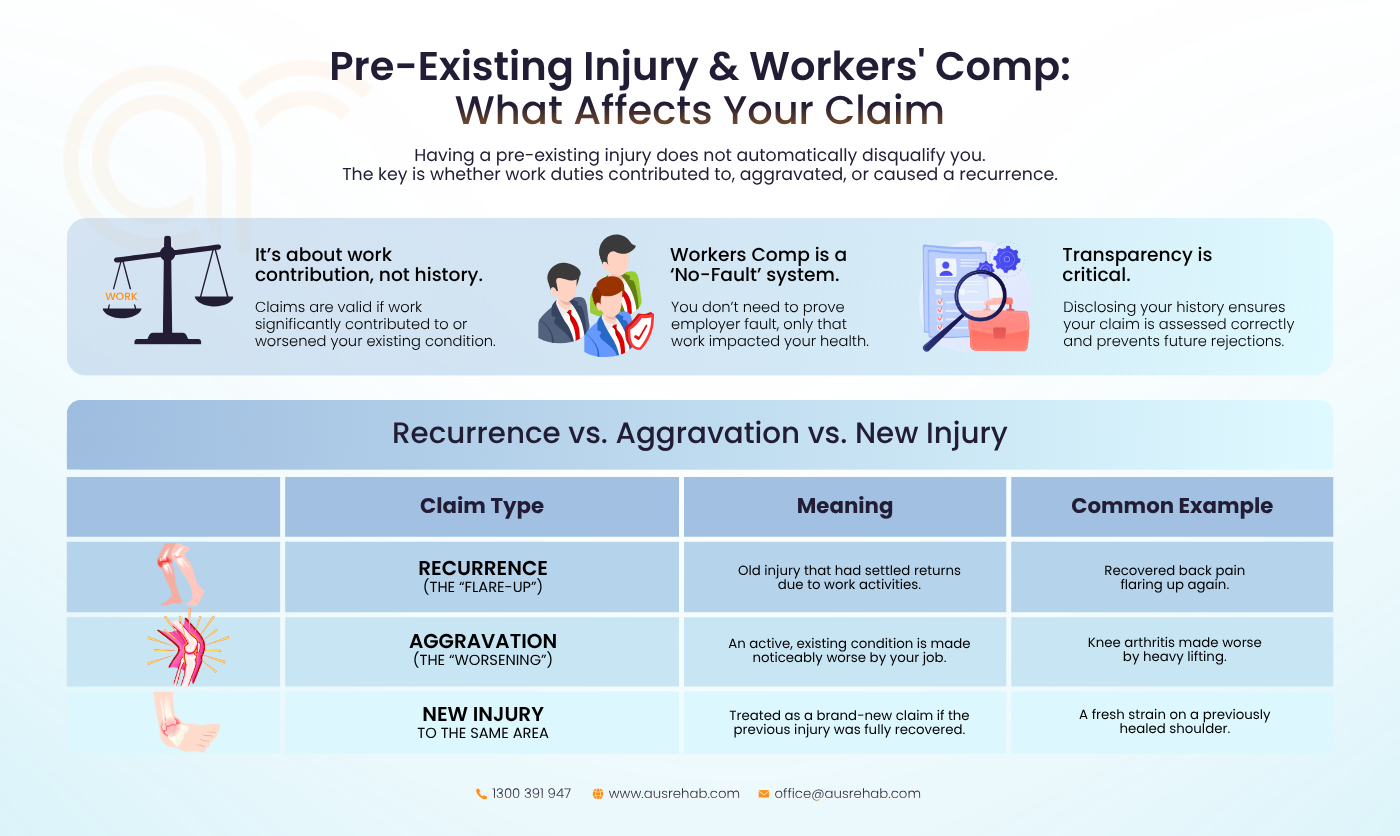
A pre-existing condition workers comp issue can make a claim more detailed. It does not automatically end the claim. An old back injury, a knee issue, a shoulder condition, or a psychological diagnosis may be relevant. The main question is still whether work caused a new problem, worsened the condition, or triggered symptoms.
It’s About Work Contribution
For workers compensation eligibility in Australia, the role of work is central. Your claim is more likely to be supported when there is evidence that:
- Your condition was stable before the work-related change.
- Symptoms increased after specific duties or an incident.
- Your doctor records a link to work.
- Your capacity changed after the workplace event.
- Your treatment needs changed after work exposure.
Different Australian schemes use different rules, but the practical focus remains similar. It needs to show that work played a real role in your current condition.
💡 Read our blog on FAQs About Workers Compensation in Australia for more information about eligibility, entitlements, and how rehabilitation fits into recovery.
Medical Evidence Plays a Key Role
Workers comp medical evidence is one of the strongest parts of any claim.
Medical evidence helps explain the injury, the diagnosis, the cause, the change in symptoms, and the impact on work capacity. It can also help separate natural progression from work-related aggravation.
Helpful evidence may include:
- GP consultation notes
- Certificates of capacity
- Specialist reports
- Physiotherapy or psychology notes
- Imaging reports
- Hospital and medication records
- Functional capacity information
- Workplace assessment reports
Be honest with your doctor about your past condition. Also, explain what changed at work. Accurate history helps your doctor give a clear opinion. It also helps reduce confusion later in the claim.
Recurrence vs Aggravation
Recurrence vs aggravation workers comp issues can affect how a claim is reviewed.
Recurrence vs Aggravation of an Injury
| Type | Meaning | Example |
|---|---|---|
| Recurrence | Old injury returns | Back pain comes back after a previous work injury |
| Aggravation | Condition worsens | Knee symptoms worsen due to repeated squatting at work |
What Is a Recurrence?
Recurrence in workers compensation usually refers to the return of symptoms from a previous injury.
For example, a worker may have had an accepted lower back injury two years ago. They completed treatment and returned to normal duties. Later, their back pain returns after work tasks. They may need treatment again and may have reduced work capacity.
A recurrence may reactivate an earlier claim in some cases. This can depend on the injury history, the evidence, the timing, and the scheme rules.
💡 In NSW, SIRA explains that a recurrence can occur when symptoms increase or re-emerge after a previous work-related injury and the worker needs treatment or has incapacity.
What Is an Aggravation?
Aggravation in workers compensation refers to a worsening of an existing injury or condition due to work.
The original condition may have come from work, sport, ageing, a car accident, home activity, or another cause. The key issue is that work made it worse.
Examples include:
- A warehouse worker with a longstanding shoulder injury experiences worsening pain after repeated lifting.
- A nurse with prior back pain has a flare-up after patient handling.
- A labourer with knee arthritis becomes unable to squat after heavy site duties.
- An office worker with prior anxiety has a worsening psychological condition after sustained workplace stressors.
Aggravation may be temporary. It may also create lasting effects. Medical evidence helps identify the likely duration and impact.
💡 Comcare notes that an aggravation can occur where work makes a pre-existing or underlying condition worse, and a claim is not automatically excluded because the worker already had a condition.
Why This Difference Matters
Workers comp claim classification can affect how the claim is managed.
A recurrence may be linked to an earlier accepted work injury. A new aggravation may be treated as a separate claim. A new injury to the same body part may also be assessed differently.
For the worker, the practical question is usually this: “What caused the current need for treatment, time off work, or changed duties?” That question is often answered through medical evidence, work details, and a clear timeline.
💡 In NSW, SIRA states that the distinction between recurrence and a new injury can affect worker benefits and employer premiums. It also states that insurers should use common-sense evaluation of the evidence.
When a Claim May Be Denied
A denied pre-existing injury workers comp claim can occur when the evidence does not support a work-related connection.
A denial does not always mean the worker is being accused of dishonesty. It may mean the insurer does not accept that work caused, contributed to, or worsened the condition based on the available evidence.
No Work Contribution
One of the common reasons for workers comp rejection is a lack of work contribution.
A claim may be denied if the evidence shows the condition worsened through natural progression, rather than work duties or a workplace incident.
For example, a worker may have a longstanding knee condition. The knee has worsened over time with no change in duties, no work incident, and no medical opinion linking the change to work. In that case, the insurer may decide that work did not contribute meaningfully.
Condition Is Unrelated to Work
A non-work-related injury workers comp issue may apply when the main cause happened outside work.
Examples include a sporting injury, home incident, unrelated medical condition, or symptoms that medical evidence does not link to work. This can still be complex. Sometimes work and non-work factors both contribute. In those cases, good medical evidence becomes even more important.
Lack of Medical Evidence
Workers comp evidence requirements can be a barrier when records are unclear.
A claim may be harder to support if there is no diagnosis, no clear timeline, no early medical record, or no medical opinion linking the condition to work.
Early medical review can help. Tell your doctor what happened at work. Explain what changed. Mention your prior history clearly. A clear record from your doctor connecting your duties to your symptoms can be important evidence.
Do You Need to Disclose Pre-Existing Injuries?
Disclosure rules can vary across Australia. The safest approach is to be accurate and honest when asked relevant medical questions. This applies during hiring, workplace assessments, medical appointments, claim forms, and return-to-work planning.
Why Disclosure Matters
Workers comp disclosure rules help employers understand relevant risks and plan safe duties.
Disclosure may support:
- Safer job placement
- Suitable duties
- Better treatment planning
- Clearer claim assessment
- Reduced risk of further injury
💡 In Queensland, WorkSafe explains that a prospective employer may request disclosure of pre-existing injuries or medical conditions that could reasonably be aggravated by the duties of the role. The request must be in writing and must include details about the nature of the duties.
What Happens If You Don’t Disclose
A workers comp claim risk may arise if a worker gives false or misleading information after a proper disclosure request.
This does not mean every non-disclosure will automatically defeat a claim. It depends on the law in the relevant state or territory, the type of request, the information provided, and the connection between the condition and the injury.
Does Disclosure Affect Eligibility?
Pre-existing injury eligibility is not automatically lost because you disclosed an old injury.
A disclosed condition may still be covered if work contributed to the current problem. The assessment still looks at the injury, duties, medical evidence, and relevant scheme rules.
How Workers Compensation Works in NSW
A pre-existing injury workers comp claim in NSW is assessed on evidence.
A workers comp assessment in NSW usually considers:
- What injury or condition is being claimed
- When symptoms started or changed
- How work contributed
- What medical evidence says
- What the worker reported
- What the employer reported
- The worker’s capacity for work
- Treatment needs
- Previous injury history
- Any earlier accepted claim
The workers comp insurer in NSW may request medical reports, speak with the employer, review certificates of capacity, approve treatment, and support return-to-work planning. The insurer may also request additional information if the claim involves a pre-existing condition.
A work injury claim in NSW is stronger when the evidence clearly shows how work affected the condition.
You can support your claim by reporting the injury early, seeing your doctor, explaining your duties clearly, and keeping copies of medical records. Your goal is not to hide your medical past, but rather to show what changed because of work.
What Support Can You Get?
If a claim is accepted, workers compensation benefits may help with income, treatment, and recovery at work. The exact support depends on the scheme, the claim decision, the medical evidence, and your work capacity.
Key Benefits Available Through Workers Compensation
| Benefit | Description |
|---|---|
| Income Support | Weekly payments if you have reduced or no capacity for work |
| Medical Treatment | GP, physiotherapy, psychology, specialist care, medication, and related treatment where approved |
| Rehabilitation | Return-to-work services, workplace assessment, suitable duties planning, and recovery support |
When Should You Seek Help for a Workers Compensation Claim?
Workers comp support can be useful when the claim feels unclear, delayed, or stressful.
You do not need to wait until the situation becomes unmanageable. Early support can help you understand what information is needed and how to keep recovery moving.
You’re Unsure About Eligibility
Seek workers comp eligibility help if you have an old injury, chronic condition, past claim, or unclear medical history.
Early guidance can help you understand what evidence is needed. You can speak with your treating doctor, insurer, relevant workers compensation authority, union, lawyer, or rehabilitation provider, depending on your situation.
Your Condition Is Getting Worse
Injury worsening at work should not be ignored. You may need help if pain is increasing, symptoms are spreading, duties feel unsafe, or your work capacity is changing.
A worsening condition can lead to longer recovery times if duties are not reviewed. Early changes may reduce strain and support better outcomes.
Your Claim Is Delayed or You're Struggling to Navigate Your Claim
Workers comp claim issues can include delays, unclear decisions, denied treatment, poor communication, or confusion about forms.
Keep written records. Note dates, names, and decisions. Ask for reasons in writing. Give your insurer updated medical information. Ask your treating doctor to clarify the work connection if needed.
If your claim is delayed or disputed, you may need advice from the relevant authority or an independent legal provider.
How AusRehab Can Help
AusRehab provides workplace rehabilitation services and return-to-work support for people recovering from work-related injuries, including cases involving pre-existing conditions.
Rehabilitation support may include:
Our role is not to decide legal eligibility. That decision sits with the insurer and the relevant scheme. We can support the recovery process by helping workers, employers, insurers, and treating practitioners understand capacity, duties, and return-to-work options.
Key Takeaways
- You may still be able to claim workers compensation if you had a workers comp pre-existing injury.
- The key issue is whether work contributed to, worsened, or triggered your condition.
- A pre-existing condition does not automatically mean your claim will be rejected.
- Workers comp eligibility in Australia depends on the relevant scheme, medical evidence, and work connection.
- Recurrence means an old injury has returned.
- Aggravation means that an existing condition has worsened.
- Medical evidence is important for showing work-related impact.
- Honest disclosure can help your claim be assessed correctly.
- Accepted claims may include income support, treatment, and rehabilitation.
- Early support can reduce confusion and delays.
- If work has affected your condition, get clarity on your workers comp eligibility summary before assuming you are not covered.
Not Sure If You’re Eligible? Let’s Talk
Recovering from a work-related injury can be more complex when an existing condition is involved. Understanding how workers compensation applies to a pre-existing injury can help you access the right support at the right time.
AusRehab supports individuals managing pre-existing injuries through workplace rehabilitation, workers comp doctor support, and coordinated care focused on recovery and return to work.
If you need workers comp support in Australia, we’re ready to help.
Frequently Asked Questions (FAQs)
Can I claim workers comp with a pre-existing injury?
Yes, you may still be able to claim workers compensation with a pre-existing injury. The key issue is whether your work contributed to, worsened, or triggered your current condition. A prior injury does not automatically prevent a claim.
What is the difference between aggravation and recurrence?
An aggravation means work has made an existing condition worse. A recurrence means symptoms from an earlier injury have returned. This difference can affect how your claim is assessed.
Will my workers comp claim be rejected because of a pre-existing condition?
Not automatically. A claim may still be accepted if medical evidence shows that work played a role in your injury or symptoms. Claims are more likely to be disputed when there is no clear work connection.
Do I need to disclose a pre-existing injury when making a claim?
Yes, you should be honest about your medical history when making a claim. Clear disclosure helps doctors, insurers, and rehabilitation providers assess your situation correctly. Giving incomplete or misleading information may create problems later.
How are pre-existing injuries assessed in NSW workers compensation claims?
In NSW, insurers usually consider your medical history, work duties, symptoms, treatment needs, and work capacity. They look at whether work caused a new injury, aggravated an existing condition, or triggered a recurrence. Medical evidence plays a major role in the decision.