
Prefer to Listen? Play this quick summary instead!
What Is Workers Compensation & How Does Physiotherapy Fit In?
Workers’ compensation refers to the scheme that is available to workers who are injured or become ill at their workplace. This compensation provides workers with medical bills, rehabilitation costs, and weekly payments if they qualify.
The workers’ compensation system is no-fault in NSW, and workers do not have to prove that an employer was negligent to get compensation. Nevertheless, the injury must meet the requirements set by law.
The State Insurance Regulatory Authority (SIRA) regulates the system and sets the standards for service providers, insurers, and rehabilitation service providers.
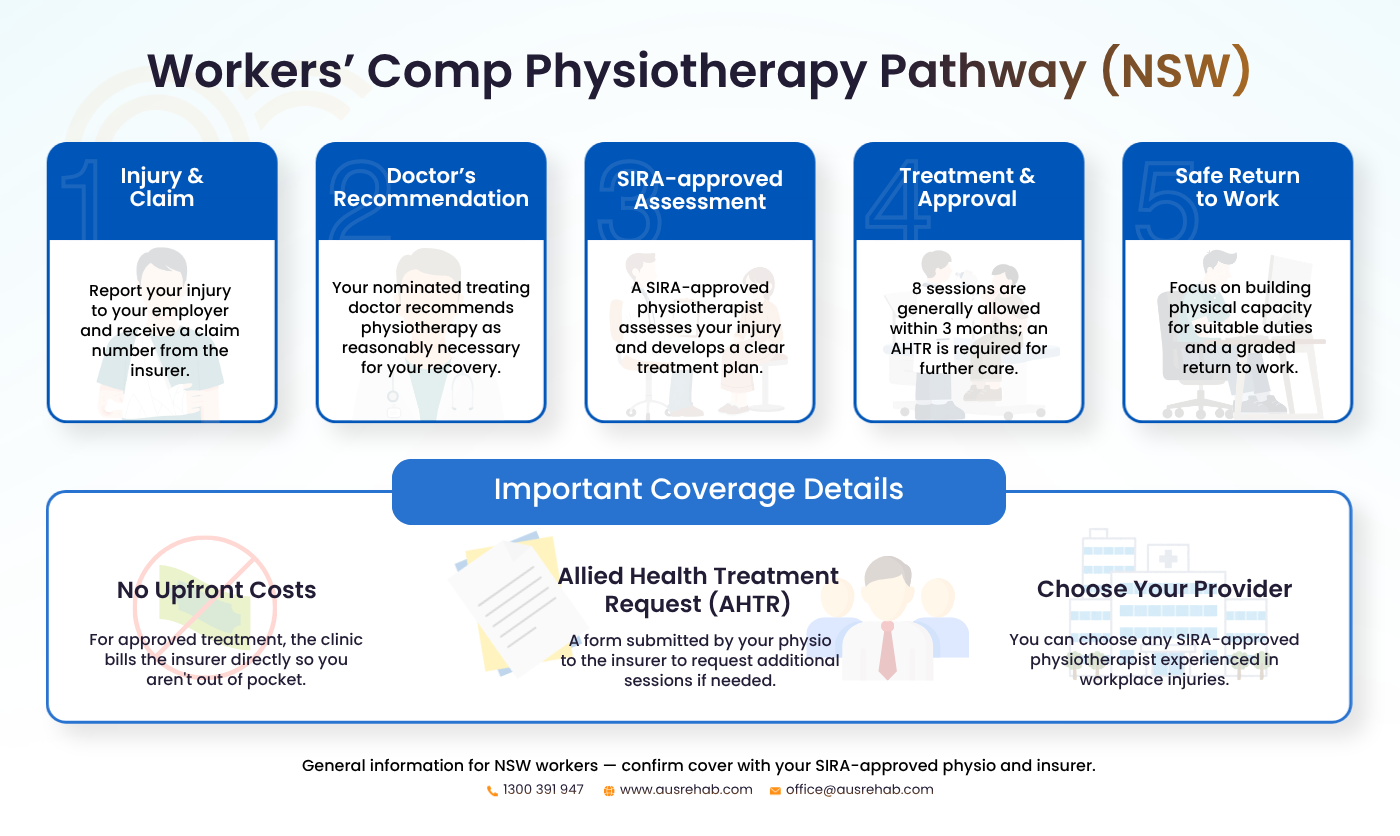
Now, if you have been thinking: is physiotherapy covered by workers’ compensation in NSW? Then the answer is yes, physiotherapy could be covered. But it does not mean that you can receive as many sessions as you may want. Your current situation with the insurance claims and treatment history needs to be taken into consideration, and insurers should make their decision on whether to provide the funds.
📌 Quick Note
For eligible treatment, a new claim may allow up to 8 consultations, while an existing claim may allow up to 3 consultations, depending on the applicable treatment rules.
If further treatment is needed, additional approval may be required.
Source: SIRA
⚡️ Expert Insight
Proper workers’ compensation physiotherapy should give priority to measurable outcomes of rehabilitation, not just the number of treatment sessions. Treatment goals should include recovery, routine daily activities and job capacity as appropriate.
Is Physiotherapy Covered by Workers Compensation in NSW?
💡 Quick Answer
Yes, physiotherapy is covered by workers compensation in New South Wales for the treatment of a reported workplace injury. The term “reasonably necessary” refers to the treatment being appropriate for the affected injury and to help in recovery. The approval for each treatment is not guaranteed. You need to check with your SIRA-approved physiotherapist to make sure the treatment cost is covered.
Remember that just because you have a claim number does not mean that you can have unlimited physiotherapy under your workers’ compensation claim. You should check with your SIRA-approved physiotherapist whether every physiotherapy treatment will be covered.
Do I Need a Referral for Workers Comp Physiotherapy?
Workers do not have to obtain a referral before accessing physiotherapy services, as outlined by SIRA. Physiotherapy, chiropractic care, as well as osteopathy do not require a referral to commence treatment.
Additionally, your nominated doctor plays an integral part in the treatment team. The information provided by your GP is needed to confirm the diagnosis, treatment requirements, and ability to work.
Do I Need Insurer Approval Before Starting Physiotherapy?
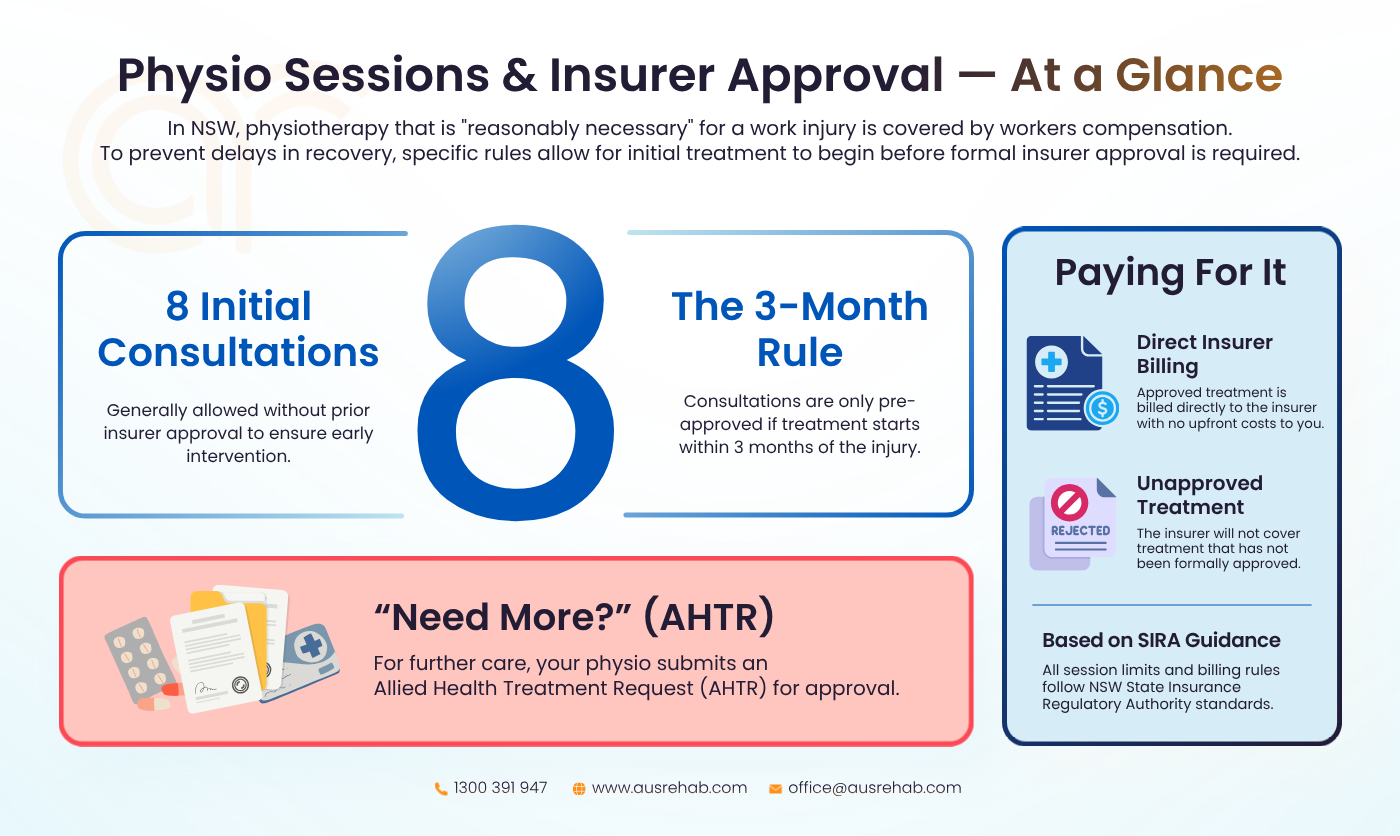
In most cases, obtaining the insurance provider’s approval isn’t required prior to the first treatment. SIRA’s directives set out the situations where an approved allied health practitioner can begin treatment without prior approval.
For example, if treatment is initiated within three months of sustaining an injury, a patient may receive as many as eight consultations if his/her injury was not previously treated by the same allied health practitioner.
You may need to fill out the AHTR form if further treatment is required. An AHTR outlines the worker’s clinical symptoms, course of treatment, recovery obstacles and treatment objectives. SIRA explains that an AHTR is required for SIRA-approved allied health practitioners when requesting treatment that requires insurer approval.
Thus, an SIRA-approved physiotherapist in NSW is an important figure to involve when applying for treatment through the scheme.
⚡️Quick Tip
It is crucial to ensure your claim exists and you are eligible for treatment. Ensure to ask whether the therapy needs to be approved by the insurer before you start treatment.
How Many Physio Sessions Does Workers Compensation Cover?
📌 Quick Answer
There’s no fixed limit as it depends on your injury, progress, work capacity and insurer approval. Up to eight initial consultations may be available without prior approval when treatment starts within three months of injury. If you need more, your physio submits an Allied Health Treatment Request (AHTR) explaining your progress and why continued physiotherapy is reasonably necessary.
Source: SIRA
Under the current SIRA guidelines, the rules include:
| Situation | Treatment Available |
|---|---|
| Treatment begins within three months and the injury has not previously been treated by the same allied health practitioner group. | Up to 8 consultations |
| Same practitioner continues treatment and an AHTR is submitted, with no insurer response within the specified timeframe. | Up to 8 consultations per AHTR |
| Treatment begins more than three months after injury and the injury has not previously been treated by the same allied health practitioner group. | Up to 3 consultations |
| Same practitioner treated the injury more than three months earlier. | 1 consultation |
SIRA's consultation rules vary according to timing and previous treatment. Individual claim circumstances can affect eligibility.
Will I Have to Pay for Workers Comp Physiotherapy?
The insurer can pay for workers’ compensation physiotherapy only if the treatment falls under the required eligibility criteria and is funded properly. SIRA has established regulations governing the amounts of costs covered and requirements for practice for physiotherapy under the scheme.
But this does not mean that all appointments are free.
Your eligibility, approval of your insurer, and arrangements with your provider can determine whether you will have physiotherapy workers’ compensation costs to pay or face any possible out-of-pocket amount.
The majority of providers opt for direct insurance billing, which allows insurers to receive invoices directly and spare employees from having to pay upfront. SIRA requires that a worker’s name, claim number and provider’s information must be prescribed in the invoice.
Ask your provider if there are arrangements made in terms of having no out-of-pocket expenses for physiotherapy workers’ compensation treatment.
Can I Choose My Own Physiotherapist?
Normally, you have the right to select the health practitioner who will provide treatment to you. However, your selection will thus be limited by the conditions of the insurance scheme and your claim. For instance, if you are choosing your physiotherapist for a workers’ compensation claim in New South Wales, then make sure that your choice is approved by SIRA.
Also, SIRA requires approved physiotherapists to provide specific treatment in relation to the scheme with a few exceptions.
What Happens at the First Physiotherapy Appointment?
The initial session with your workers’ compensation physiotherapist starts with evaluating your condition, symptoms, motor ability, and ability to function normally.
Your physiotherapist may discuss:
- How the workplace injury occurred
- Current symptoms and limitations
- Previous treatment
- Your normal work duties
- Your current work capacity
- Your treatment goals
- Exercises or other rehabilitation strategies
The plan of treatment must be prepared for each individual patient and must take into account his or her situation as a whole.
The goal is not just to alleviate the symptoms. The physiotherapy treatment can also concentrate on regaining movement, power, flexibility, and functional capacity related to work.
What Should I Bring to My First Appointment?
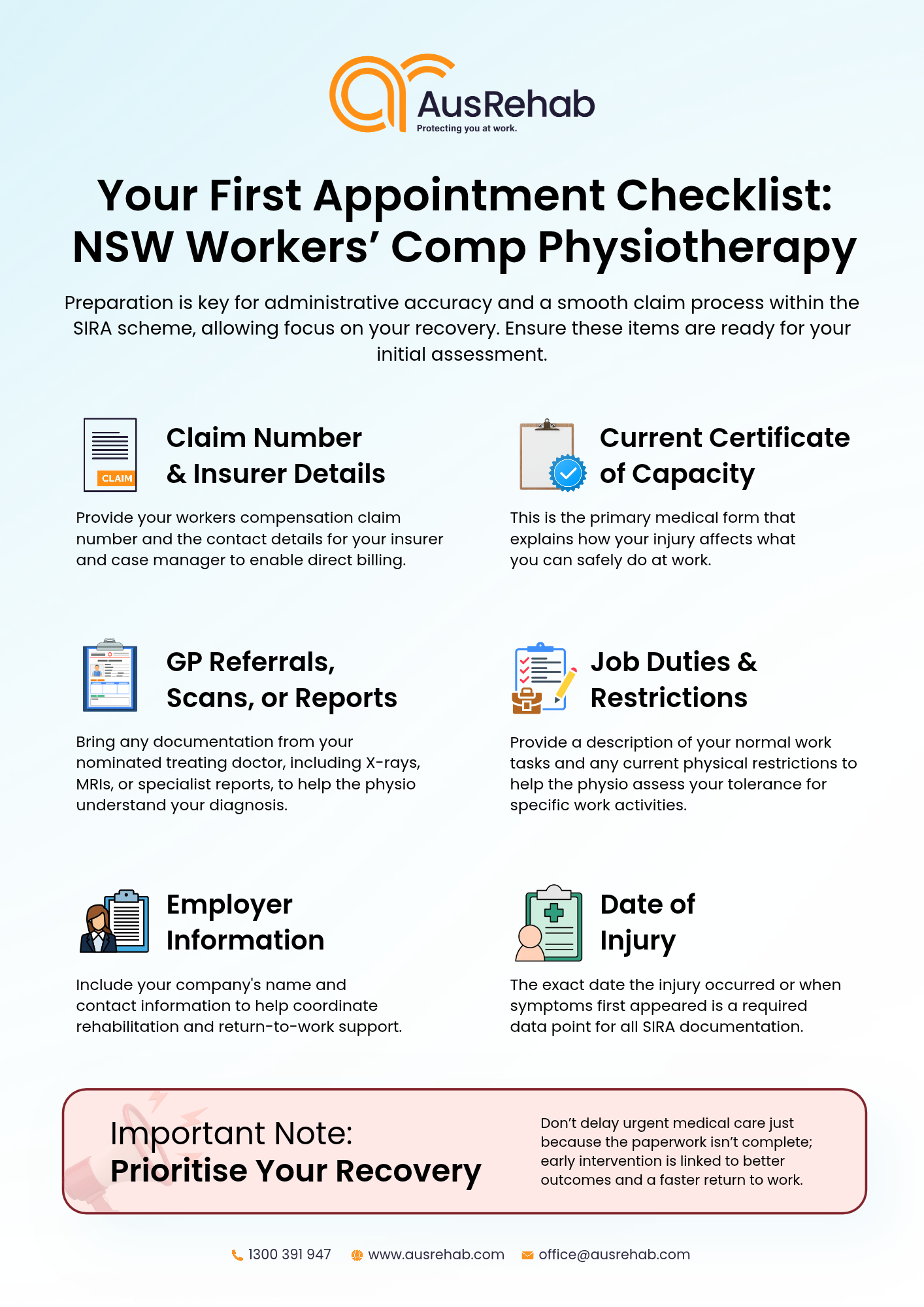
Your workers’ comp physio appointment checklist can include:
- Workers compensation claim number
- Certificate of Capacity
- Relevant medical reports
- Imaging or scan results, if available
- Details of your insurer and case manager
- Information about your normal work duties
- Current restrictions or suitable duties
Having this information at hand simplifies the work of your treating doctors and insurer.
What Workplace Injuries Can Physiotherapy Treat?
Physiotherapy for workplace injuries can treat an extensive range of physical and musculoskeletal injuries depending on how complicated the individual claim and treatment process is.
Examples include:
- Back injuries and strains
- Neck injuries
- Shoulder injuries
- Injuries to knees and ankles
- Repetitive strain injuries
- Manual handling injuries
- Soft tissue injuries from work
- Broken bones rehabilitation
- Recovering from surgical operations
- Deconditioning and loss of physical ability
It’s also possible for treatment to cover exacerbation of a prior injury provided that the specific requirements under workers’ compensation are met. Each case must be assessed on an individual basis.
What Is a Certificate of Capacity?
A Certificate of Capacity is a written confirmation used in the workers’ compensation framework in NSW to provide information related to the condition of the injured employee, necessary treatment, and work capabilities.
⚠️With the help of a Certificate of Capacity, one can determine the status of the injury, treatment requirements, and capabilities.
The initial certificate is filled in by the worker’s treating doctor or specialist. In subsequent certificates, a physiotherapist who is accredited by SIRA can issue a certificate in case of injury in his area of expertise.
So, can a physiotherapist issue a Certificate of Capacity in NSW? Yes, under the conditions set by SIRA, a physiotherapist can issue the document, especially for certificates issued after the first one and related to injuries pertaining to physiotherapy.
To know more about this document, head on to our blog “What is Certificate of Capacity?” to help you with your recovery and return to work.
How Does Physiotherapy Help With Return to Work?
Physiotherapy can help promote a faster recovery by dealing with matters related to the potential for work-related movements. Physiotherapy professionals communicate with the entire medical team and the local work rehabilitation organization in order to define suitable activities.
A return-to-work plan may include:
| Return-to-Work Step | What It May Involve |
|---|---|
| Assess current capacity | Understanding what work activities you can safely perform |
| Suitable duties | Temporarily modifying tasks to match current capacity |
| Graduated hours | Increasing hours as your capacity improves |
| Modified duties | Reducing or changing physically demanding tasks |
| Progress reviews | Checking recovery and adjusting the plan |
| Recovery at work | Supporting a safe and sustainable return to work |
A graded approach can help match work requirements to a person's current abilities while they're still recovering.
The goal isn’t necessarily to wait until all symptoms are gone. If the medical situation allows, applying early physiotherapy measures and coordinated workplace support can help employees with their recovery.
Work capacity rehabilitation should be planned according to clinical data and job demands.
💡 Expert Insight
Return to work should be planned according to the worker’s abilities. Partial duties may help to make the transition between the ongoing treatment and the regular work.
What If Physiotherapy Is Declined?
If the denial of your workers’ comp physiotherapy relates to funding for your treatment, you should request the insurer’s written decision corresponding to their reasons.
Depending on the situation, you may be able to seek an internal review of the matter. If necessary, the Independent Review Office can provide injured workers with advice on complaints against insurers. SIRA also recognises the Personal Injury Commission as a viable resource for specific disputes.
How Can AusRehab Help?
Obtaining the correct treatment provider may be a challenge when dealing with workplace injury issues.
At AusRehab, our workers connect with a SIRA-approved physiotherapist for their rehabilitation process while also receiving assistance to coordinate with the treatment team, employer, and insurance company.
Our workplace injury rehabilitation NSW services can also support:
- Work capacity assessments
- Return-to-work planning
- Communication with treating providers
- Employer and insurer coordination
- Workers compensation return to work support
- Workers compensation injury management NSW
If you are looking for a workers compensation rehabilitation provider or workplace injury rehabilitation provider, AusRehab can help.
Key Takeaways
- Workers comp physiotherapy NSW can be covered when treatment is related to the compensable injury and reasonably necessary.
- Physiotherapists generally do not require a referral to start treatment.
- SIRA approval is important when choosing a physiotherapist under the NSW scheme.
- Treatment limits depend on timing, previous treatment and approval requirements.
- An AHTR may have to be obtained if more treatment is required after the initial treatments are provided.
- Physiotherapy helps with obtaining help in getting back to work.
- If treatment is declined, there are review and dispute pathways.
Need Help Finding a Workers Comp Physio in NSW?
If you are seeking workers’ comp physiotherapy or help with any other workplace injury recovery, we at AusRehab can help you.
Speak to the AusRehab team to learn about the services we offer in workers’ comp physiotherapy.
- 📞 1300 391 947
- 📧 office@ausrehab.com
- 🔗 Speak with our team today.
Frequently Asked Questions (FAQs)
Do I need a referral for workers comp physiotherapy?
Usually not. The SIRA has advised that physiotherapists do not need a referral for physiotherapy under the NSW workers’ compensation scheme. Nevertheless, your nominated treating doctor should still play a important role in your recovery process and treatment team.
Do I need insurer approval for workers comp physio?
It is not always required for your first eligible treatment. The guidelines from SIRA state situations in which up to 8 consultations may occur without needing prior approval. However, further therapies may require approval from the insurer.
How many physio sessions does workers comp cover?
The number varies. For eligible early treatment, the maximum number of permitted visits is eight. Different rules apply when treatment starts more than three months after the injury occurred or when injury treatment has been done earlier.
Does my physio need to be SIRA approved?
Normally, yes, if providing certain physiotherapy services under the workers’ compensation scheme of NSW. SIRA provides a list of approved physiotherapists.
Can a physiotherapist issue a Certificate of Capacity?
An approved treating physiotherapist according to SIRA has the authority to issue subsequent certificates for injuries that are covered by their expertise. Normally, it is the doctor who issues the first certificate.
What is an AHTR?
An Allied Health Treatment Request contains detailed information about the worker’s clinical condition, healing status, obstacles to recovery and treatment plan. It serves as a supporting document for the insurance company to make treatment decisions.
Can I return to work while having physiotherapy?
Yes, it’s safe as long as your medical team approves it. The timely process of returning to your position could involve performing functions that conform to your availability/ability to work.
Can I find workers comp physio near me?
Yes, indeed. The State Insurance Regulatory Authority (SIRA) has an interactive tool that allows workers to search for authorised service providers. AusRehab would be pleased to assist you with your query. You may connect with us on 1300 391 947 or speak with our team directly.
Does workers' compensation cover physiotherapy for RSI?
In certain cases, workers’ compensation does guarantee treatment when it meets the requirements above, as long as the treatment is directly related to the agreed condition.
What if I had a pre-existing injury?
As a rule, a pre-existing injury does not dictate the outcome of the workers’ compensation claim. If the injury has been aggravated by the work or the job itself contributed to it, it is important to evaluate the conditions and the applicable NSW laws accordingly.