

Prefer to Listen? Play this quick summary instead!
⚡️ Quick Answer:
An IME is a one-off assessment by an independent doctor, arranged and paid for by the insurer, to answer specific questions about your injury. It does not replace your treating doctor, and going in prepared gives you the best chance of a fair outcome.
Getting a notice concerning an independent medical examination (IME) may be a cause for concern. You may not receive enough information to understand the reason behind the insurance agency’s decision to ask you to visit. When you are dealing with an injury, the lack of information can increase the stress level of the process.
An IME is a one-time assessment conducted by an objective specialist who is arranged and paid for by the insurer to answer particular questions concerning the nature of your injuries but does not substitute your physician or the continuing medical treatment that you receive. Knowing what you should expect at IME can help you prepare better for the examination.
In this blog, we are going to explain IMEs, reasons for seeking one out, your rights, preparation for the appointment, what will happen on the day of the medical exam, content of the IME report, and possible actions in case you wish to pursue the dispute process.
What Is an Independent Medical Examination?
📌 Quick Answer:
An independent medical examination is an evaluation performed by a doctor who is not your treating physician and who has been retained by the insurance company to provide their assessment of your injury. The doctor evaluates your injury, responds to the insurer’s inquiries, and prepares a report of the findings.
An independent medical examination (IME) is an examination by a medical doctor who is not your treating physician. The company employs the physician to provide an independent opinion regarding the injury and its effect on your work.
What does an IME doctor assess?
The examiner may be asked to provide an opinion about:
- Diagnosis and work-relatedness: What is the injury or illness, and is it work-related?
- Treatment: Is the treatment adequate and indispensable?
- Likely progress: How is the ailment expected to progress or improve?
- Current capacity and return to work: What type of work may be done and when will the individual be back at work?
- Permanent impairment: Is any permanent impairment caused by the injury, to be considered in the process of adjudication of the case?
The examiner is taking note of the assessment and is formalizing it in the medical report that is submitted to the party who needed the examination. In most cases, this will be the insurance company, although an IME may sometimes be arranged and financed by a representative of the law.
If you want a copy of the report, you can request your own copy afterwards.
Why the Insurer Has Asked for an IME
To be sent for an IME doesn’t necessarily mean something is wrong with the claim. An insurer may ask for an IME when it requires more medical information about the injured party’s work capacity, treatment and/or permanent impairment.
Common reasons include:
- Your treating doctor’s information is unavailable, unclear or inconsistent.
- The insurer needs an independent opinion about your diagnosis or whether the injury is work-related.
- It needs to review whether your treatment remains appropriate.
- It needs an opinion about your current work capacity or return to work.
- An assessment of permanent impairment is required.
Importantly, SIRA guidance says the insurer should first consider whether the issue can be resolved by getting further information from your nominated treating doctor or specialist before arranging an IME.
Your Rights Before and During an IME
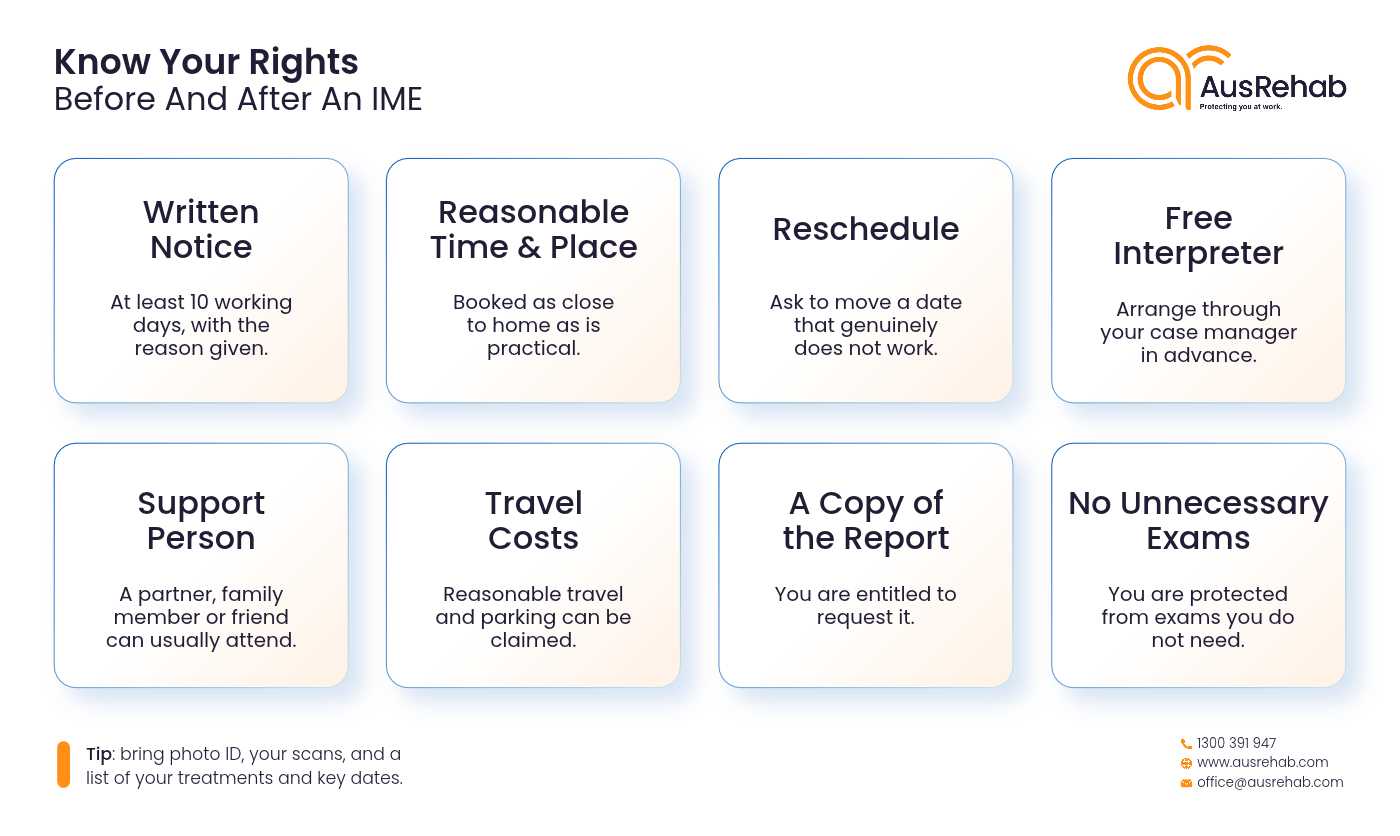
Your knowledge of the IMEs you have hosted in NSW is an important part of managing the entire process. SIRA has standard policies with respect to notice, interpreters, support etc.
| Your IME Right | What It Means |
|---|---|
| Notice | You should receive written notice at least 10 working days before the examination, including the reason for the IME and appointment details. |
| Reasonable appointment | The examination should be arranged at a reasonable time and date, with the location taking your travel needs into account. |
| Attendance | If the request is reasonable, you are generally expected to attend. If the date does not work, ask the person who arranged the IME to reschedule rather than simply not attending. |
| Support person | A partner, family member or friend can usually accompany you. They cannot participate in the examination and may be asked to step out during parts of it. |
| Interpreter | If you need an interpreter, tell the insurer when the appointment is arranged. A qualified interpreter should be provided when required. |
| Travel costs | Reasonable travel costs can be covered by the insurer. You can also ask about pre-payment if needed. |
| Your report | You can request a copy of the IME report and relevant documents provided to the examiner. |
Knowing your rights can help you feel more prepared for an IME. If you have concerns about the appointment, speak with the person who arranged it before the examination.
💡 What Happens on the Day?
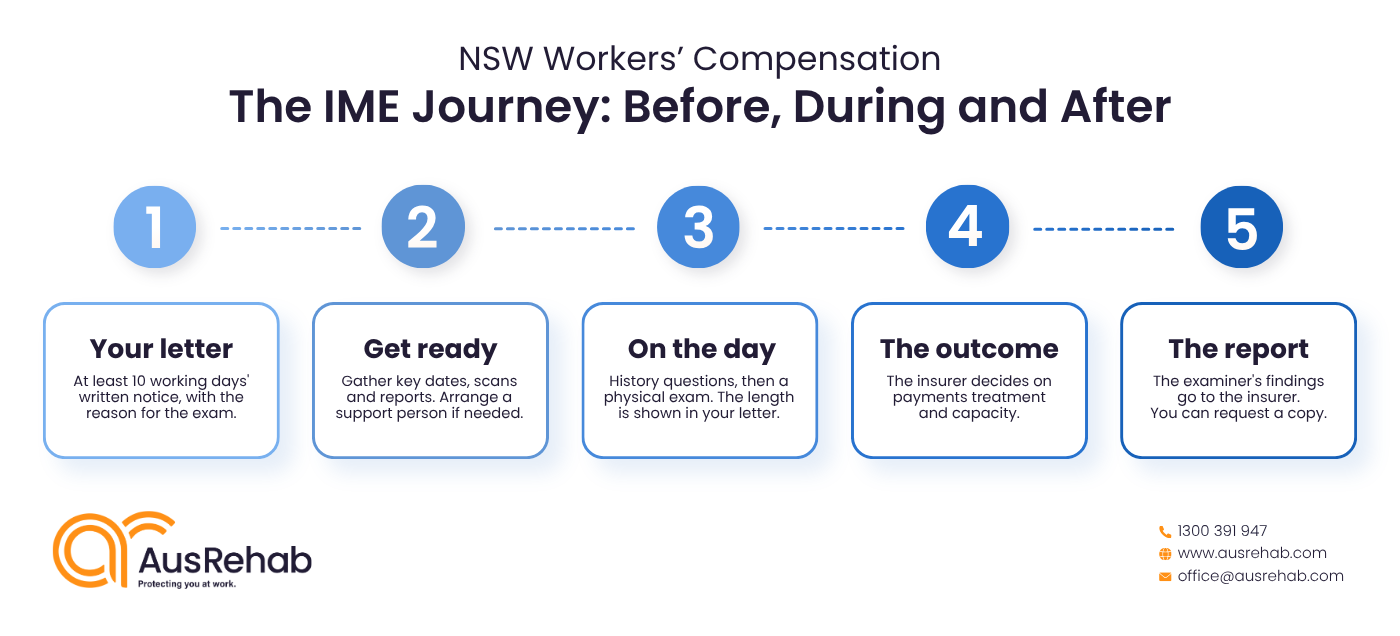
Having a basic understanding of how an IME is carried out will make you feel more confident about what awaits you. You should arrive early at your appointment, taking your ID as well as all the information mentioned in your letter.
- Check in and complete forms
At the reception desk you can be asked to confirm your identity and fill in any forms required.
- Answer questions about your injury
The doctor will usually ask about your injury, symptoms, medical history and treatment. They may also ask about:
- Your daily activities
- What work you can currently do
- How your injury affects your sleep and normal routine
Answer honestly and describe your condition as it is, without exaggerating or minimising your symptoms.
- Have a physical examination
The examiner might do a physical exam for your injury. The type of exam will depend on the condition, the specialty involved, and the question posed to the doctor.
- The report comes later
You will not get the results right away after the IME. The doctor composes a complete report, which he submits to the insurance company or another party requesting an evaluation.
Your appointment can last for an otherwise unpredictable period of time depending on your injury, specialist, and the inquiries. There should be a letter sent to you informing you how long to expect your appointment.
How to Prepare in the Days Before
Good IME preparation can help you feel more confident and give clear, accurate information on the day.
- Compose a medical timeline: Document the date of your injury, the main treatments undergone, and the doctors or specialists consulted.
- Bring your medical records: Collect any imaging and scan reports that you have, in addition to the actual films or similar means that allow you to see the digital scans in case a request is made.
- Dress comfortably: Wear an outfit that will allow for easy examination of the injured part of the body.
- Arrange for support: Make sure that you arrange for someone to accompany you in advance if you wish to have someone present during the time of your visit.
- Speak to your treating GP or physiotherapist: Inform them about the upcoming IME and share any queries you have with them.
The IME can seem rather new to some people, but if you prepare yourself in advance and know your rights, it will be easier for you to go through this procedure.
📌 Regulatory note:
Take medication as prescribed unless your treating practitioner advises otherwise, and do not change your usual regimen just for the IME.
The key is to remain honest, well-organised, and prepare yourself to explain how your injury affects you.
During the Examination: What to Do and What to Avoid
Knowing what you should and should not say will help you give accurate and truthful information during the examination.
What to Do:
Be specific:
Be precise when describing your symptoms and their severity. Do not state that they “always hurt”.
Be honest:
Describe your symptoms honestly. If a particular movement instigates pain, then state so.
Ask for clarification:
In case you do not understand the question, ask the examiner again.
Answer what is asked:
Stay composed and do not provide more information or argue with the examiner.
Take mental notes:
Try to memorise what was examined, and what was not and soon after the appointment record the details.
What to Avoid:
- Do not undermine or embellish the severity of your symptoms.
- Do not guess at the answer to keep the appointment moving along.
- Do not contact the examiner after the appointment. Further communication should go through the referrer that arranged the IME.
What an IME Report Can Affect
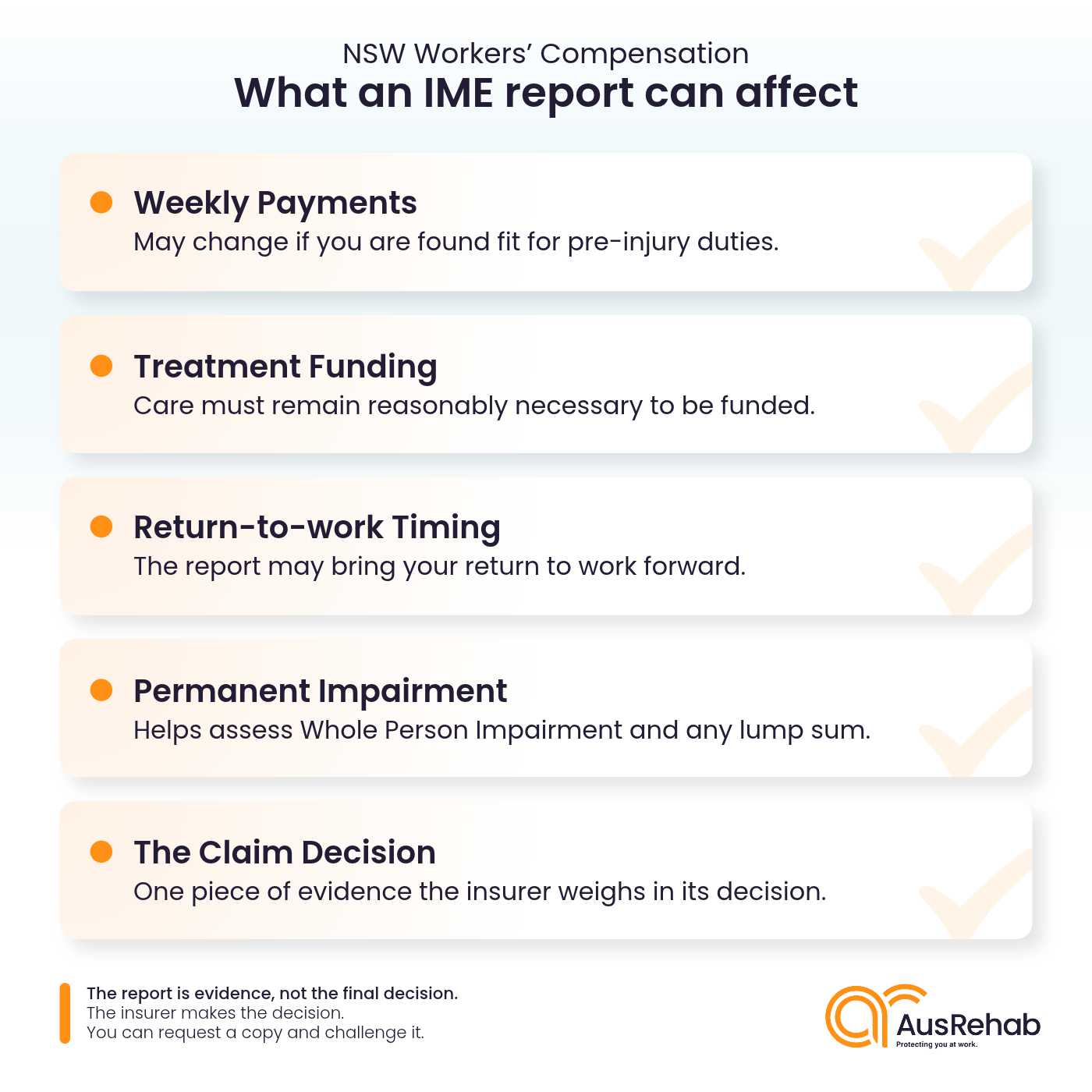
An IME report in workers compensation in New South Wales is an evidence that the insurer may take into account while making their decisions regarding your claim. It could affect weekly payments, necessary treatment, your capacity to work, return-to-work timing, and anything else that lies within your claim.
The report could as well help assess your permanent impairment, including your Whole Person Impairment (WPI) percentage and eligibility for a lump-sum payout.
An IME report is just one piece of evidence of the insurer’s decision-making process. You are welcome to get a copy of the report and express disagreement with its findings if you believe that they do not reflect your condition appropriately.
What If the Report Doesn't Reflect the Injury?
In the event that you are not satisfied with an IME report in NSW, it is important to understand that the IME report is not the last word on your case as only one report is one piece of evidence in the process. Your doctor has the right to provide a written response in relation to the IME report indicating if the IME report differs from his or her own medical opinion. Another option is to file an appeal against the insurance company’s decision and take the matter to the Personal Injury Commission (PIC) when necessary.
You also have the possibility to contact the Independent Review Office (IRO) for support on some employer liability claims for free.
Making a Complaint About an IME
If something went wrong during your assessment, you can voice your views. Speak to the independent medical examiner at the time if you can.
If your concerns remain unanswered or unresolved, contact the person who referred you to the IME, your union or the SIRA Customer Service Centre.
You can also make a complaint about a doctor’s behavior and treatment to the Health Care Complaints Commission (HCCC) or Medical Council of NSW through AHPRA.
How AusRehab Can Help
An IME can feel overwhelming, especially when you are unsure what to expect or how the findings may affect your claim. AusRehab can help you navigate the process, coordinate communication and plan your recovery and return to work.
- Help you understand your IME appointment letter and what to expect.
- Liaising between your GP, physiotherapist, employer and insurance company before and after the IME.
- Offering assistance for helping your recovery and return to work after making a claim under workers compensation.
- Help coordinating with experts in case you want to dispute any findings mentioned in the IME report.
- Maintain communication and plan for the future so you know what help is available to you during every step in the process.
Do not face IME on your own. AusRehab is here to provide you with updates, support, and assistance in your recovery and work return
Key Takeaways
- An IME is an independent assessment arranged to answer specific questions about your injury and workers compensation claim.
- You are generally expected to attend a reasonable IME request, but you have rights around notice, support, interpreters and travel costs.
- Before attending your appointment, make sure to study your previous injuries, treatments, and any medical reports and scans.
- Be truthful about symptoms, and ask the examiner to clarify anything you don’t understand.
- The IME report can have a big effect on the outcome of treatment, payment, ability to work, as well as permanent impairment conditions.
- If you disagree with the report or an insurer’s decision, you can seek medical input, request a review and access dispute support.
Need Support With Your IME or Return-to-Work Journey?
When dealing with an injury and a workers’ compensation claim, the independent medical examination can feel new and complicated. The right support will help you understand the process, plan for the exam, and concentrate on getting better and returning to work.
Speak with AusRehab about the right support for your workers’ compensation journey
- 📞 1300 391 947
- 📧 office@ausrehab.com
- 🔗 Speak with our team today.
Frequently Asked Questions (FAQs)
Can my employer attend my IME in NSW?
Generally, no. From 1 July 2026, an employer or employer representative cannot attend a worker’s medical examination unless the worker specifically requests it.
Can an IME appointment be recorded?
There is no automatic right for you to record an IME. If you want the examination recorded, ask the referrer or examiner beforehand. If the examiner routinely records examinations, you must be informed and can consent to or decline the recording.
Can I be sent to more than one IME?
Yes, but repeat IMEs are subject to specific rules. For example, another IME may be arranged if there has been a significant change in your injury or treatment, or if at least six months have passed since the last IME.
How long does it take to get the IME report?
The timeframe can vary depending on the assessment and the questions being asked. Ask your case manager or referrer for the expected timeframe rather than assuming a fixed number of days.
Is an IME the same as an IMC?
No. An IME and an IMC are different. See our guide on IME vs IMC to understand the difference.
Is an IME the same as a permanent impairment assessment?
Not exactly. An IME may include or inform an assessment of permanent impairment, but the two are not the same. Permanent impairment assessments have their own requirements under the NSW workers’ compensation system.