

Prefer to Listen? Play this quick summary instead!
⚡️ Quick Answer:
In most cases, yes. A holiday does not automatically stop your workers’ compensation or end your claim. You just need to plan it: keep your certificate of capacity current, tell your insurer, and choose activities that suit your injury. Payment and leave rules vary by state, so check before you book.
When you are injured at work and off work, a break may be just what you need. But you may worry that a holiday while on workers’ comp could put your payments at risk.
The good news is that you can usually go on holiday while on workers’ comp, as long as you plan ahead and meet your claim requirements. The rules can differ between states and territories. So, before you book, check what applies to your situation.
In this blog, we explain how to protect your payments, keep your certificate of capacity up to date, tell your insurer, plan overseas travel, understand annual leave rules and choose activities that suit your injury.
Can you go on holiday while on workers comp?
There is no blanket rule that says you must stay home while receiving workers’ compensation. However, you still need to follow the rules of your claim.
Your insurer may pay weekly payments to help replace the wages you have lost because of your work injury. These payments are based on your circumstances and the rules of your state or territory.
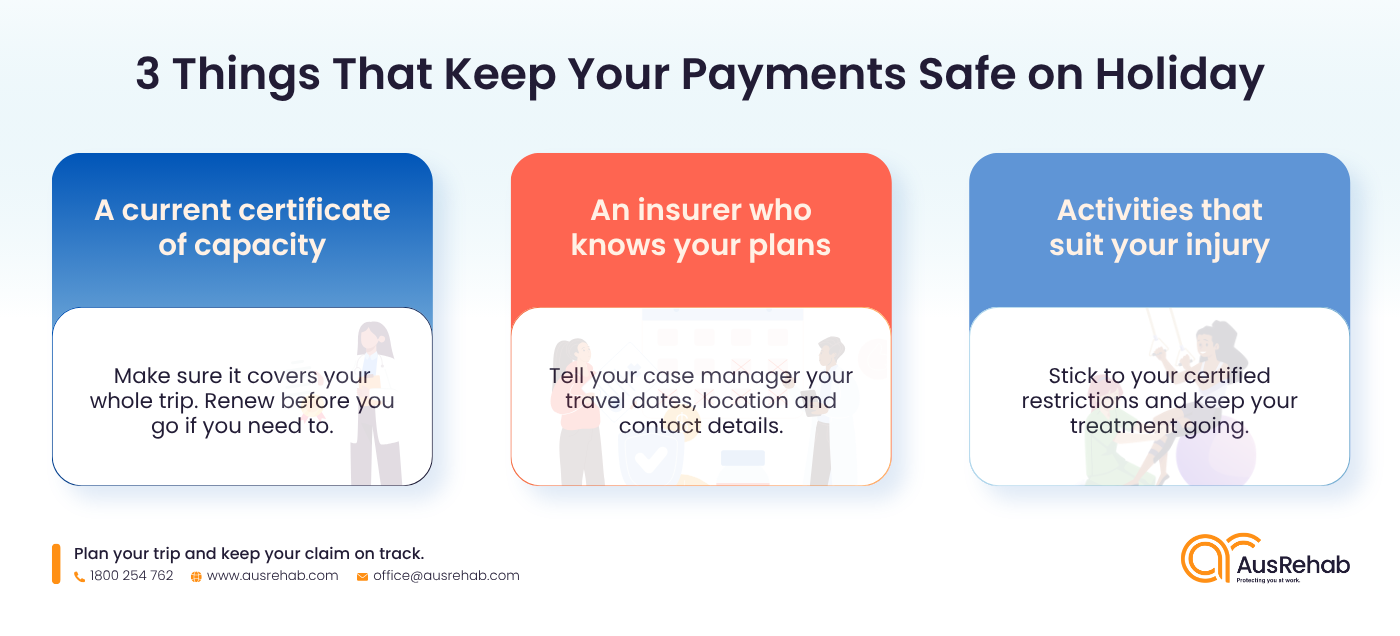
Before you travel, focus on three things:
- Keep your certificate current: Check that your certificate of capacity covers your full trip
- Tell your insurer: Share your travel dates and contact details with your case manager.
- Choose suitable activities: Plan activities that match your injury and your doctor’s advice.
📌What is a Certificate of capacity?
A document from your treating health professional that explains how your injury affects your ability to work. *For more details, read our blog on Certificate of Capacity.
📌Who is a Case Manager?
The person who manages your workers’ compensation claim and is usually your main contact with the insurer.
Do workers comp payments stop if you go on holiday?
⚡️ Quick Answer:
Not automatically. Your weekly payments continue while you are on holiday if your certificate of capacity still covers you, your insurer knows your plans, and you meet your claim obligations. Payments are most at risk when a certificate expires while you are away or appointments are missed.
Going on holiday does not automatically stop your payments. But problems can arise if you do not meet your claim requirements.
Two common risks are:
- Your certificate expires:
Your insurer may stop your payments if you do not provide an updated certificate when required. - You miss required appointments or other obligations:
Your claim may be affected if you do not attend an appointment or follow a requirement linked to your claim.
For example, if your physiotherapy appointment falls during your holiday, contact your provider before leaving. Ask whether you can move the appointment or arrange suitable care while you are away.
Keep your certificate of capacity up to date
💡 Your weekly payments rely on a current certificate of capacity, the form your doctor completes to set out what work you can do and for how long. In NSW, a certificate generally cannot exceed 28 days without specific reasons. If your trip runs past the end date, see your doctor before you leave.
A certificate of capacity is a document that explains how your injury affects your ability to work. It also records your treatment needs and whether you can return to some or all of your usual duties. Your insurer uses this information to help assess your claim and manage your recovery.
What if your certificate expires while you are away?
Check the end date before booking your trip. If your certificate will expire during your holiday, arrange a review with your treating doctor before you leave, where possible.
If you need a new certificate while away, contact your insurer and treating doctor to ask what arrangements are accepted under your scheme.
⚡️ Quick Tip
Check your dates before you book. Make sure your certificate, medical appointments and travel dates fit together. Do not leave this until the day before you go.
Tell your insurer before you go
Always ensure you tell your case manager before you travel. Share your dates, where you will be and how to reach you, even if you have no current work capacity. This lets appointments be planned around your trip and keeps your claim running smoothly while you are away.
It is best to tell your insurer about your plans before you leave. This is practical advice to help you manage your claim. The exact notification rules can depend on your scheme and circumstances.
Give your case manager:
- Your departure and return dates.
- Where you will be staying.
- A contact number or another way to reach you.
- Details of any treatment or appointments that may fall during the trip.
Ask whether you need to arrange anything else before leaving. Keep a record of any advice you receive. If you are working reduced hours or doing suitable duties, tell your employer too. Apply for annual leave through your usual process and agree on how you will return to work after your break.
📌What are suitable duties?
Suitable duties are work tasks or hours adjusted to match what you can safely do while recovering.
Going overseas
A short overseas holiday usually will not affect your payments if your certificate of capacity covers the trip and your insurer knows your plans. If you need treatment overseas, get your insurer’s approval first. Rules differ by state, so check with your insurer or regulator before you book.
An overseas holiday needs more planning than a local trip. You may have to make extra arrangements for medical reviews, treatment and claim paperwork.
Before you book, contact your case manager. Explain where you are going, how long you will be away and whether you expect to need treatment. Ask what documents you must provide and whether any appointments need to be arranged before you leave.
Do not assume your insurer will pay for treatment received overseas. Ask for approval first and keep receipts and treatment records.
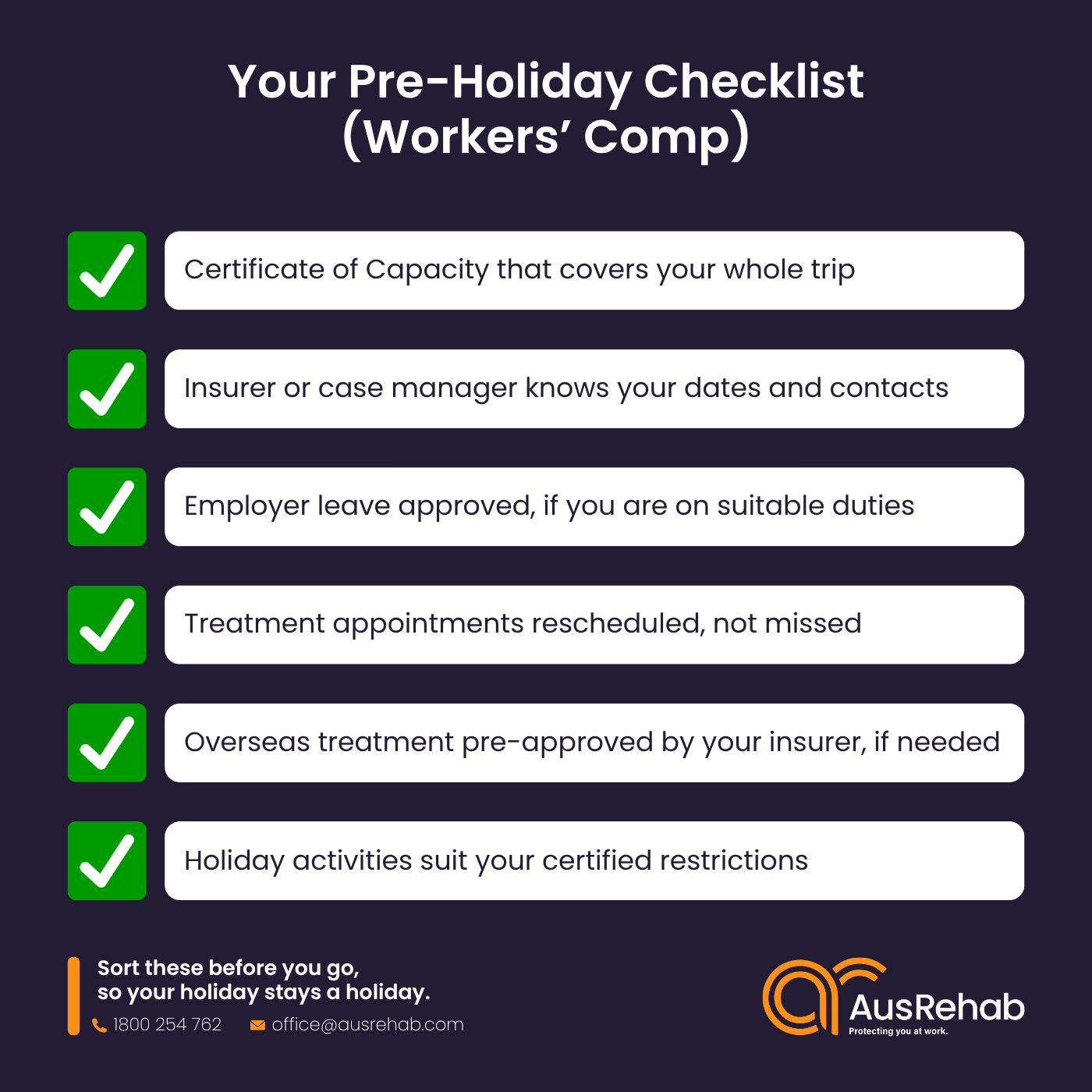
Your pre-holiday checklist
Use this checklist before travelling while on workers’ comp.
- My certificate covers the whole trip.
- I have told my insurer my travel dates and contact details.
- My employer has approved my leave, if I am working.
- I have rescheduled treatment or appointments instead of simply missing them.
- I have checked approval requirements for overseas treatment, if needed.
- My planned activities suit my injury and certified restrictions.
Which workers' compensation regulator should you contact?
Workers’ compensation rules differ across Australia. If you are unsure what applies to your claim, contact the regulator for your state or territory.
| State or Territory | Regulator |
|---|---|
| New South Wales (NSW) | SIRA |
| Victoria (VIC) | WorkSafe Victoria |
| Queensland (QLD) | WorkCover Queensland |
| South Australia (SA) | ReturnToWorkSA |
| Western Australia (WA) | WorkCover WA |
| Tasmania (TAS) | WorkSafe Tasmania |
| Australian Capital Territory (ACT) | WorkSafe ACT |
| Northern Territory (NT) | NT WorkSafe |
| Commonwealth employees | Comcare |
Contact your regulator before you travel to confirm the rules that apply to your claim and avoid unexpected issues with your payments.
Short holiday vs moving overseas
A short holiday is not the same as moving or living overseas. A temporary trip usually keeps your payments running, but choosing to reside in Australia can trigger separate weekly-payment rules in some schemes. If your trip is long or a relocation, get advice before you go.
A short trip and a permanent move overseas can have different requirements. Some schemes ask workers living overseas to provide extra medical documents or proof of identity to keep receiving payments.
📌 For example,
WorkSafe Victoria has a separate process for injured workers who move overseas. This shows why you should check the rules for your own claim before making a long-term move.
💡Fact:
In Victoria, workers who move overseas may need to provide a medical certificate covering their work capacity for the next three months, along with a signed statement of identity.
If you plan to stay overseas for an extended period or move there permanently, speak with your insurer before making arrangements.
Do you need to use annual leave?
💡Quick Answer:
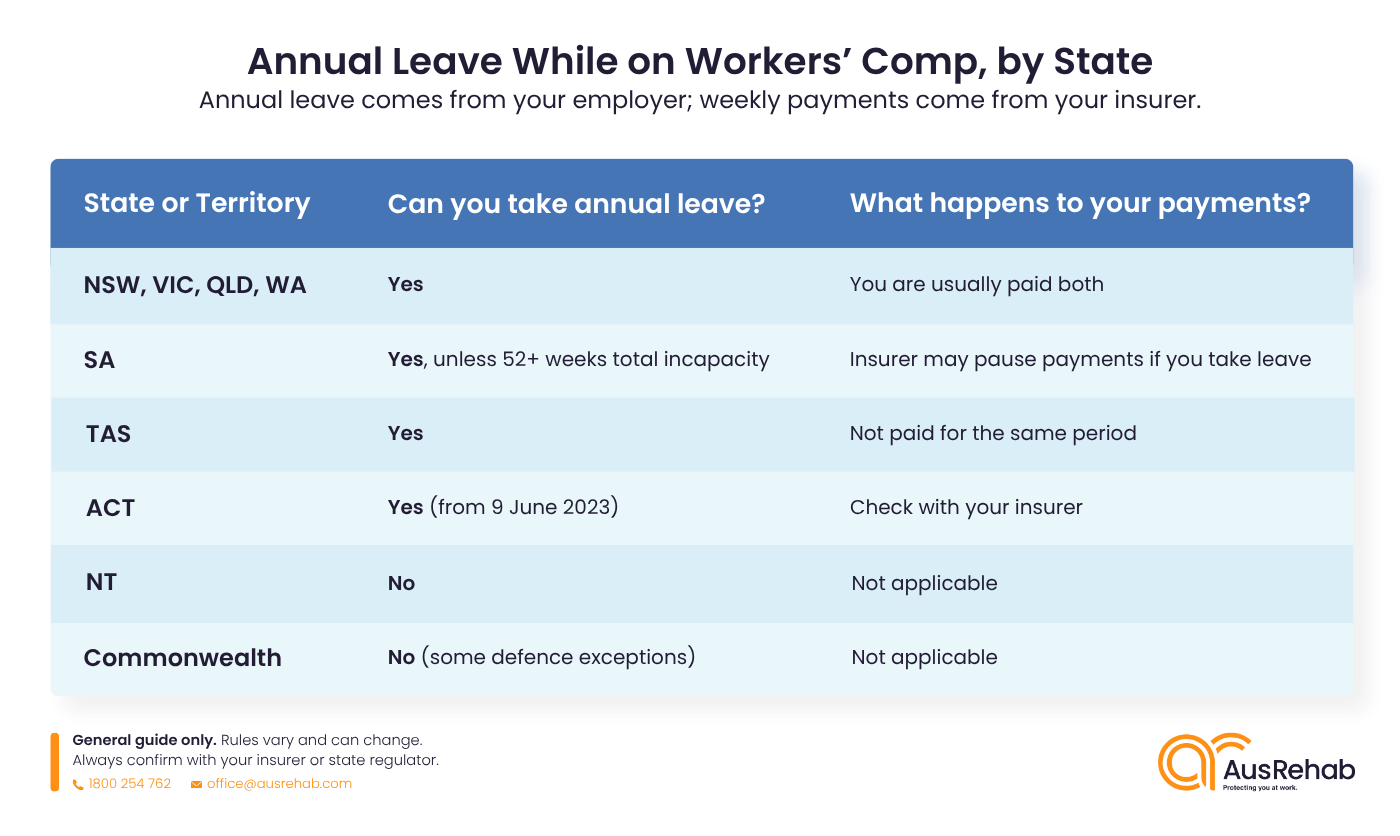
It depends on your state. Annual leave comes from your employer, and weekly payments come from your insurer, so they are two separate things. In several states, you can take annual leave while on workers’ comp, and you may be paid both, but the payment effect differs by scheme.
If you are planning a break, it helps to understand the difference between annual leave and workers’ compensation payments.
- Annual leave is paid time off provided by your employer.
- Weekly payments are compensation payments made under your workers’ compensation claim to help replace lost wages.
Whether you can take annual leave while on workers’ compensation depends on the law that applies to your claim. Now Section 130 of the Fair Work Act 2009 links leave entitlements during workers’ compensation to the relevant state or territory law.
Can you take annual leave and workers comp at the same time?
The rules differ across Australia. The table below is a general guide. Your eligibility and the effect on your payments may depend on your circumstances, so check with your insurer or regulator before making plans.
💡 Quick Tip:
Check before using your leave. Ask your insurer how annual leave will affect your weekly payments, and ask your employer to confirm your leave dates. Get the answer before you commit to bookings.
Stick to your restrictions
Choose activities that match your certified restrictions: a gentle walk is very different from jet skiing with a back injury. Keep your treatment going and reschedule rather than miss appointments. A new injury from a holiday activity is generally not covered, because it did not happen at work.
A holiday should give you time to rest and enjoy yourself. It should also fit with your recovery.
If your injury limits lifting, walking, standing or driving, think about those limits when planning your activities. Follow your doctor’s advice and the restrictions in your certificate of capacity.
💡 For example,
A short, easy walk may suit one person recovering from an injury. A long hike or an activity with sudden movements may not suit someone with the same injury.
This is not about avoiding all activity. The right movement can be part of recovery. The key is choosing activities that match your current ability.
How AusRehab Can Help
Planning a trip while recovering from a work injury can feel like another job. You may need to manage appointments, paperwork, work arrangements and questions from your insurer.
As a workplace rehabilitation service provider, AusRehab can help you plan your trip around your return to work plan. We can help coordinate communication between you, your doctor, employer and insurer, where appropriate.
We can also support you in preparing to return to suitable duties after your break.
Our role is to support your recovery and return to work. We are not your insurer or legal representative, and we cannot guarantee how your insurer will decide your claim or payments.
Learn more about our workplace rehabilitation services, return to work planning and suitable duties support.
💡What is a return to work plan?
A plan that sets out how you can safely return to work, which may include adjusted hours, tasks or support.
Enjoy your break without the worry
You deserve a proper break. A little planning can help you enjoy your time away and return with a clear plan for your recovery.
Before you book your holiday while on workers’ comp, check your certificate dates, tell your insurer, sort out your leave and make sure your plans suit your injury. These simple steps can help you avoid problems while you are away.
If you are unsure about the workers’ comp holiday rules Australia applies to your claim, speak with your case manager or the relevant regulator.
Key Takeaways
- You can usually go on holiday while on workers’ compensation if you plan ahead.
- Keep your certificate of capacity current to help protect your weekly payments.
- Tell your insurer your travel dates, destination and contact details before leaving.
- Payments may be affected if your certificate expires or you miss required appointments.
- Overseas travel may require extra planning and approval for treatment.
- Annual leave rules differ across Australian states and territories.
- In NSW, a certificate of capacity generally covers up to 28 days unless specific reasons support a longer period.
- Moving overseas can trigger different workers’ compensation requirements from taking a short holiday.
- Choose holiday activities that match your injury and certified work restrictions.
- A new injury during a leisure activity is generally separate from your existing work injury claim.
- Workplace rehabilitation can help you plan your return to suitable duties after your holiday.
Frequently Asked Questions (FAQs)
Do I need my employer's approval for annual leave while on workers' comp?
Yes. Workers’ compensation does not replace your employer’s normal leave process. If you want to use annual leave, apply through your employer as usual and wait for approval. Receiving workers’ compensation does not automatically give you the right to choose your holiday dates without your employer’s agreement.
Can I travel interstate while on workers comp?
Usually, yes. Keep your certificate current, tell your case manager your travel dates and contact details, and make sure your treatment and appointments stay on track. Interstate travel is often simpler to organise than overseas travel, but you should still inform your insurer before leaving
Can workers' compensation pay for treatment I get overseas?
Not automatically. Overseas treatment may need your insurer’s approval before you receive it, and the rules differ between schemes. Ask your insurer what is covered before travelling and keep receipts and treatment records. Do not assume you will be reimbursed without prior agreement.
What happens if my certificate of capacity expires while I am away?
Your weekly payments may stop if your certificate expires and you do not provide an updated one when required. Arrange a medical review before leaving so your certificate covers your trip, where possible. If you need a review while away, contact your doctor and insurer to ask what arrangements they accept.
Can I go on holiday while working reduced hours or suitable duties?
Yes, in many cases. If you are working reduced hours or doing suitable duties, apply for leave through your employer as usual and tell your insurer. Plan your return-to-work arrangements before leaving so you know when and how you are expected to resume your duties.
What happens if I get a new injury while on holiday?
A new injury caused by a leisure activity is generally separate from your work injury claim because it did not happen at work or during approved treatment. Seek medical care if needed, tell the relevant parties and ask your insurer how the new injury affects your circumstances.