
Prefer to Listen? Play this quick summary instead!
Why are pre-employment medicals a smart investment?
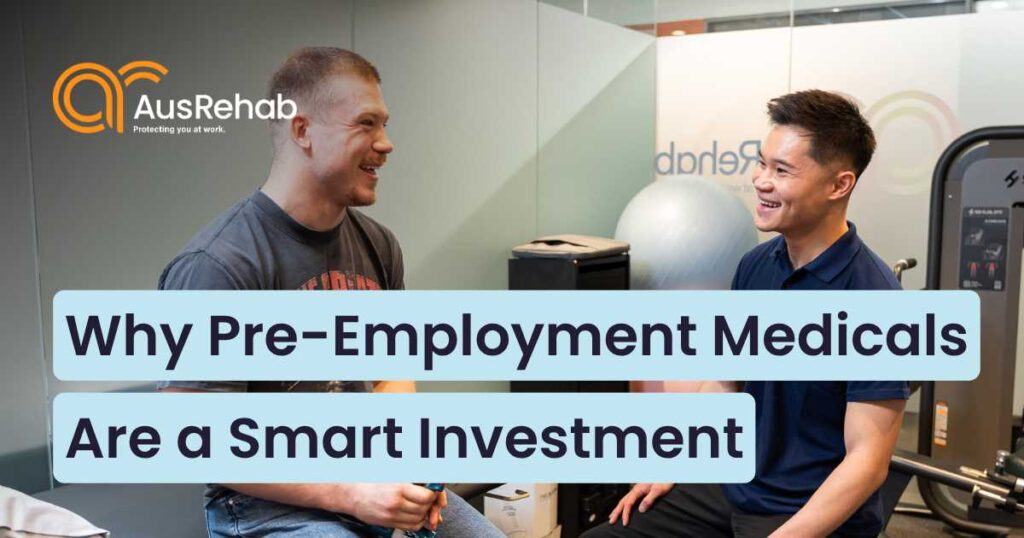
A role-matched pre-employment medical gives you documented information about whether a candidate can safely meet the physical and health requirements of a job. It can flag issues that need review or adjustment before work starts, support more informed hiring decisions, and give the candidate a clearer, safer start.
When hiring for a job that requires strenuous activity in physical terms, you must consider more than just the CV and the references. In the case of physically demanding occupations requiring lifting, driving, climbing, repetitive tasks, etc., it is essential to determine whether a candidate is capable of doing the job at hand safely.
A pre-employment medical assessment helps answer that question. When it is matched to the actual role, it can give employers useful information before work begins.
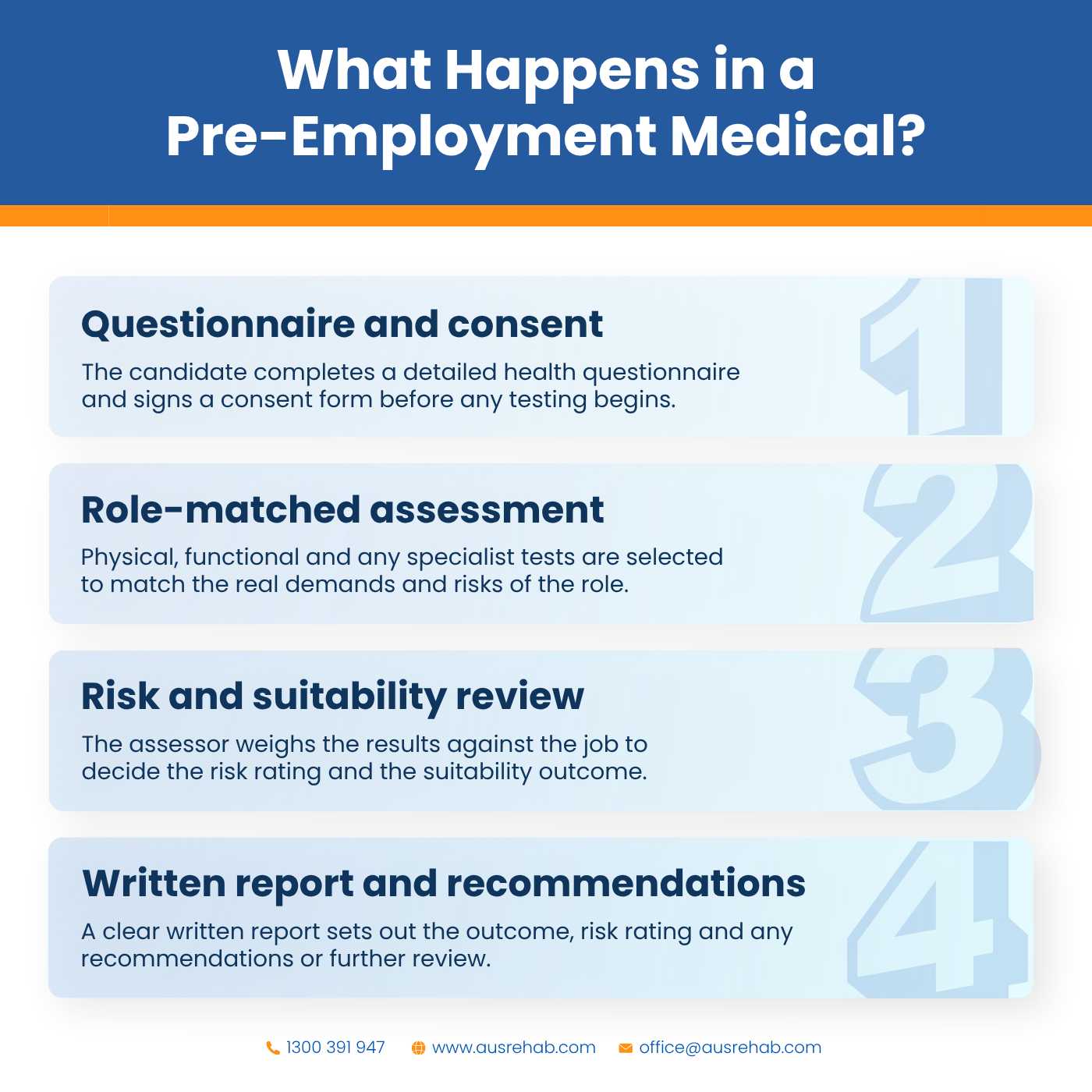
At AusRehab, the process includes a health questionnaire and consent step, role-specific physical and functional testing, and a written report explaining the outcome.
A quick overview of AusRehab’s screening services, locations, pricing and process. Handy to keep on hand or share with your HR team
What's Included in a Pre-Employment Screening?
📌 What does a pre-employment medical test include?
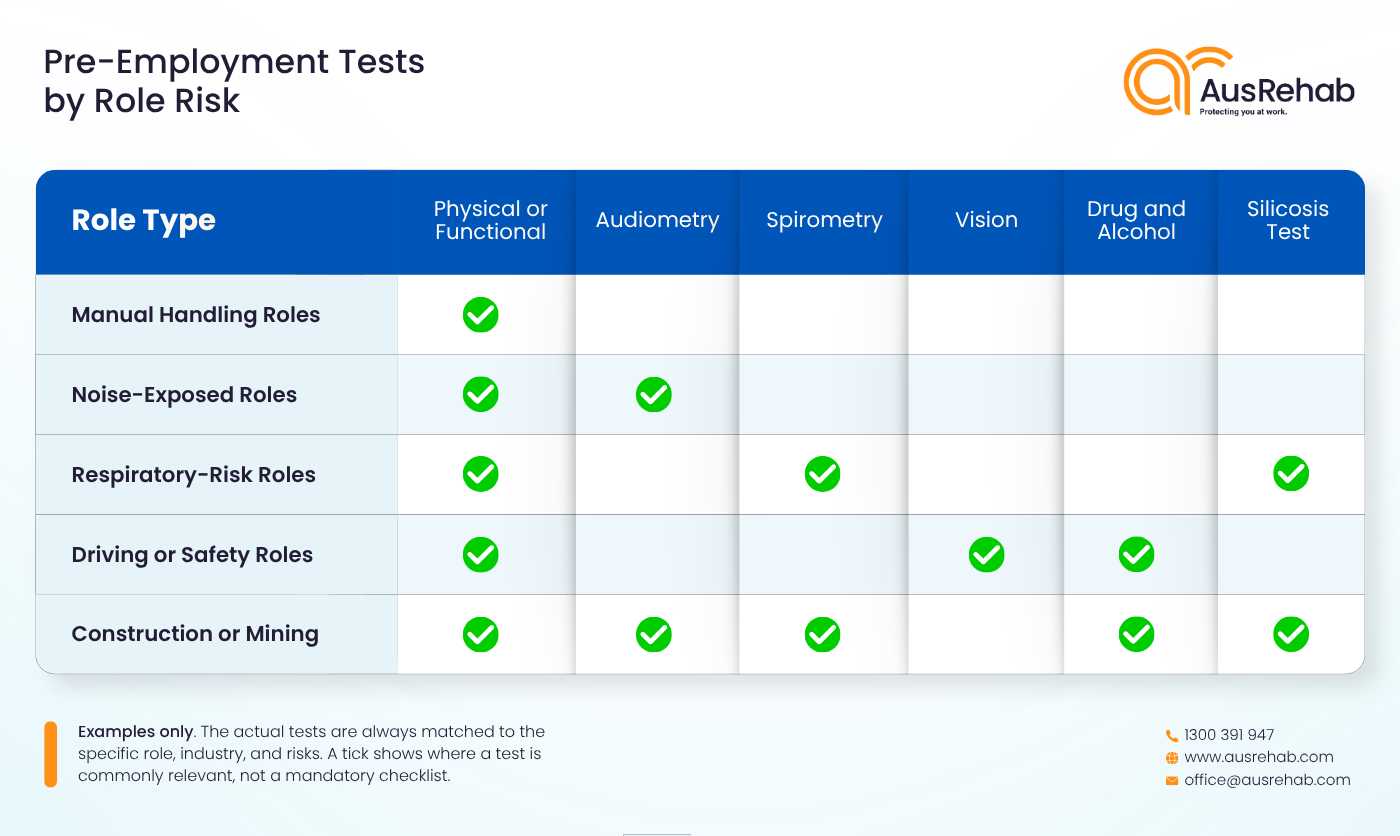
The exact tests depend on the job. A pre-employment medical may include a physical or functional assessment, plus hearing, lung function, vision, drug and alcohol screening, or other exposure-related checks. The useful part is matching the assessment to the real demands and risks of the role, so a desk-based candidate and a manual labouring candidate are never run through the same checklist.
A pre-employment medical test list can look different from one job to another. There is no need to put every candidate through the same tests. For example, a candidate applying for a clerical position will have different screening needs than a candidate in the construction industry or in heavy manual labour.
The appropriate pre-employment screening tests should be done based on the nature and risks involved in a job.
AusRehab’s pre-employment screening service matches each candidate with relevant tests for the job in question. The right combination depends on the role:
| Assessment | Best For | What It Involves |
|---|---|---|
| Physical / fit to work | Most physical roles | Baseline measures, posture and movement checks, and functional tests like lifting, carrying and grip strength |
| Audiometry test | Noise-exposed roles | A hearing test measuring the softest sounds a candidate can detect across different frequencies |
| Spirometry test | Dust or respiratory-risk roles | A breathing test measuring lung volume and airflow to check lung function |
| Visual acuity test | Driving and safety roles | An eye chart test for clear distance vision, plus a colour vision check where required |
| Skin check | Outdoor or high-risk roles | A visual check of exposed skin for any concerning spots or abnormalities |
| Drug and alcohol screening | Safety-sensitive roles | An instant urine drug screen and a breath alcohol test |
| Silicosis test | Construction, mining and silica-exposed roles | A medical evaluation and lung function test to check for silica-related lung disease |
| Asbestos test | Asbestos-exposed roles | A medical exam, spirometry test and chest X-ray to check for asbestos-related lung conditions |
Every test is chosen because it relates to something the role actually requires. A candidate applying for a desk-based role and a candidate applying for a manual labouring role will not be run through the same series of tests.
Before the Assessment: The Questionnaire and Consent Step
Every candidate must fill in an extensive health questionnaire before the commencement of their assessment and sign a consent form indicating their understanding of the process.
This serves to provide the assessor with useful contextual information before any physical or functional tests are conducted. It also helps the candidate understand what the assessment involves and how their information may be used.
| What We Ask | Why It Matters |
|---|---|
| General health, past injuries, surgery and medication | Provides background before testing |
| Difficulties with stairs, prolonged standing, kneeling or repetitive movement | Helps relate capacity to job demands |
| Blood pressure history, hearing, vision and any previous medical restrictions | Identifies areas that may need further consideration |
| Consent for physical, fitness and manual-handling tasks | Makes the assessment process clear |
| Informed consent around how results may be used and shared | Creates a documented record of what the candidate agreed to |
This step helps ensure the assessment is based on relevant information while giving the candidate a clear understanding of the process.
💡What is informed consent?
Informed consent is basically when a person is informed about what they are agreeing to, the reason why the information is gathered, and the possible use before giving consent. As per the Australian Privacy Act, consent for any sensitive information would have to be considered informed, voluntary, current, and particular.
The candidate stays informed:
The candidate should know what will happen before the assessment starts. They can also raise concerns during the process. AusRehab’s process explains how results may be used, including sharing relevant outcomes with the employer or seeking further medical advice where needed.
What Actually Happens During the Assessment?
The pre-employment medical process is designed to follow a clear sequence. The exact tests depend on the role.
The assessment at a glance:
- Review:
The assessor reviews the questionnaire and consent.
- Baseline checks:
Basic health checks and movement measures are taken.
- Role-specific testing:
Physical, functional or specialist tests are completed.
- Review and report:
Results are considered against the job and included in the written report.
This approach helps keep the assessment focused on the actual work rather than using a generic checklist. The aim is to understand how the candidate’s current capacity relates to the requirements of the role.
Why Employers Use Behavioural Assessments Before Hiring
⚡️ What a physical and functional assessment includes:
A pre-employment functional assessment may include:
- Height and weight
- Resting heart rate and blood pressure
- Posture and gait
- Range of movement
- Grip strength
- Lifting and carrying
- Pushing and pulling
- Squatting, kneeling and reaching
- Cardiovascular fitness
The assessor chooses tests based on what the candidate may actually need to do at work.
📌 What is functional capacity?
Functional capacity means what a person can safely do physically, such as lifting, carrying, standing, walking or reaching.
Understanding Your Pre-Employment Medical Results
Once testing is complete, the candidate receives a structured outcome through a pre-employment medical report. The pre-employment medical results are considered against the requirements of the position.
A typical report may include:
| Report Component | What It Tells the Employer and Candidate |
|---|---|
| Relevant medical history summary | Context from the questionnaire that relates to the assessment and the role |
| Physical and functional test results | The specific results from each test performed on the day |
| Risk rating | An overall rating, such as low, moderate or high risk of injury in that specific role |
| Suitability outcome | Whether the candidate is suitable for the role applied for, and whether any recommendations apply |
| Recommendations | May range from a simple suggestion to check in with a GP through to a referral for further review |
A report is therefore more useful than a simple "pass" or "fail". It gives the employer information they can use when considering the candidate and the role.
What Happens If Something Is Flagged?
📌 Can you fail a pre-employment medical?
A pre-employment medical is not usually a simple pass or fail test. Any finding is considered against the actual demands of the role. It may lead to a recommendation, a restriction, a request for more information or further review, rather than automatically making the candidate unsuitable.
How is a flagged finding handled?
- A finding is identified during the assessment.
- It is compared with the actual physical demands of the role.
- The assessor decides whether it changes the risk or suitability outcome.
- A recommendation is added, more information is requested, or further review is arranged if needed.
For example, even if a candidate may have a degree of reduced fitness, they might still be suited for such a job that does not require intensive physical exertion in the workplace.
A health check finding does not mean that someone is automatically disqualified. Where necessary, the employer has to consider the question of any reasonable adjustments to help such a person carry out the role.
📌 Quick Tip:
Don’t judge a medical result before looking at the job requirements. The same finding may have very different implications for a desk-based role and a physically demanding role.
Why Pre-Employment Medicals Are Worth the Investment
Investing in a comprehensive pre-employment medical examination is beneficial for a company when employing a new worker since the procedure helps provide the employer with more information before the candidate starts working. Apart from that, many problems may be identified early, along with critical issues requiring attention that may arise later.
⚠️ Fact: Workplace injuries have a wider cost:
Safe Work Australia reported 6.9 million work-related injuries and illnesses between 2008 and 2018, averaging 623,663 cases each year. The research also estimated $49.5 billion in efficiency costs associated with work-related injury and illness over that period.
This does not mean a medical can prevent every workplace injury. Instead, it shows why understanding work capacity and managing workplace risks matter.
Benefits of pre-employment medicals can include:
- Better matching between the worker and the role
- Earlier identification of potential risks
- More informed hiring decisions
- Clearer documentation
- Better planning where further review is needed
- A more structured recruitment process
A medical should still be viewed as one part of a wider safety system. It does not replace safe work design, training, supervision or other workplace controls.
📌 Quick Tip:
Give the assessor a clear description of the job. The more accurately the physical demands are explained, the more useful a role-specific assessment can be.
Confidentiality: What Actually Gets Shared?
A common question is: does an employer see your medical history?
Not necessarily. Since health information is regarded as sensitive under Australian privacy law, it implies that strict privacy requirements are applied to its collection, use, and disclosure. Candidates need to be aware of the parties their information may be shared with, along with the manner in which their data will be utilized.
| What the Employer Typically Receives | What Is Not Automatically Shared |
|---|---|
| Outcome and suitability information relevant to the role | A candidate’s entire medical file |
| A risk rating or role-relevant recommendations | Unrelated health history that is not relevant to the purpose |
| A further review or additional testing recommendation where it applies | Medical information outside the agreed assessment and reporting purpose |
This helps candidates understand what information may be shared, while keeping their broader medical history private unless relevant and appropriately authorised.
At AusRehab, candidates are informed through the consent process about how assessment information may be used and shared. Good privacy practice gives candidates a clearer understanding of what happens to their information after the assessment.
What Employers Should Consider
Employers can get more value from pre-employment medicals when they prepare properly.
Before arranging screening:
- Define the actual physical and safety demands of the role before selecting tests. A desk-based role and a manual labouring role should not be run through the same checklist.
- Give the assessor a clear, accurate description of the role’s physical demands. A vague job description leads to a less useful assessment.
- Use role-relevant screening rather than a one-size-fits-all package.
- Consider reasonable adjustments where appropriate, rather than ruling a candidate out outright.
- Remember that work health and safety obligations, including maintaining a safe system of work, sit with the employer under Australian work health and safety law, so a properly tailored screening process supports compliance rather than just ticking a box.
- Use a consistent process for comparable candidates and keep health information handled appropriately.
Employers still have wider WHS responsibilities. Screening should support those systems rather than replace them.
⚠️ Fact: Safe Work Australia’s latest national data shows 146,700 serious workers’ compensation claims in 2023–24, with a median of 7.4 weeks of time lost.
The goal is not simply to screen people out. It is to understand the role, assess relevant capacity and make a better-informed decision.
Common Misconceptions About Pre-Employment Medicals
There are several common pre-employment medical myths that can make the process seem more complicated than it is.
| Myth | Reality |
|---|---|
| A flagged finding automatically means the candidate fails. | A flagged issue is weighed against the actual demands of the role. A candidate can still be assessed as low risk and suitable, with a simple recommendation attached, rather than ruled out entirely. |
| The employer gets the candidate's entire medical history. | Employers typically receive the outcome and risk rating, not the underlying detail of a candidate’s medical history. |
| Every candidate completes exactly the same tests. | The tests performed are matched to the physical demands of the specific role, industry and relevant risks, not applied as a blanket standard. |
Understanding what screening can and cannot do helps employers use it properly and gives candidates clearer expectations.
How AusRehab Can Help
- Book and prepay through the AusRehab PES Portal in under 5 minutes.
- Candidates are typically scheduled within 3 business days.
- Reports are generally delivered within 48 hours, subject to the booked assessment and any additional review needed.
- Every candidate completes a detailed health questionnaire and signed consent form before the assessment, so there is a clear, documented process behind every result.
- Assessments are carried out by qualified, experienced assessors across NSW locations including Bankstown, Alexandria, Blacktown, Hurstville and Eastwood, with on-site screening also available for bulk bookings.
- Track, edit and download everything through your own dashboard, so there is a clear record of who was assessed, what for, and what the outcome was.
Hiring smarter starts with knowing your candidates can safely do the job, backed by a process that is thorough, documented and fair.
Book pre-employment screening with AusRehab, or speak with the team about the right assessment mix for your role
Key Takeaways
- Pre-employment medicals help employers understand whether a candidate can safely meet the physical requirements of a role.
- The tests included in a medical should be matched to the specific demands and risks of the job.
- A flagged result does not automatically mean a candidate is unsuitable for the role.
- Candidates should understand how their health information is collected, used and shared before giving consent.
- Pre-employment screening supports better hiring decisions but does not replace workplace safety measures.
- A clear and documented screening process helps employers make informed decisions while giving candidates a safer start.
Ready to Arrange Pre-Employment Screening?
Pre-employment medical assessment can provide valuable information for employers before a candidate begins working. The critical factor is to ensure that the evaluation is relevant to the actual work position the candidate is applying for and to incorporate the results in the wider recruitment and occupational health process.
📌 Speak with AusRehab about the right screening options for your team.
- 📞 1300 391 947
- 📧 office@ausrehab.com
- 🔗 Speak with our team today.
Frequently Asked Questions (FAQs)
How long does a pre-employment medical take on the day?
The time taken for job-related tests is dependent upon the type of examinations required for the job and thus differs from candidate to candidate. The confirmation of your booking will give you an idea of the length of your specific assessment.
How soon will the results be ready?
Generally, AusRehab assessment reports are available within 48 hours of the completion of the test undertaken, unless any supplementary data is needed.
Does a pre-employment medical mean I have the job?
Not entirely. The pre-employment medical is just one step in the process of hiring. It helps in finding out if you can fulfil the physical requirements of the role.
Are pre-employment medicals hard to pass?
It is not a test of fitness levels. It simply assesses whether you are capable of performing the job requirements, in accordance with the duties required for the role.
Does a pre-employment medical include a drug and alcohol test?
Drug and alcohol tests are carried out only when necessary. While the assessments are done for jobs that have safety implications, this type of evaluation is not done for all candidates alike.
Who arranges and pays for a pre-employment medical?
Generally, employers will arrange for and pay for pre-employment medical assessments that form part of the recruitment procedure. For more details on the current rates, dates, and scheduling, please refer to the AusRehab pre-employment medical screening.
What should I bring to my appointment?
If you wear glasses, contact lenses or hearing aids, please bring them with you. It also helps to bring a list of any medicines you are currently taking. The confirmation letter gives all the information about the preparation for the examination.
Can an employer arrange screening for several candidates at once?
Yes. On-site screening is provided to multiple candidates as a single order at AusRehab facilities in different locations. Get in touch with our expert team for more details.