

Prefer to Listen? Play this quick summary instead!
Quick Answer
Yes, especially if the details posted on social media are relevant to the worker’s injury, symptoms, or work capabilities. A single photo or a brief video does not necessarily present the entire context surrounding the injury, which is why it is important to report all relevant information and maintain accurate recovery records.
When recovering from an injury at work, it is important to understand that an insurance company could use social media to investigate one’s condition, or even observe the worker.
However, this does not mean that one should stop being active on social media platforms. The main point is to be truthful and consistent.
NSW’s social media workers’ compensation claim system does allow surveillance under particular circumstances. According to the SIRA’s S25 Surveillance standard, which came into effect on December 10, 2025, insurance companies should use surveillance wisely, since it may damage the trust between the parties involved in the claim process.
This blog article gives a detailed description of workers’ compensation surveillance in NSW, the problems that arise when social media is used in workers’ compensation claims, as well as what you should do to ensure accurate and consistent reporting while recovering from an injury.
What Is Surveillance in a Workers Comp Claim?
Workers’ compensation surveillance can be understood as a form of observation that allows surveillance of workers with regard to their actions and abilities.
SIRA identifies two main forms:
- Desktop surveillance:
Searches aimed at Internet surveillance and observation of social networking media. - Optical surveillance:
Using photography, videos, and simply watching workers on social media platforms.
In referring to workers’ compensation surveillance, it indicates that being followed by an investigator is not the only option available. Information that can be retrieved from public sources online is also helpful.
⚡️What is desktop surveillance?
Desktop surveillance refers to the research of readily available online information, including that from various social media forums, rather than the physical surveillance of the employee in question.
Here is an example of desktop surveillance in real-life: the insurance company can perform a review of information that is accessible online (across social media platforms) if it’s relevant to the claim.
⚡️What is optical surveillance?
It refers to the process in which the actions of an employee are observed or recorded through the use of photographs or video footage wherever legal.
Knowing this difference is important, as both types of surveillance involve completely different evidence.
| Type of Surveillance | What It Involves | Possible Example |
|---|---|---|
| Desktop surveillance | Searching online sources and publicly available information. | A public Facebook, Instagram, TikTok, LinkedIn or other online content. |
| Optical surveillance | Direct observation, photography or video recording. | Observing movement or activities in a public space. |
SIRA identifies desktop and optical surveillance as the two main types of surveillance used on workers in the NSW workers' compensation system.
When Can an Insurer Use Surveillance in NSW?
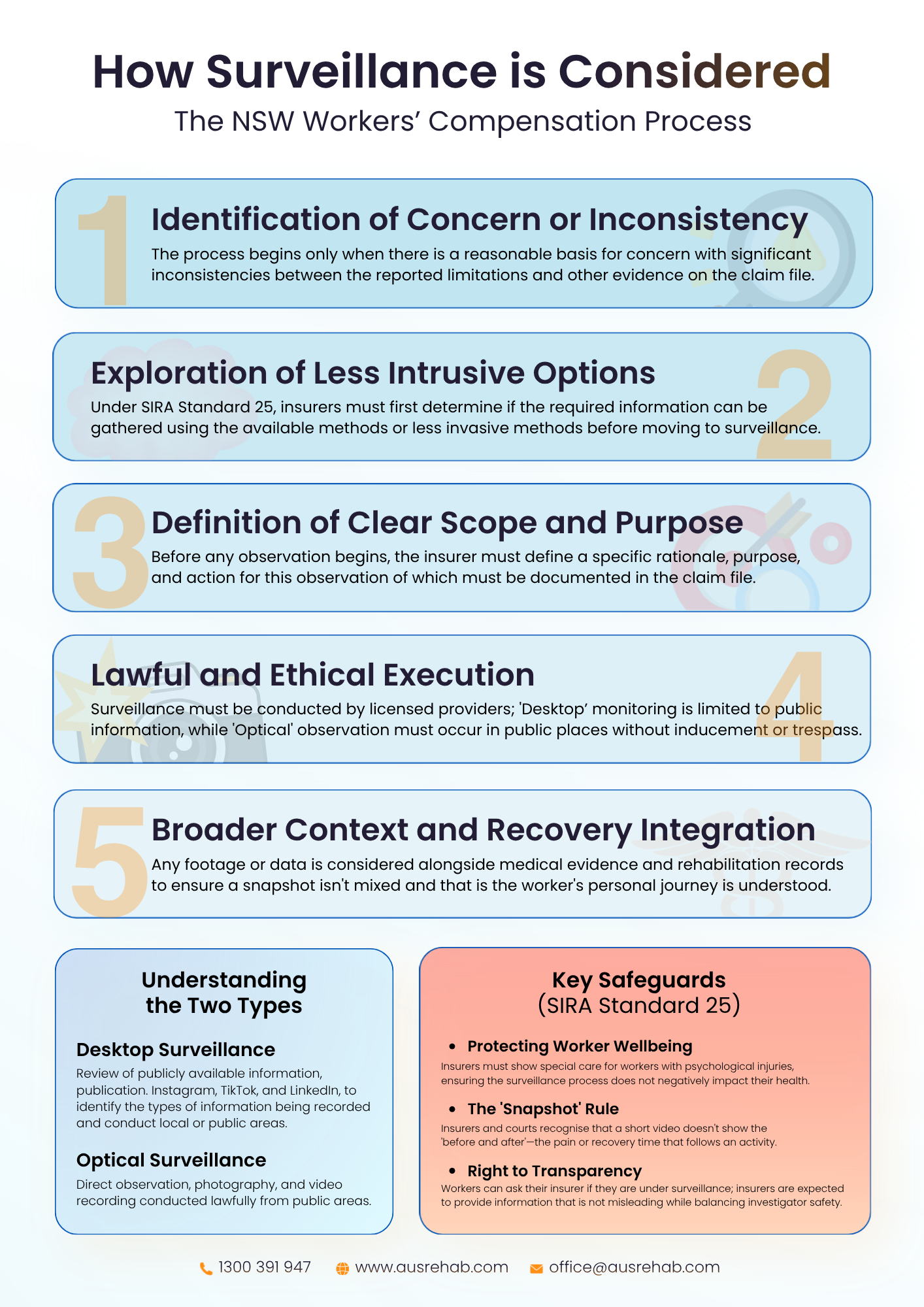
Under Standard 25, an insurer is only to conduct surveillance when there is evidence that:
- A worker may be exaggerating an aspect of their claim.
- A worker may be providing misleading information.
- The claim appears inconsistent with information already held by the insurer.
- The insurer reasonably believes fraud may be occurring.
There are additional requirements.
Before implementing surveillance, the insurance company must determine whether the necessary knowledge can be obtained by less intrusive means. Surveillance should only be performed if it’s necessary, beneficial, and if the good outweighs any downsides.
💡What is SIRA Standard 25?
SIRA Standard 25 sets expectations for insurers when conducting surveillance in NSW workers’ compensation claims. When an insurer decides to use surveillance in a workers’ compensation claim, they’re required to follow this standard.
According to SIRA, insurers have to rely on solid evidence instead of rumours or guesswork when they are determining whether surveillance is necessary in the first place.
⚡️Quick Fact
Every surveillance gathering company must possess the relevant qualifications and licensing. Surveillance must have definite limits in terms of time and scope, and it has to be conducted in accordance with the law and ethical workers’ compensation surveillance rules in NSW.
Source: SIRA
What SIRA Standard 25 Says About Surveillance?
SIRA Standard 25 covers what is acceptable in terms of when and how surveillance is carried out. The workers’ compensation surveillance regulations in New South Wales are concerned with factors of necessity, fairness, privacy, and the legality and ethics of surveillance activities.
Can You Ask If You Are Under Surveillance?
It is possible to ask your insurer whether you are under surveillance or not. They must not provide any false information in their response, although they may take into account the safety of the investigator and concerns regarding your well-being.
📌 What SIRA Expects?
SIRA is clear about its expectations of when and how surveillance may be employed in workers’ compensation surveillance in NSW.
- Surveillance should only be used if there’s a good reason for it, and if other means are not enough.
- Define objectives, expectations, and the scope of the operation before it begins.
- Use qualified and licensed providers and follow the workers’ compensation surveillance rules in NSW while conducting surveillance.
- Optical surveillance should be carried out from a public place. It’s not allowed to trick or pressure the claimant, pay for their cooperation, or trespass.
- Respect the privacy of others and keep surveillance records safe.
- Take into consideration the worker’s health and wellbeing when using surveillance, especially if the claimant suffers from psychological problems.
Can Social Media Be Used Against You?
Yes. Social media material might be looked at if it’s relevant to the details of your injury or how well you’re able to work.
The focus is on relevance and consistency rather than on how the social media is used.
Public Posts, Photos, Videos and Check-ins:
Publicly accessible posts, pictures, videos, stories and captions can be used, as long as they refer to the case in question.
What About Private Accounts or Messages?:
Private information is regarded differently from public information and, therefore, the approach to analysing it can vary if it is important in any dispute.
Can a Friend or Family Member’s Post Affect Your Claim?
Yes. Public photos and labels can flag a potential issue even if you are not an active social media user, but one picture is usually not enough.
| Content Type | What May Be Relevant |
|---|---|
| Public social media | Posts, photos, videos, comments and check-ins. |
| Private content | May involve different processes in a formal dispute. |
| Friends/family posts | Public tags or photos that are clearly visible. |
Various types of social media information can raise different arguments during a workers’ compensation case.
How Can Surveillance Affect a Genuine Claim?
There is no guarantee that social media surveillance indicates deceitfulness. However, information that contradicts your stated limitations may cause doubts about your claim.
“A single image or brief video captures a particular instant and cannot always convey suffering, exhaustion, support, or rehabilitation.”
Why a Photo or Short Video Can Miss Important Context?
It is possible that social media evidence should not be relied upon when proving a particular case, as it often doesn’t show the full picture of what happened before or after the moment captured. For example, a photo or video can’t show things like the person’s pain levels, fatigue, or how long it took them to recover afterward.
Case Example: Digby v The Compass Institute Inc & Anor [2015] QSC 308
In this particular case, a worker claimed to have suffered from a shoulder injury at her workplace. At the same time, the evidence provided from Facebook and videos raised certain doubts in terms of the validity of the restrictions announced by the worker. Eventually, the Court accepted the claim but still used additional pieces of evidence so as to judge about the limitations and damages.
⚠️The key takeaway:
Surveillance evidence can trigger controversy on particular statements. However, it does not necessarily signify deceitfulness nor validate any claims.
How to Protect a Legitimate Workers' Comp Claim?
It doesn’t necessarily mean that all you need to do in order to keep your workers’ comp claim valid is to refrain from any surveillance or change your actions. The best way to protect your claim is to be honest and straightforward.
Be Honest and Consistent About Your Capacity:
In order to avoid inflicting damage to your workers’ compensation claim, you must provide truthful information about your abilities. Make sure your documentation is in order, and tell your medical professionals if any activities make your symptoms worse.
Think Before You Post, But Do Not Start Deleting:
Make sure to think twice before sharing any information related to any physical activities, travels, or social gatherings, taking into account that people may perceive this information differently.
Keep Your Recovery Properly Documented:
Accurate recovery documentation can assist in understanding your workers’ compensation recovery process. Make sure that your records of the medical and rehabilitation process are accurate and inform your case manager, rehabilitation service provider, and/or doctor about any posts that may cause suspicion.
| Do | Avoid |
|---|---|
| Describe your symptoms and capacity accurately. | Exaggerating or understating what you can do. |
| Tell your treating team when activity causes symptoms later. | Assuming one photo shows the full context. |
| Think twice before posting any information that can be misunderstood. | Posting information that might not be clear may create problems for you. |
| Keep the recovery and work capacity data consistent. | Deleting old posts once a claim is active without obtaining appropriate advice. |
| Tell your rehab or treating team if something online raises questions. | Trying to hide activity or mislead an investigator. |
The main objective is not to avoid being monitored, but to be truthful, consistent with your work, and accurate. When in doubt, consult your treatment or rehabilitation team rather than trying to erase information.
💡 Quick Tip
A change in work capacity requires informing the healthcare team. Regular communication about capacity can clarify the reasons why an activity seems difficult one week but becomes doable in later weeks.
How Can AusRehab Help?
The wide-ranging implications of surveillance and social media may make the process feel overwhelming, but the focus of workplace rehabilitation efforts should be on health and functional capacity as well as on a safe return to work.
It is essential to keep in mind that the recovery process involves something more than treatment. Careful record-keeping of one’s capacity, progress and return-to-work goals is necessary for everyone taking part in the process to be informed.
AusRehab‘s workers’ compensation return-to-work support can include:
- Recovery and capacity planning
- Suitable duties planning
- Workplace assessments
- Functional assessments
- Communication with your treating professionals, employer, and insurer
- Return-to-work planning
- Progress monitoring
Worried Something Online Could Be Misread? Let’s Talk!
If you are worried that something on the internet can be misunderstood or if you are unsure about the proper documentation of your recovery and employment capacity, contact AusRehab.
We are available to help you with the rehabilitation process and can help you concentrate on your recovery at the same time.
Speak to the AusRehab team to learn more about our workplace rehabilitation and workers’ compensation return-to-work support.
- 📞 1300 391 947
📧 office@ausrehab.com - 🔗 Speak with our team today.
Key Takeaways:
- Workers’ compensation surveillance in NSW (New South Wales) has particular SIRA regulations. This could mean online surveillance of what is easily discoverable from public sources and surveillance that covers observation, taking photographs, as well as video recording.
- Social media may come into play when your posts do not match what you have told your insurer about your injury or ability to work.
- The answer is simple: always be truthful, accurately report your rehabilitation progress, consider whether to post anything, and find assistance if you doubt your decision.
Frequently Asked Questions (FAQs)
Can workers' comp check your social media?
Indeed. The State Insurance Regulatory Authority recognises that desktop surveillance in workers’ compensation checks encompasses internet searches and social media surveillance for information that is accessible to the public at large.
Can social media be used against you in a workers' comp claim?
The public information published on social media is relevant if it is connected to the matter being investigated. Individual factors such as the content, context, and available evidence have a heavy influence on the significance of such evidence.
Can surveillance footage affect a workers' compensation claim?
Workers’ comp surveillance footage may play a role in workers’ compensation claims. It can help make decisions about liability and other claims, remaining one of the factors to consider.
Can private social media posts be used in a workers' comp claim?
When it comes to private social media posts in relation to workers’ compensation, insurers need to recognise that they are different from public social media posts.
Can a friend tagging me affect my workers' comp claim?
In the case where a friend tagged you in a picture, it is public information and can be seen. However, while it does not disprove your ability to work, it only captures one moment and can be misleading.
What is desktop surveillance in workers' compensation?
Desktop surveillance involves searches on the web and accessing publicly available materials, including those regarding social media.
What is optical surveillance in workers' compensation?
Optical surveillance in workers’ compensation comprises image capturing, which can be either through still shots or motion pictures. SIRA has determined the necessity for witnessing these operations being carried out in a legal and moral way, as well as in locations that can be freely accessible to everyone.
Can workers' comp investigators follow you?
Such activities imply the possibility of conducting visual surveillance, yet SIRA underlines various circumstances under which such observation can be done in compliance with the law.
Is workers' compensation surveillance legal in NSW?
The use of surveillance in connection with a workers’ compensation claim in NSW is allowed, provided the relevant criteria are satisfied in accordance with SIRA Standard 25. It specifies that the surveillance must be done lawfully and ethically, referencing the Surveillance Devices Act 2007.
Should I delete social media posts during a workers' comp claim?
Do not rush to delete or modify your posts simply because you have a claim in process under the social media evidence workers’ compensation. If you are worried about anything specific, consult the right professionals instead of attempting to hide evidence.
Why does consistency matter during a workers' comp claim?
Any type of claim needs consistency so that an accurate view of a claimant’s injury, condition, functioning capability and progress can be achieved. A claimant’s condition may change over time, but any changes should be reported to their doctor.
⚠️ Disclaimer: This article provides general educational information about NSW workers compensation surveillance and rehabilitation. It is not legal or financial advice. Individual claims and circumstances differ. For advice about your specific legal rights or dispute, consult an appropriately qualified professional.