
Prefer to Listen? Play this quick summary instead!
The rules for workplace injury claims are shifting drastically, and understanding these changes could save your long term entitlements.
Most people assume their workers compensation entitlements are locked in forever once established. This is simply not the case. The NSW workers compensation changes in 2026 are sweeping across the state and altering the landscape for employees and employers alike.
From 1 July 2026, the rules are changing significantly. For some workers, particularly those suffering from psychological injuries, the window to claim under the current system is closing fast. The recent reforms are designed to manage scheme sustainability, but they place a much higher burden of proof on the injured individual.
If you are currently managing an injury, dealing with the stigma surrounding WorkCover claims, or considering lodging a claim, understanding these shifts is absolutely crucial. You are not just a claim number. You are a person with rights, and staying informed is your best protection against losing out on vital support.
What Changes Have Been Passed?
Two critical bills have passed through parliament that rewrite the rules for both workers and employers across the state.
To address scheme sustainability and rising costs, the state government has established the foundation for major workers comp reform in NSW. These legislative updates aim to align compensation laws with broader workplace safety frameworks.
The strategy relies on two separate pieces of legislation. Together, these bills tighten the eligibility rules and enforce strict new timeframes for how decisions are made.
November 2025 Bill
This legislation tightens the liability tests specifically for mental health claims and dispute resolutions.
The Workers Compensation Legislation Amendment Bill 2025 was officially passed on 18 November 2025. This initial legislation primarily targets the liability tests used to determine if a claim is valid.
It specifically addresses psychological injury claim rules and removes the ambiguities that previously allowed claims based on general workplace stress to succeed easily.
February 2026 Bill
Focused on long term scheme viability, this bill introduces higher impairment thresholds and premium caps.
Following the first bill, the Workers Compensation Legislation Amendment (Reform and Modernisation) Bill was passed on 4 February 2026. This secondary bill focuses heavily on long term scheme liabilities.
It introduces strict new impairment thresholds and outlines the single assessment process for permanent injuries. While some early updates have already commenced, the majority of the restrictive changes will take effect from 1 July 2026.
What Is Already in Effect from March 2026?
Several early updates have already rolled out ahead of the massive July legislative overhaul.
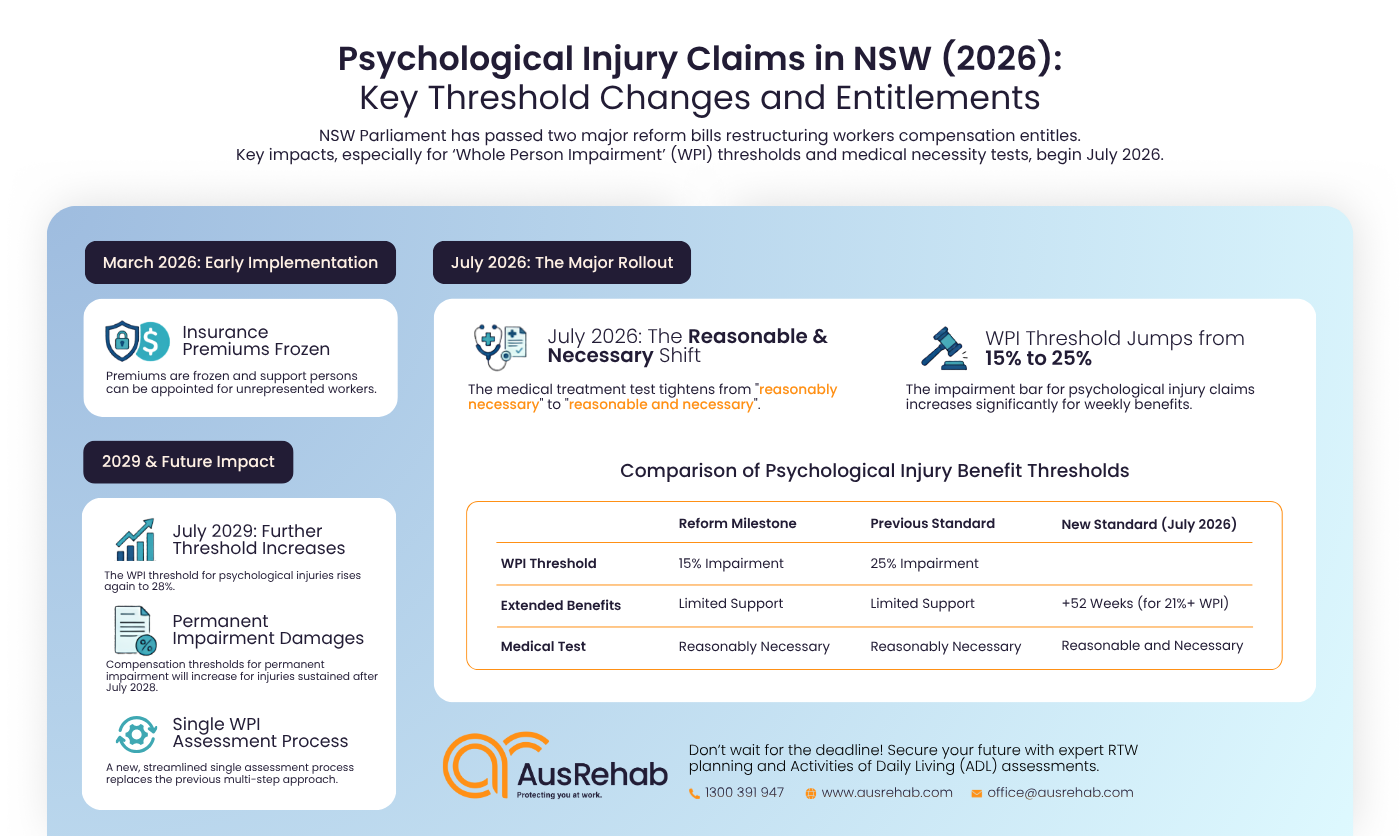
Before the massive July transition occurs, several early workers comp updates 2026 came into effect in late March. These changes act as a precursor to the broader reforms rolling out later in the year.
One major update is an insurance premium rate freeze for the 2026 to 2027 and 2027 to 2028 policy periods. This measure is designed to stabilise employer costs in the short term.
Additionally, new powers have been granted to the Personal Injury Commission. They can now appoint a support person for workers who cannot legally represent themselves during proceedings. A formal review of the way psychological injuries are assessed has also been initiated.
What Is Changing for Psychological Injury Claims?
From July 2026, the barrier to accessing support for mental health injuries is becoming significantly higher.
This is the most impactful area of the new laws. From 1 July 2026, the legal bar for psychological injury workers comp in NSW is getting much higher. The state government is attempting to curb the rising costs of mental health claims by introducing highly objective legal tests.
💡 Did you know?
Data from Safe Work Australia highlights that thousands of workers are awarded compensation for mental disorders caused by bullying every year, but the new laws will make securing this support much harder.
Changes to Psychological Injury Claim Thresholds from July 2026
| Change | Before | After July 2026 |
|---|---|---|
| WPI threshold | 15% | 25% |
| Extended benefits | Limited | +52 weeks (21%+) |
Conduct vs Traumatic Events
Claims will now need to be linked to highly specific, objective events rather than general workplace stress.
Under the new rules, claims must be linked to a clearly defined incident. According to the icare workers compensation reform, this must be either a conduct event or a traumatic event. A traumatic event involves incidents like workplace violence, witnessing a serious accident, or experiencing a critical emergency.
A conduct event relates to continuous issues like severe workplace bullying, racial conduct, sexual harassment, or unreasonable work demands. You can no longer rely on cumulative, generalised stress to form the basis of a successful claim.
WPI Explained Simply
The way your injury is measured is changing, and the required score is jumping significantly.
The level of impairment you need to show to access weekly payments beyond 130 weeks will increase from 15 percent to 25 percent. This is measured using a system called WPI workers comp in NSW, which stands for Whole Person Impairment.
WPI is basically a medical score that reflects how much your injury permanently affects your daily life and functioning. This massive ten percent jump means you must prove a far more severe level of psychological damage to qualify for long term help.
💡 Remember: The WPI threshold will rise again to 27 percent in 2027 and reach 28 percent from 1 July 2029. Acting early is the only way to avoid these future restrictions.
What Is Changing About Disputes?
The way contested claims are handled is moving to a much stricter and faster timeline.
The workers comp dispute process in NSW is undergoing a massive procedural realignment. If your psychological claim is based on a conduct event and the insurer disputes it, it will go through a mandatory internal review first.
Following this review, the matter escalates to the Industrial Relations Commission to determine if the misconduct actually occurred. Once the Industrial Relations Commission confirms the misconduct, the insurer has exactly 7 days to accept liability or keep disputing the medical facts.
Insurers now have a strict 42 day window to make a decision on misconduct based claims. If they miss that deadline, your claim may be automatically accepted. Once accepted, the back payment of your weekly benefits and medical expenses must be paid within 21 days.
What Is Changing About Reasonable Management Action?
Employers are gaining clearer legal protections when dealing with performance and workplace management.
This is a specific legal defence that often catches injured workers off guard. Compensation will not be payable if reasonable management action in NSW is the main cause of a psychological injury.
Reasonable management action includes routine employer activities like conducting a performance review, giving discipline, offering a promotion, or executing a corporate restructure.
The new laws have clarified this defence by stating it applies if the management action is the significant cause of the psychological injury. If an employer performs these actions in a reasonable and fair manner, they are highly protected from liability.
What Is Changing About Medical Treatment?
Accessing funded medical support will require passing a much stricter legal test.
Securing funding for your physical or mental recovery will face tighter scrutiny moving forward. The legal test for covering workers comp medical expenses in NSW will shift from reasonably necessary to reasonable and necessary.
This addition of the word “and” creates a tighter dual standard for approval. Furthermore, the legislation introduces a single WPI assessment process.
This replaces the previous approach where multiple doctor assessments could delay a claim and create conflicting results. To provide some relief against inflation, statutory entitlements will now be indexed annually.
What Does the Premium Freeze Mean for Employers?
The state is capping average premium rates, but individual businesses still need to manage their own risk.
For businesses navigating these changes, the reforms offer temporary financial relief. The legislated workers comp premium in NSW freeze runs from 30 June 2026 to 30 June 2028.
However, employers must understand that this freeze applies to a specific part of the average target collection rate, not the total amount a business pays.
Your individual premium can still go up or down based on your specific industry classification, your total wages paid, and your claims history. Proactive risk management and teaching your team how to write an incident report remain the best ways to keep premium costs low. Read more about why reporting near misses matters to protect your business.
Why You Should Act Before July 2026
Delaying your claim could mean losing out on vital long term financial and medical support.
When dealing with workplace injuries, workers comp claim timing is absolutely critical. Workers who currently meet the 15 percent WPI threshold may no longer qualify for anything once the threshold rises to 25 percent in July.
What you qualify for today may not apply after July. This rule applies regardless of whether you decide to stay or are leaving your job while on workers compensation. Getting the right medical support early can strengthen your claim and speed up your clinical recovery.
Securing your entitlements under the current system ensures you have the necessary safety net to focus on your health. Do not wait for the new rules to lock you out of your rights.
💡 If you are struggling with a work-related injury, reviewing the Top 10 Essential Workplace Safety Tips and seeking professional guidance immediately is crucial before the July changes take effect.
How AusRehab Can Help
Navigating these complex new rules is easier when you have a dedicated rehabilitation team on your side. You should not have to figure this complex legislative system out on your own.
At AusRehab, we provide expert workplace rehabilitation services in NSW to help you navigate this changing environment.
We work alongside injured workers, treating doctors, employers, and insurers to ensure the right support is in place at the right time. Whether your injury requires psychological injury support or involves a complex physical condition like neck injuries at work , we help you recover safely.
Our comprehensive suite of services includes:
- Designing structured return to work planning programs tailored to your capacity.
- Conducting objective ADL assessments to measure functional impact at home and in the community.
- Recommending specific workplace adjustments and providing expert manual handling training to ensure a safe environment.
- Finding suitable duties that match your current medical restrictions.
- Coordinating transparently with your GP, psychologist, employer, and the insurer.
For businesses looking to proactively protect their teams, we also offer proactive pre-employment screening and injury prevention training.
Support Through Workers Compensation Changes
Get the right advice and safeguard your recovery journey today before the system changes.
Workers compensation changes can feel incredibly complex, especially if your claim involves a nuanced psychological injury. Understanding your options early can make a significant difference to your final medical and financial outcome.
AusRehab supports workers navigating these unprecedented changes with specialised rehabilitation and coordination tailored perfectly to your situation. If you are unsure how these sweeping changes affect your claim, expert help is available right now.
Call our friendly team today to secure your recovery pathway.
Frequently Asked Questions (FAQs)
What are the NSW workers comp changes in 2026?
Sweeping reforms are modifying liability rules for psychological claims, raising WPI impairment thresholds dramatically, introducing 42 day insurer decision limits, and freezing average employer premiums. The vast majority of these restrictive measures will take effect on 1 July 2026.
How do the changes affect psychological injury claims?
Claims must now be explicitly linked to clearly defined conduct or traumatic events. Furthermore, the WPI threshold required to access extended weekly payments increases massively from 15 percent to 25 percent for new claims beginning in July 2026.
What is WPI in workers compensation?
WPI stands for Whole Person Impairment. It is a standardised medical score reflecting exactly how much your permanent injury affects your daily life and functioning.
Will my existing claim be affected?
The application of the new legislation is complex. Some major changes apply only to new claims notified after July 2026, while other updates like benefit indexation will apply to existing claims. It is essential to review your specific case with an expert.
Should I make a claim before July 2026?
Yes. Acting early and lodging a claim before July 2026 ensures your situation is assessed under current, more accessible rules. This protects your long term entitlements and potential lump sum payouts.
What support does AusRehab provide?
AusRehab provides comprehensive rehabilitation services. We focus on improving rehabilitation outcomes through tailored return to work planning, ADL assessments, and seamless stakeholder coordination.