

Prefer to Listen? Play this quick summary instead!
Receiving a letter that starts with “Important notice about your claim under section 78” can be worrying, especially when you are already dealing with an injury, treatment and concerns about money.
A Section 78 notice is not necessarily the end of your workers compensation claim. It is a formal decision by the insurer that you may be able to challenge. This guide explains what a Section 78 notice means, why you might receive one and what you can do next.
What Is a Section 78 Notice?
A Section 78 notice is a formal written notice from your workers compensation insurer. It tells you that the insurer is disputing all or part of your claim, or that it has decided to stop or reduce certain payments. When an insurer says it is disputing liability, it means the insurer is saying it does not accept responsibility for paying all or part of your claim.
For example, the insurer may dispute:
- part of your claim while accepting another part.
- whether your injury is related to your employment
- whether a particular treatment should be paid for
- whether you are entitled to ongoing weekly payments
Receiving a Section 78 notice means a formal decision has been made and you should carefully review the reasons behind it.
What Must a Section 78 Notice Include?
A Section 78 notice should clearly explain what the insurer has decided, why it reached that decision and how the decision affects you. It should include information such as:
- the insurer’s decision
- the date the decision was made
- when the decision takes effect
- the reasons for the decision
- the evidence relied on, such as medical reports
- how the decision affects your entitlements
- your rights to have the decision reviewed
- how to request a review
- information about legal and other support available to you.
The insurer should also identify the documents it relied on when making the decision.
This is important because you need to understand exactly why the insurer has reached its position before deciding what to do next.
💡Remember: If the notice refers to medical reports, independent medical examinations or other documents, request copies so you can see what the decision was based on.
Why Would an Insurer Issue a Section 78 Notice?
An insurer may issue a Section 78 notice when it disputes responsibility for all or part of your workers compensation claim. The exact reason will depend on your circumstances, but common reasons can include the insurer arguing that:
- your injury did not arise out of your employment
- you do not meet the legal definition of a worker
- your employment was not a substantial contributing factor to the injury
- requested treatment or surgery is not reasonably necessary
- your current symptoms are caused by a pre-existing or degenerative condition rather than your workplace injury
- medical information indicates you are fit to return to work.
Your notice should explain the specific reason that applies to you.
My Payments Were Reduced. Is That a Section 78 Notice?
No. Sometimes an insurer reduces or stops weekly payments because it has decided you have some capacity for work, either in your pre-injury role or in suitable duties. That is a work capacity decision, which is about how much you can earn, rather than a dispute about whether your injury is covered at all.
Both types of decision can arrive as a written notice under section 78, so check what the decision is actually about. If you disagree with a work capacity decision, you can ask the insurer for an internal review or apply directly to the Personal Injury Commission. Before you decide which path to take, it is worth contacting the IRO. They can explain what review options apply to your type of decision.
A Common Trap: Blaming a Pre-existing Condition
Having a pre-existing condition does not automatically mean a workers compensation claim should be denied. Sometimes an insurer may argue that your current symptoms are caused by an existing or degenerative condition rather than your workplace injury.
However, a worker can have a pre-existing condition and still experience a work-related aggravation or worsening of that condition. If your Section 78 notice refers to a pre-existing condition, pay close attention to the medical evidence the insurer has relied on.
Your treating doctor may also need to provide further information about the relationship between your work, your injury and your current symptoms.
Watch Out for "Verbal Declines"
If an insurer tells you over the phone that a treatment, surgery or part of your claim will not be approved, ask for the decision in writing. For example, you may be told:
“We’re not approving the surgery.”
A verbal conversation alone may not give you enough information to understand why the decision was made or what you can do about it. Ask the insurer to provide the formal decision and reasons in writing.
A written decision allows you to review the evidence relied on and understand what review or dispute options may be available. If the insurer will not put it in writing, you can raise a complaint with the IRO.
How Much Notice Before Workers Compensation Payments Stop?
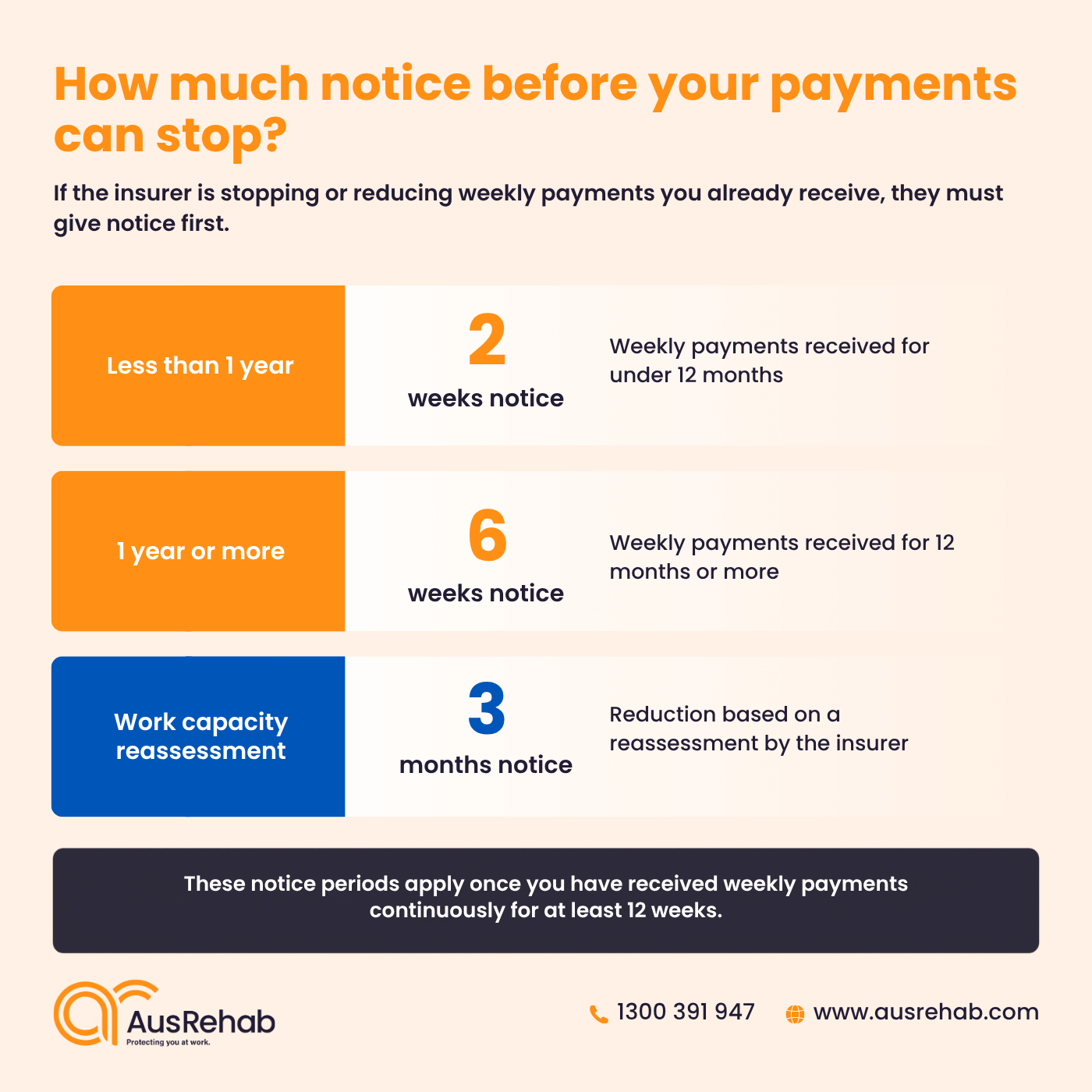
If you have already been receiving weekly payments, the insurer may need to give you notice before reducing or stopping those payments. Under section 80 of the legislation, these notice periods generally apply once you have received weekly compensation continuously for at least 12 weeks.
| Your Situation | General Notice Period |
|---|---|
| Weekly payments received for less than 1 year | 2 weeks |
| Weekly payments received for 1 year or more | 6 weeks |
| Reduction or discontinuation following a work capacity reassessment | 3 months |
Notice periods before weekly payments may stop under section 80.
The notice you receive should explain when the change will take effect. This gives you time to understand the decision and seek advice before the change to your payments occurs.
What Should You Do If You Receive a Section 78 Notice?
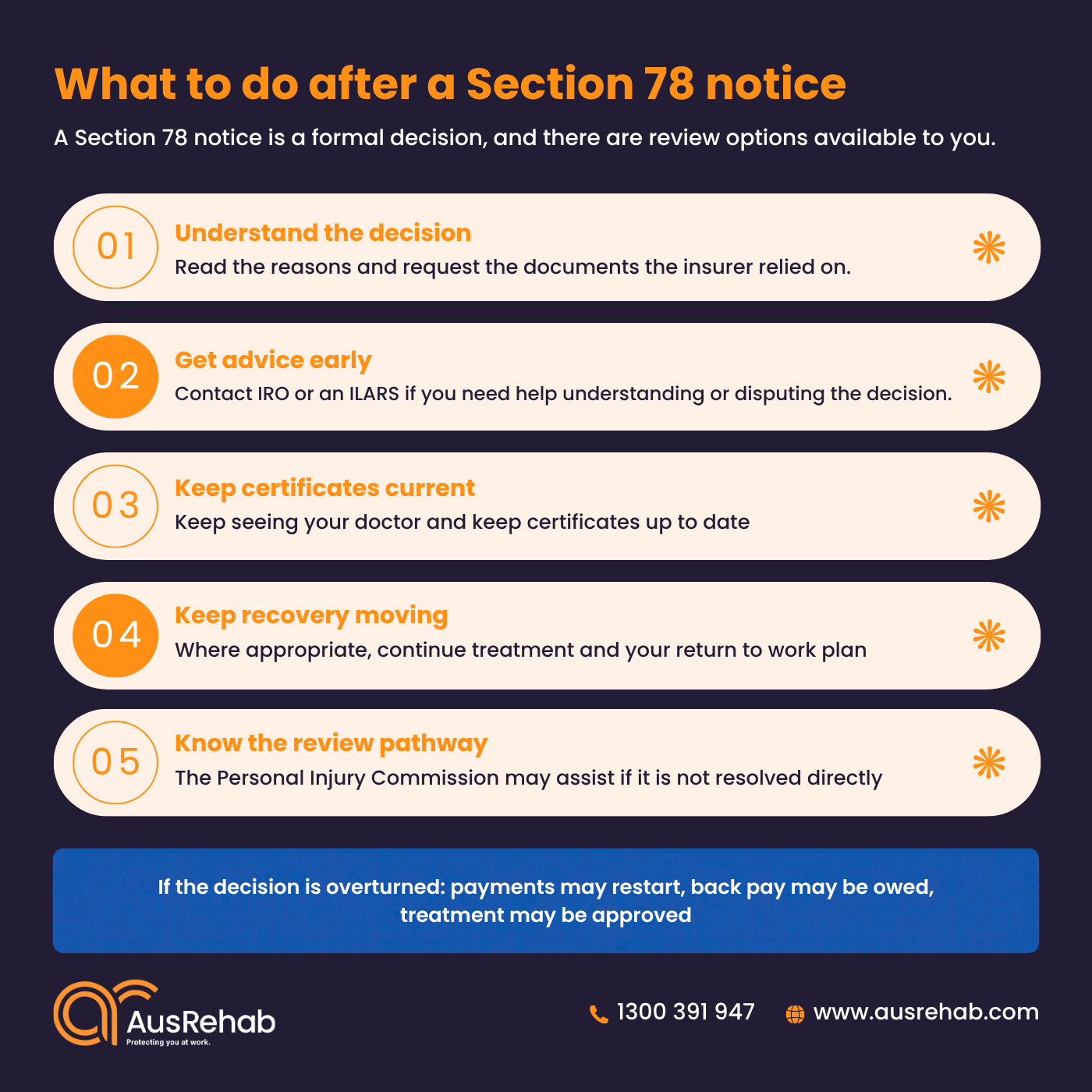
A Section 78 notice is a decision that may be challenged. The most important thing is not to ignore it. There are several practical steps you can take.
- Read the full notice carefully. Check what part of your claim has been disputed and when the decision will take effect.
- Get copies of the evidence. Make sure you have every medical report, assessment or other document the insurer relied on.
- Seek advice early. Different disputes can have different review processes and timeframes, so avoid leaving it until the last minute.
- Keep seeing your doctor. Continue attending relevant medical appointments and keep your Certificates of Capacity current where required.
- Keep your recovery moving. A dispute about your claim does not mean your recovery should automatically stop. Where possible, continue working with your treatment and rehabilitation team on your recovery and return-to-work goals.
💡Remember: Keeping your medical information current is especially important if the insurer’s decision is later changed or overturned.
Will It Cost You to Challenge a Section 78 Notice?
Eligible injured workers may be able to access free independent legal assistance without having to personally pay the legal costs.The Independent Review Office (IRO) operates the Independent Legal Assistance and Review Service (ILARS).
Approved lawyers can apply for ILARS funding to provide legal advice and, where appropriate, representation in workers compensation disputes. If you have received a Section 78 notice and are unsure what it means, getting advice early can help you understand:
- whether the decision can be challenged
- what evidence may be needed
- what review process applies
- whether any time limits affect your case.
Concerns about legal costs should not stop you from seeking information about your options.
What Happens If the Decision Is Overturned?
If the insurer’s decision is successfully challenged, the entitlements affected by that decision may be restored. Depending on what was disputed, this could include:
- weekly payments restarting
- payment of amounts owed for the period payments were stopped
- approval of reasonably necessary treatment
- other benefits connected with the claim.
The exact outcome will depend on the decision being challenged.
What Happens If the Dispute Isn't Resolved?
Many unresolved workers compensation disputes in NSW are dealt with by the Personal Injury Commission (PIC).
Before a matter reaches the Commission, there may be opportunities to request a review of the insurer’s decision or provide further evidence. You can read more about how matters progress on the Commission’s workers compensation dispute pathway page.
The appropriate pathway depends on the type of decision you have received. Free or funded legal assistance through the IRO may also be available to help you understand the dispute process.
How AusRehab Can Help
A Section 78 notice can affect more than your workers compensation paperwork.
It may affect your income, access to treatment, confidence and plans for returning to work. When that happens, it can be tempting to put your recovery on hold while the dispute is sorted out.
Where appropriate, your rehabilitation can continue moving forward. AusRehab can support injured workers by:
- helping you understand where your rehabilitation sits within your claim
- keeping your rehabilitation and return-to-work plan moving
- coordinating with your GP, employer and insurer through a medical case conference
- helping identify barriers affecting your recovery or return to work, including through a functional capacity evaluation
- directing you towards appropriate independent legal support where required.
If your payments or treatment have been affected and you are unsure what to do next, contact AusRehab. We can help you understand your rehabilitation options and continue working towards a safe and sustainable return to work.
Speak to the AusRehab team:
- 📞 1300 391 947
- 📧 office@ausrehab.com
- 🔗 Speak with our team today.
Frequently Asked Questions (FAQs)
How long do I have to challenge a Section 78 notice?
Time limits depend on the type of decision. Your notice must explain your review rights and how to ask for a review. Read it carefully and act quickly. The IRO or an approved lawyer can help confirm the deadline for your claim.
Is a Section 78 notice the same as a Reasonable Excuse Notice?
No. A Reasonable Excuse Notice is used earlier in a claim when an insurer has a reason not to start provisional weekly payments while it assesses the claim. A Section 78 notice is a formal decision to dispute all or part of a claim, or to reduce or stop benefits.
What is the difference between a Section 78 notice and a work capacity decision?
A work capacity decision is about how much work the insurer believes you can do and may affect your weekly payments. A Section 78 notice may dispute whether all or part of your claim is covered. The review processes are different, but both types of decisions can be challenged.
Do I have to stop treatment when I receive a Section 78 notice?
Not always. Keeping treatment and rehabilitation moving can be important for your recovery. AusRehab can help with your rehabilitation plan while the dispute is being sorted out.
Will challenging the notice affect my current payments?
Challenging a Section 78 notice does not automatically pause the insurer’s decision. Your payments may still be reduced or stopped as stated in the notice. If you succeed, payments may restart and back pay may be owed.
What happens at the Personal Injury Commission?
The Personal Injury Commission looks at the dispute and the evidence from both sides. An independent member then makes a binding decision. You may be able to get free legal help through an IRO-funded lawyer.
Can I still get help if my claim is for a psychological injury?
Yes. From 1 July 2026, some psychological injury claims follow new rules and review pathways in NSW. This can include an internal review and, in some cases, the NSW Industrial Relations Commission. Get advice about your own claim so you follow the right process.
Do I need a lawyer to challenge a Section 78 notice?
You do not have to use a lawyer, but getting legal advice can help. The IRO has approved lawyers who can apply for ILARS funding to cover legal costs if your matter qualifies. AusRehab can also point you towards independent legal support.