
Prefer to Listen? Play this quick summary instead!
🗒️ Does exercising help you return to work faster after an injury?
For many workplace injuries, it is true that physical activity can really assist you in maintaining your fitness, contributing to the process of healing, and enabling you to go back to your workplace sooner.
Recovering from a workplace injury often comes with one big question:
Should I rest completely, or should I keep moving?
Now, some may think that not doing anything at all until the pain subsides would be the best way to approach an injury. However, it is important to remember that while taking a break from activity is necessary, being inactive for extended periods of time can extend the recovery process.
Exercise after workplace injury is not all about going back to the gym and lifting weights for lots of workers. It is about performing movements that are safe and appropriate for the recovery without putting too much strain on the affected area. Exercising while injured can prevent loss of coordination. It can also increase self-confidence and help people be ready for a safe return to work after injury if performed under the direction of a medical professional or a workplace rehabilitation expert.
In this blog, you will learn why staying active matters, what happens when movement stops completely, and how the right rehabilitation approach can support your recovery.
What Happens When You Stop Moving Completely?
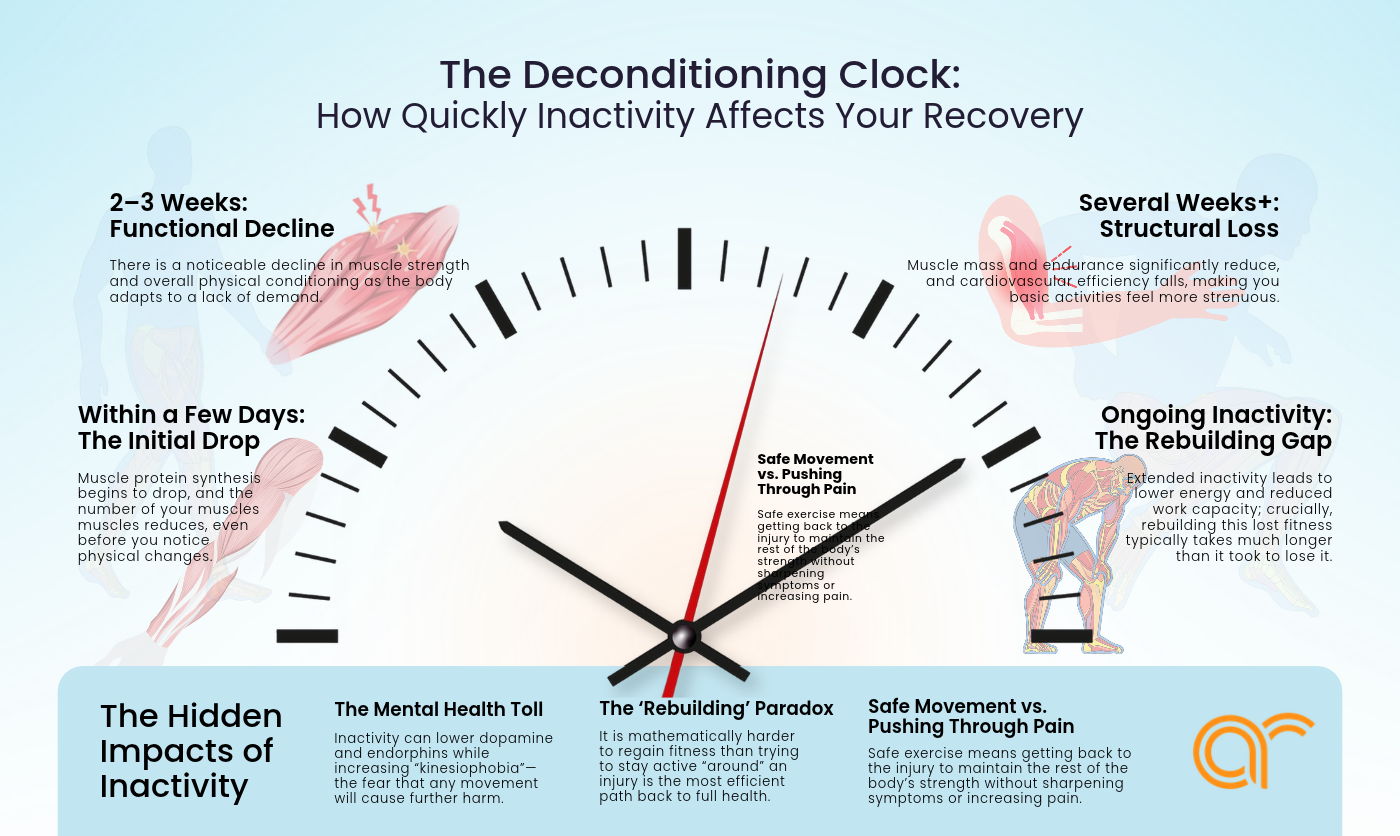
If you stop exercising completely, it may result in the loss of physical fitness. This can result in deconditioning, making it very difficult to go back to a regular life and start work again.
What is Deconditioning?
Deconditioning can defeat your muscle strength, stamina, movement, and physical experience. It takes place after long periods of inactivity.
It is natural for your body to need some time to recover after an injury. But when you stop moving for too long, your body simply gets used to being inactive.
Your muscles weaken, joints stiffen up, and cardiovascular fitness is impaired. Activities that were easy before, for example, climbing the stairs, walking long distances, or standing for a long time, become much harder.
This is why healthcare professionals define it as appropriate to encourage some safe movement, instead of complete immobility.
However, before understanding how these processes take place, it is first necessary to comprehend how adaptive changes occur.
Remember, adaptive changes in the body occur quite fast, especially after immobilization or long inactivity.
| Time Without Regular Activity | What May Happen |
|---|---|
| Within several days | Physical movement begins to decrease as the tissue sustains less use. |
| Around 2–3 weeks | After about two to three weeks, physical strength and overall conditioning can be reduced. |
| Several weeks | All through the following weeks, endurance, mobility, and cardiovascular fitness can continue to decline. |
| Prolonged inactivity | Inactivity can make daily living more difficult, and restoring fitness is often more difficult than maintaining it. |
Deconditioning is known to negatively affect physical well-being. The length of time it takes for deconditioning to occur will differ based on the type of injury, overall health of the individual, age of the individual, and the recommendations provided by the physician
The Impact on Mental Health
Recovery is not only physical. Being unable to work, exercise, or carry out regular activities can affect one’s confidence and emotions in the long run.
Many injured workers often develop a fear of movement (kinesiophobia). This means that, although they may have been prescribed some physical movements by healthcare professionals, they may still refrain from doing anything due to the fear that the injury may worsen with movement.
Over time, inactivity can lead to:
- Reduced confidence in your physical abilities.
- Increased stress about returning to work.
- Lower motivation during rehabilitation.
- Anxiety about re-injury.
- Reduced independence during everyday activities.
Physical rehabilitation and mental rehabilitation are usually linked. Being able to move freely makes it easier to adjust to a return to work after injury.
📚 Key Statistic:
As per Safe Work Australia’s Key Work Health and Safety Statistics Australia 2025 report, in the years 2023-24, a total of 146,700 serious compensation claims (for workplace injuries) were filed. This means nearly 400 claims were being made each day. That tells us how the need for rehabilitation and return to work support cannot be ignored.
Source: Safe Work Australia.
Why Staying Active Helps You Heal
Keeping fit while recovering from a workplace injury is not just about being able to improve workout capacity. The role of exercise is to complement the process of natural healing in the body and ensure the maintenance of physical capacity in connection with daily activities.
When movement is allowed in your injury, it will benefit you in many ways.
- Improves circulation: Gentle movements ensure better blood circulation, which means that oxygen and nutrients reach injured tissues more efficiently.
- Helps reduce stiffness: Exercising will help avoid stiffness of uninjured joints and muscles, thus improving the whole process of recovery.
- Maintains strength around the injury: While the injured body part should be protected, it is still possible to exercise other muscles in the body.
- Supports confidence during recovery: Minor changes in movement can help those recovering to develop trust in what their bodies are capable of safely doing.
- Prepares you for returning to work: Many occupations involve a variety of physical actions. This includes standing, walking, lifting, pulling, or repeated activities. Trying to maintain physical ability throughout the recovery will ensure it is easier to resume work.
In practice, safe movement means working with the injury and not trying to force oneself through pain.
Quick Tip:
If any exercise causes severe pain, increased swelling, or aggravation of the discomfort felt, stop doing the exercise and consult your workers’ compensation doctor immediately.
Rest vs Exercise: Which Is Better After an Injury?
⚠️ Should you rest or exercise after an injury?
Both techniques and approaches of exercise for active recovery are critical. A period of rest can be necessary during the phase of a subacute or acute injury. As the body heals, it often becomes appropriate to start moving safely to restore strength, mobility, and proper functioning.
It is commonly believed that rehabilitation involves making a choice between resting and physical activity. In fact, rehabilitation involves the combination of both means at different stages.
After some injuries, reducing movement can help protect injured tissues as well as reduce pain and swelling. However, inactivity during recovery can have negative consequences and could contribute to deconditioning.
The objective is not about total rest or constant exercise. The aim is to do things in terms of what is correct and according to the type of injury.
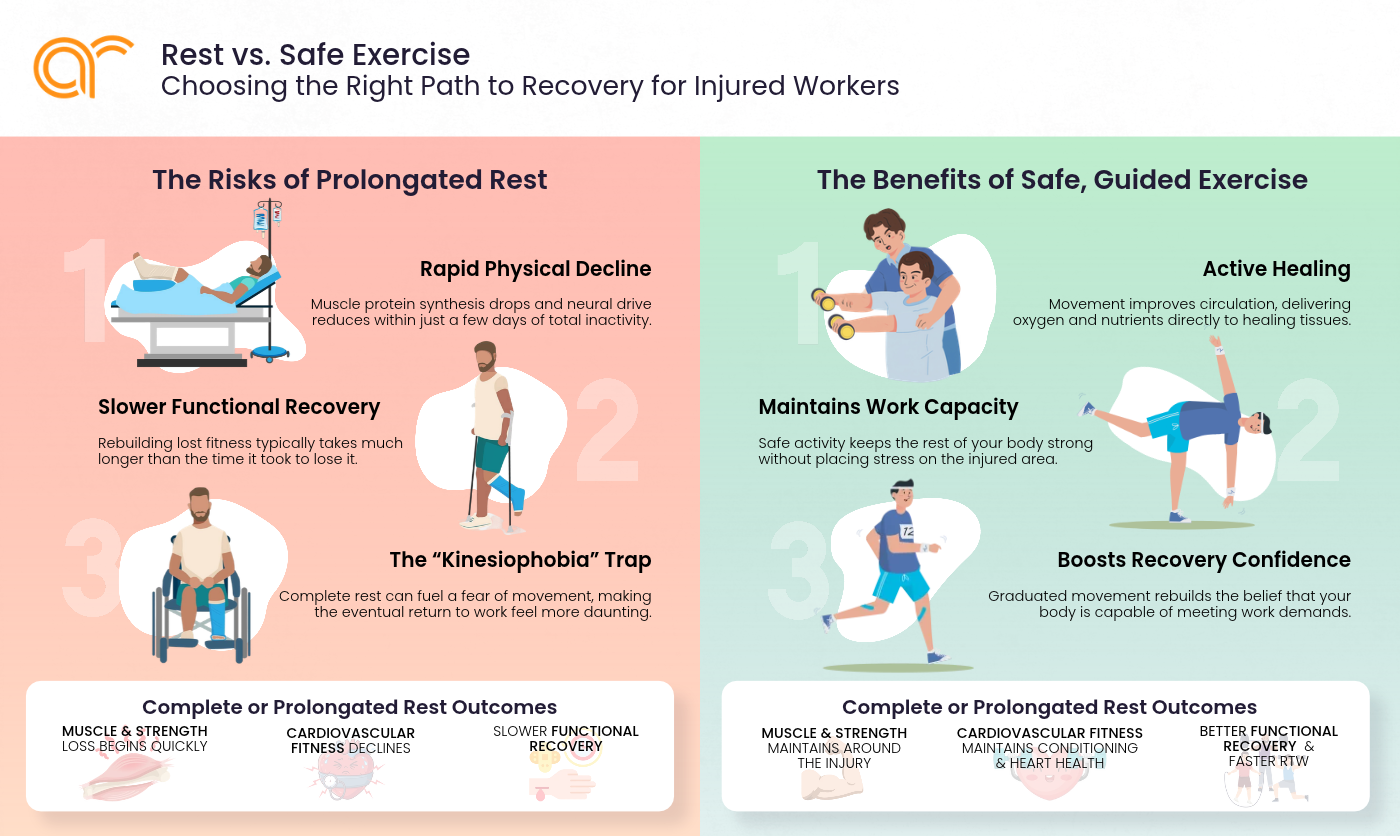
Understanding the role of prolonged rest and how it compares to safe guided movement can be helpful before determining what is best to do.
| Prolonged Rest | Safe Guided Exercise |
|---|---|
| May reduce pain during the early stage of some injuries | Helps maintain circulation and mobility |
| Muscle strength gradually declines | Helps preserve strength around the injured area |
| Cardiovascular fitness reduces over time | Maintains overall physical conditioning |
| Functional recovery may take longer | Supports gradual return to normal activities |
| Confidence in movement may decrease | Builds confidence before returning to work |
Recovery is very rarely about choosing rest or exercise alone. Most successful recovery programs consist of a combination of the right amount of rest and safe and proper movement. This is based on the needs of the recovering individual.
What Counts as Safe Exercise While You're Injured?
In general, safe exercise while injured is movement that aids your recovery without exacerbating the pain or unnecessarily stressing the affected body area. The important aspect is to understand that the proper exercise for the return-to-work plans is quite dependent on the injury condition. It also depends on the recovery stage and advice from the medical specialist.
Now, a fundamental principle used throughout the rehabilitation process is load management.
What is Load Management?
Load management refers to the process of progressively increasing physical activity so that injured tissues can be trained safely without overloading the tissues.
Some general principles include:
- Follow the exercise program prescribed by your treating practitioner.
- Progress gradually instead of increasing intensity too quickly.
- Change activities if there are signs of an increase in symptoms. Allow enough recovery period between exercise sessions.
- Consult your doctor if pain increases or is persistent after any activity.
Safe Exercise Examples by Injury Type
The best kind of exercise is the one that gets you moving but is safe for the area that has been hurt. Often, it is possible to exercise other parts of your body without hindering your recovery.
If You've Injured Your Legs, Feet or Ankles:
Injury of the limbs leads to restrictions in the ability to walk, run or remain standing for a long time, but can still allow exercising other parts of the body with reduced weight-bearing.
Examples may include:
- Seated upper-body resistance exercises
- Resistance band training
- Swimming or hydrotherapy where approved
- Gentle core strengthening
- Seated cardiovascular equipment
The suggested exercises help to remain fit while enabling recovery of the injured leg.
If You've Injured Your Arms, Shoulders or Upper Body:
An injury to the upper body can affect the ability to lift, carry an object, or reach overhead. In many cases, the treating practitioner may suggest modifying the plan to focus on the lower body instead of the affected upper body.
Suitable options may include:
- Walking
- Stationary cycling
- Lower-body strengthening exercises
- Balance training
- Gentle lower-body mobility work
Make sure to avoid any exercise that would place strain on the injured shoulder, arm, or wrist until cleared by a medical professional.
Exercises Suitable for Many Injuries
Based on your injury, different rehab programs can involve gentle exercises like:
- Walking
- Hydrotherapy
- Swimming
- Stretching
- Mobility exercises
- Modified yoga
- Clinical Pilates
- Light resistance exercises
These activities can help preserve your mobility and boost your confidence during your recovery process. Keep in mind that the most beneficial exercise therapy is the one that takes into account your individual injury and recovery process.
Tips to Help Your Body Recover Faster
Exercises represent only part of the recovery process. Your everyday habits might have a strong influence on your injury recovery process.
The rehabilitation checklist below may help your recovery along with the treatments given by your physician.
💡 Recovery Checklist:
✔ Remain physically active according to the advice from the healthcare professional.
✔ Gradually increase physical activity instead of going back to the same physical level immediately.
✔ Eat a healthy and nutritious diet with enough fruits, vegetables, whole grain foods, lean protein, and healthy fats to help tissue healing.
✔ Drink a lot of fluids.
✔ Have good quality sleep to assist recovery.
✔ Do your rehabilitation exercises as per your physician’s recommendations.
✔ Make sure that you go to your doctor for follow-up appointments and ask them about any issues you may have regarding recovery.
✔ It’s not productive to compare yourself to someone else while recovering.
Can Exercise Help You Return to Work Faster?
Returning to the job is more than healing injured tissues. It’s about having enough strength, endurance, coordination and confidence to carry out everyday work tasks safely.
Being active during recovery can expedite this process since it will provide you with the following benefits:
- Maintain physical conditioning.
- Improve confidence in movement.
- Reduce stiffness.
- Restore functional capacity.
- Prepare your body for work-related activities.
Being in touch with your workplace might also help you recover. Early planning regarding recovery between the employee, employer, treating doctor, and rehabilitation provider often betters the process of returning to the working routine.
As per the information provided by the Australian Rehabilitation Providers Association (ARPA), timely intervention and early rehabilitation in the workplace facilitate the recovery process.
What Does Returning to Work Actually Look Like?
Some people think they must be fully healed before coming back to work. In reality, this is not always necessary.
A phased return to work offers injured workers the opportunity to augment their tasks while still being treated for their injuries. This process ensures that the injured worker’s ability to work is gradually regained without the stress involved in extra workload.
For a return-to-work program to be successful, all parties involved must agree upon the plan.
The following table displays a regular framework associated with a staged return-to-work plan.
| Return-to-Work Component | Purpose |
|---|---|
| Medical capacity advice | Identifies activities that are currently safe to perform. |
| Suitable or modified duties | Matches work tasks to current physical capacity. |
| Graduated increase in hours | Builds endurance without overloading recovery. |
| Regular progress reviews | Restructures duties due to recovery progress. |
| Workplace modifications | Limits unnecessary strain on the body and decreases the chances of re-injuring oneself. |
The return-to-work process for a wounded worker can incorporate a number of elements to promote successful reintegration.
Safe Return-to-Work Plan
A successful return to work often includes:
- Clear medical guidance about your current capacity.
- Appropriate duties according to the level of recovery.
- Gradual increment in the workload.
- Continuous communication among all stakeholders.
- Adjustments in the workplace if necessary.
- Constant assistance from workplace rehabilitation services.
A worker rehabilitation service provider can also work with the employee’s employer, doctor, and insurer to ensure that they are all aiming at the same recovery and rehabilitation objective.
When Should You Get Professional Support?
Quick Answer: Seek professional advice before beginning or modifying any exercise regimen following a major workplace injury. You should also consult your caregiver when the pain worsens or when the recovery process slows down.
Recovering from an injury is hardly ever straightforward. Although remaining active helps the recovery.
Professional support becomes particularly important if:
- Your pain continues to increase instead of improving.
- You notice swelling, reduced movement or new symptoms after exercising.
- Your recovery has plateaued despite following your treatment plan.
- Your job involves heavy lifting, repetitive movements or physically demanding tasks.
- You’re recovering through a workers’ compensation or transport accident claim.
- You’re unsure whether you’re ready to return to work.
⚠️Note:
If your rehabilitation is in the context of a work injury claim, your rehabilitation provider can collaborate well with your doctor, employer, and insurer. This helps make sure you have a rehabilitation program tailored to your goals.
How Can AusRehab Help?
Recovering from a workplace injury is more than just treating the injured body part. The next steps include rebuilding one’s confidence, restoring work capability, and preparing for returning to one’s role.
AusRehab offers a professional injury rehabilitation program to help injured workers, employers, physicians and insurers collaborate in creating effective rehabilitation plans that facilitate long-term recovery.
Each rehabilitation program is individualised and based on medical prescriptions, current capabilities and specific job needs, rather than the one-size-fits-all approach.
Knowing how each rehabilitation service is supportive of one’s recovery process is useful when selecting the right option for rehabilitation services.
| Service | How It Supports Your Recovery |
|---|---|
| Personalised rehabilitation program | Develops a rehabilitation plan based on your injury, goals and job requirements. |
| Functional Capacity Evaluation | A detailed study that evaluates individual functioning level for safe employment. |
| Return-to-work planning | An action plan that develops a stepwise return to work. |
| Ergonomic and workplace assessment | Identifies workplace adjustments that may reduce the risk of re-injury. |
| Rehabilitation support | Monitors your progress and adjusts your rehabilitation plan as your capacity improves. |
The service utilizes a portfolio of rehabilitation services to help clients recover, increase their ability to work, and return to work.
Core Insight:
The main point is the fact that successful rehabilitation does not mean that the injured person returns to the workplace very quickly. What is more important is safety, confidence, and the ability to work in the long run.
Key Takeaways
Rehabilitation from a workplace injury doesn’t necessarily mean one should stop moving altogether. For a lot of injuries, exercise that is safe and supervised is an irreplaceable part of the recovery process. This indeed is quite essential for returning to normal life.
Remember these key points:
- Complete rest is not always the fastest path to recovery.
- Deconditioning can occur after prolonged inactivity and may slow rehabilitation.
- Safe exercise can help maintain strength, mobility and confidence during recovery.
- Rehabilitation programs should always be tailored to your injury and guided by your treating healthcare professional.
- A graded return to work allows many injured workers to safely resume suitable duties before they have fully recovered.
- Early rehabilitation and coordinated workplace support can improve return-to-work outcomes.
Need Support Returning to Work After an Injury?
Trying to get back to normal after a workplace injury is not easy, but some people can help you.
If you do not know what sort of exercise to follow, need assistance to plan your return to work, or need someone to liaise with your employer and medical team, AusRehab can provide the right solution for you.
Connect with the team at AusRehab and find out about rehabilitation services to develop an effective, personalised strategy for your recovery.
Frequently Asked Questions (FAQs)
Can you exercise while injured?
Yes. Safe exercises as per recommendations of your medical professional can help retain strength, flexibility and condition during recovery. They should never require overcoming pain or doing anything that can worsen the condition.
Is it better to rest or exercise after an injury?
Both approaches have their place in recovery. Temporary rest may be needed in the early stages of recovery, but safe movement is deemed to be essential to recovery as the healing process progresses.
How long should you rest after an injury?
The duration of rest depends very much on the type and the severity of the injury. Your concerned doctor will be able to advise you on when the time has come to gradually start your activity.
Does staying active help recovery?
In many cases, staying active after injury can be useful for recovery from injuries as it contributes to strength, mobility, and circulation. In fact, it also helps with confidence and comes with reduced negative effects caused by immobility.
What exercise is safe while injured?
The safest exercises differ depending on the type of injury you sustain. For example, someone may be good to walk and partake in an aqua therapy program. Others might need different exercises or rehabilitative activities.
Can I exercise with a workers' compensation injury?
Yes, if the exercises are a part of your treatment or rehabilitation. Your healthcare worker and rehabilitation professional can assist in making sure that your exercises fit in your recovery plan.
When should I start exercising after an injury?
This is determined by your diagnosis and recovery status. In many situations, this activity will slowly begin to be incorporated into your daily routine as soon as the healthcare provider provides the go-ahead for post-injury exercises.
Can I return to work before I fully recover?
Usually, yes. Very often, workers are able to return under the graded return-to-work program. This means that they can have assignments that match their current physical capabilities, and hence, return to their workplace.
What happens if you stop exercising after an injury?
Being inactive for long periods of time can lead to deconditioning, loss of strength, drop in endurance, and loss of motivation to return to work. These factors will complicate the rehabilitation process further.
How can I return to work faster after an injury?
In order to return to work sooner after sustaining an injury, it is necessary to stick to your rehab program and remain physically active as much as possible. It is also important to attend your rehab appointments and keep your employer up to date about your recovery progress.
⚠️ Disclaimer: This article provides general information only and should not replace personalised medical advice. Always follow the recommendations of your GP, physiotherapist, exercise physiologist or other treating healthcare professional regarding exercise and recovery after a workplace injury.