
Prefer to Listen? Play this quick summary instead!
Quick Answer
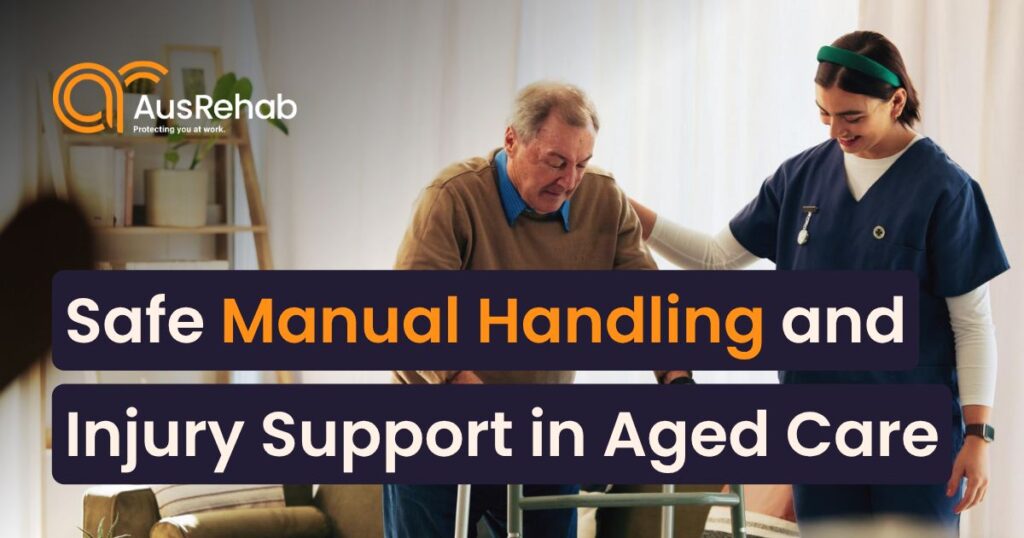
Manual handling in aged care means using your body to lift, lower, push, pull, carry, move, hold, support, or restrain a person or object. A task becomes hazardous when it involves repetitive movement, sustained or sudden force, awkward posture, or other risk factors. Safe Work Australia describes these as key features of hazardous manual tasks.
Years without injury do not always mean a technique is safe. It may only mean your body has been carrying the strain quietly. That is the problem with manual handling in aged care. Many injuries build over time through repeated bending, twisting, reaching, pushing, pulling, and supporting. One rushed transfer or awkward reach may only be the final trigger.
Safe Work Australia identifies people handling, laundry work, cooking tasks, and similar duties as common hazardous manual tasks in healthcare and social assistance. These tasks can place stress on the body and contribute to injury, especially when they involve force, repetition, awkward posture, or sudden movement.
This guide explains what manual handling in aged care means, when it becomes hazardous, how to perform safer transfers, and what to do after an injury at work.
What Is Manual Handling in Aged Care?
Manual handling in aged care includes many daily tasks. SafeWork NSW explains that manual tasks involve using the body to lift, lower, push, pull, carry, move, hold, or restrain a person, animal, or thing. It also notes that hazardous manual tasks in NSW can harm workers when they create risk to health and safety.
Safe handling is not only about strong arms or “good technique.” It is about planning the task, checking the person’s capacity, using suitable equipment, setting up the space, communicating clearly, and stopping when the task exceeds your training or the care plan. That is why safe manual handling aged care practices must consider the person, the worker, the environment, the equipment, and the task.
Everyday Manual Handling Tasks in Aged Care
Not every manual task is hazardous. Many tasks are part of normal daily care.
Common examples include:
- Bed transfers
- Wheelchair transfers
- Wheelchair to toilet transfers
- Car transfers
- Repositioning in bed
- Shower chair assistance
- Walking support
- Domestic cleaning
- Laundry handling
- Meal preparation
- Moving waste bags
- Handling mobility aids
These tasks may feel ordinary but routine does not always mean low risk as familiar tasks can lead to shortcuts. A task can become unsafe when the worker reaches too far, twists, rushes, works alone, skips equipment, or helps beyond the care plan.
When Manual Handling Becomes Hazardous
Hazardous manual tasks that aged care workers face often involve more than weight.
A task may become hazardous when it includes:
- Repeated bending
- Twisting during a transfer
- Supporting sudden loss of balance
- Pushing a wheelchair over thick carpet
- Moving a resident up the bed without the right aid
- Working in a cramped bathroom
- Handling laundry or domestic tasks for long periods
WorkSafe WA notes that manual tasks in healthcare and social assistance can cause injury, with people handling being a major contributor. This is covered in its guidance on manual tasks in healthcare and social assistance.
📖 What is a hazardous manual task?
A hazardous manual task is a task that places extra strain on the body because of force, repetition, awkward posture, sudden movement, or the way the task is performed. In aged care, this can happen during a resident transfer, a hoist setup, a wheelchair movement, or a domestic task in a client’s home.
Why Manual Handling Injuries Build Up Before You Notice Them
Many aged care manual handling injuries are not caused by one dramatic event. They often build through repeated stress. Each task may feel manageable, but the combined strain can be significant.
Safe Work Australia explains that musculoskeletal disorders can have complex causes. Physical hazards and psychosocial hazards can interact and increase risk. That means the body may be affected by more than lifting alone. Fatigue, rushing, understaffing, poor layout, unsuitable equipment, stress, and unpredictable behaviour can all add to injury risk.
What Are Musculoskeletal Injuries?
Musculoskeletal injuries that aged care workers experience can affect the muscles, tendons, ligaments, joints, nerves, discs, or the spine.
These injuries may feel like:
- Lower back pain
- Shoulder strain
- Neck stiffness
- Wrist pain
- Elbow pain
- Knee pain
- Hip pain
- Tingling or numbness
- Reduced strength
- Pain that worsens across a shift
An aged care worker’s back injury is common because many care tasks involve bending, reaching, pushing, and supporting body weight. SafeWork NSW lists muscular stress from hazardous manual tasks and patient handling as a key risk in its aged care industry guidance.
Why Gradual Wear and Tear Matters
Pain is not always immediate. A worker may develop symptoms after weeks or months of repeated strain. This can make it harder to identify the exact task that caused the injury.
Gradual injuries often come from patterns such as:
- Reaching across beds
- Twisting during transfers
- Pulling residents up the bed without a slide sheet
- Pushing heavy wheelchairs over thick carpet
- Supporting a person who suddenly loses balance
- Working from low chairs or beds
- Repeating domestic tasks without posture changes
These patterns matter because “no pain today” does not mean “no risk today.”
Why “Just Helping” Can Become Risky
Aged care workers often push through because they care deeply about the people they support.
They may think:
- “It will only take a second.”
- “The resident needs help now.”
- “Everyone else is busy.”
- “I have done this before.”
That pressure is real, but can also be dangerous. Pushing through can turn a manageable task into a hazardous one. It can place the worker and the person receiving care at risk.
47.6%
Body stressing injuries account for nearly half of all serious workers compensation claims among nursing, care, and support workers — every year since 2012-2013.
(Source: Safe Work Australia WHS Profile, Nursing & Care Workforce)
WHS Legal Obligations in NSW: What Employers and Workers Must Do
Manual handling safety is not only a personal technique issue. It is also a work health and safety issue.
SafeWork NSW states that workplaces must put measures in place to protect workers from injuries and disease caused by hazardous manual tasks. The NSW Code of Practice for Hazardous Manual Tasks provides guidance on identifying hazardous tasks, assessing risks, controlling risks, and reviewing controls.
For aged care managers and team leaders, this matters because a manual handling policy aged care document is not enough on its own. Workers need training, suitable equipment, supervision, consultation, reporting systems, and real controls that match the work.
Employer and Worker Responsibilities Under WHS Law
| Employer Obligations | Worker Obligations |
|---|---|
| Provide manual handling training that reflects real workplace duties. | Take reasonable care for your own safety and the safety of others. |
| Eliminate or minimise hazardous manual handling risks. | Follow safe work procedures and reasonable instructions. |
| Provide suitable equipment and mobility aids. | Use equipment and mobility aids as trained. |
| Consult workers about safety risks and workplace hazards. | Participate in training and risk assessments. |
| Conduct and document a manual handling risk assessment when required. | Report hazards, pain, near misses, and incidents early. |
| Review controls and safe work procedures regularly. | Stop and ask for help when a task feels unsafe. |
Under NSW WHS law, both employers and workers share responsibility for reducing manual handling risks. Workers should stop and ask for support when a task feels unsafe, and employers must respond appropriately.
The 5 P’s of Safe Manual Handling
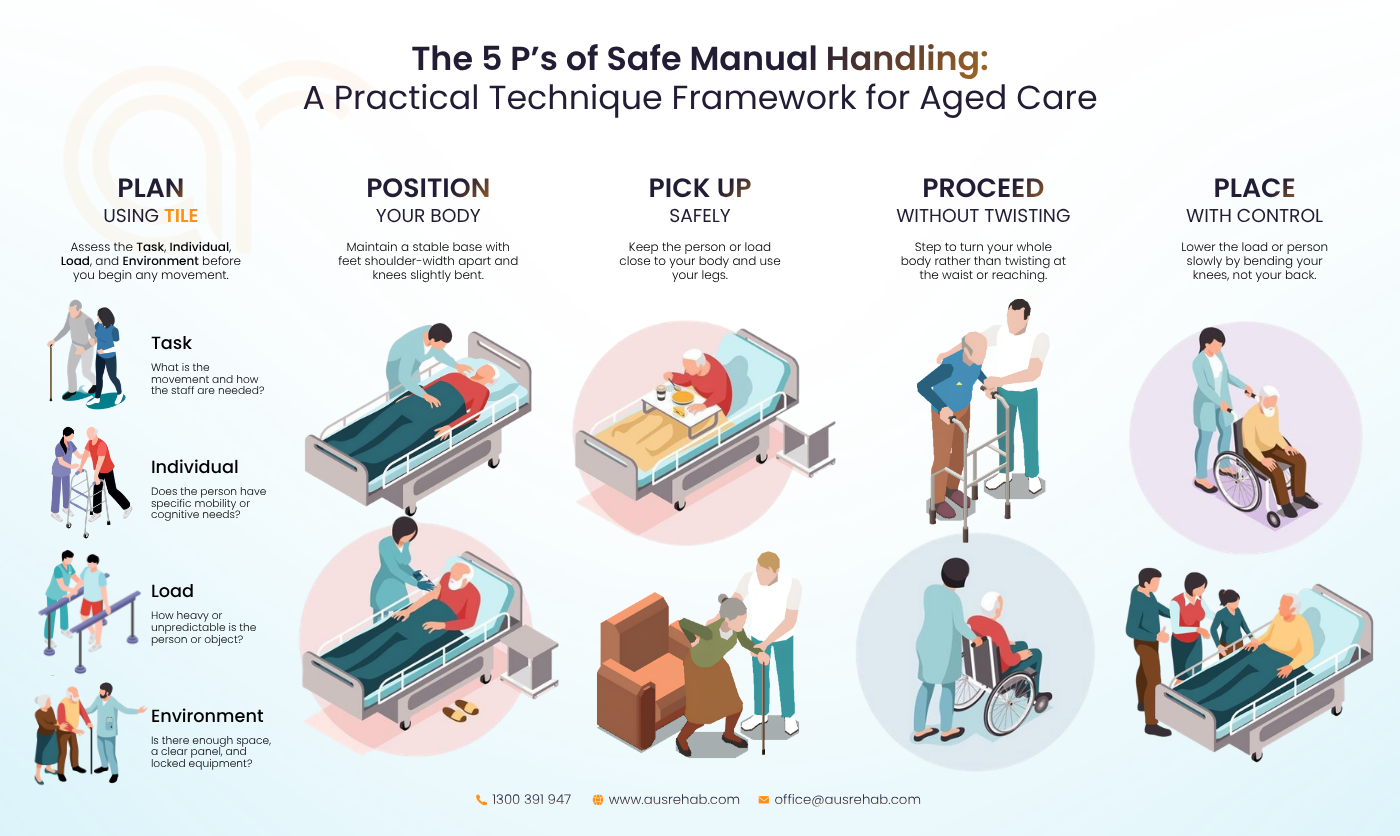
The 5 P’s help aged care workers slow down, assess the situation properly, and reduce the risk of preventable injury during everyday tasks. They support safer choices before, during, and after movement.
The 5 Ps of Safe Manual Handling
| Step | What It Means | Practical Reminder | Common Mistake |
|---|---|---|---|
| Plan | Assess the task using TILE. | Think about the task, person, load, and environment. | Skipping the assessment because the task feels routine. |
| Position | Set your body up safely. | Keep feet stable, knees soft, and body close. | Reaching too far or standing off balance. |
| Pick | Lift or assist safely. | Keep the load close and use your legs. | Lifting with the back instead of the legs. |
| Proceed | Move without twisting. | Step to turn and keep movement smooth. | Twisting while carrying or transferring. |
| Place | Lower or position safely. | Bend knees and maintain control. | Dropping quickly or overreaching at the end. |
💭 What Is TILE?
TILE means:
- Task: What are you doing?
- Individual: Who is involved?
- Load: What or who is being moved?
- Environment: Where is the task happening?
In aged care, TILE must include the person receiving care. Their strength, pain, mobility, cognition, fatigue, behaviour, and understanding can change the safest method.
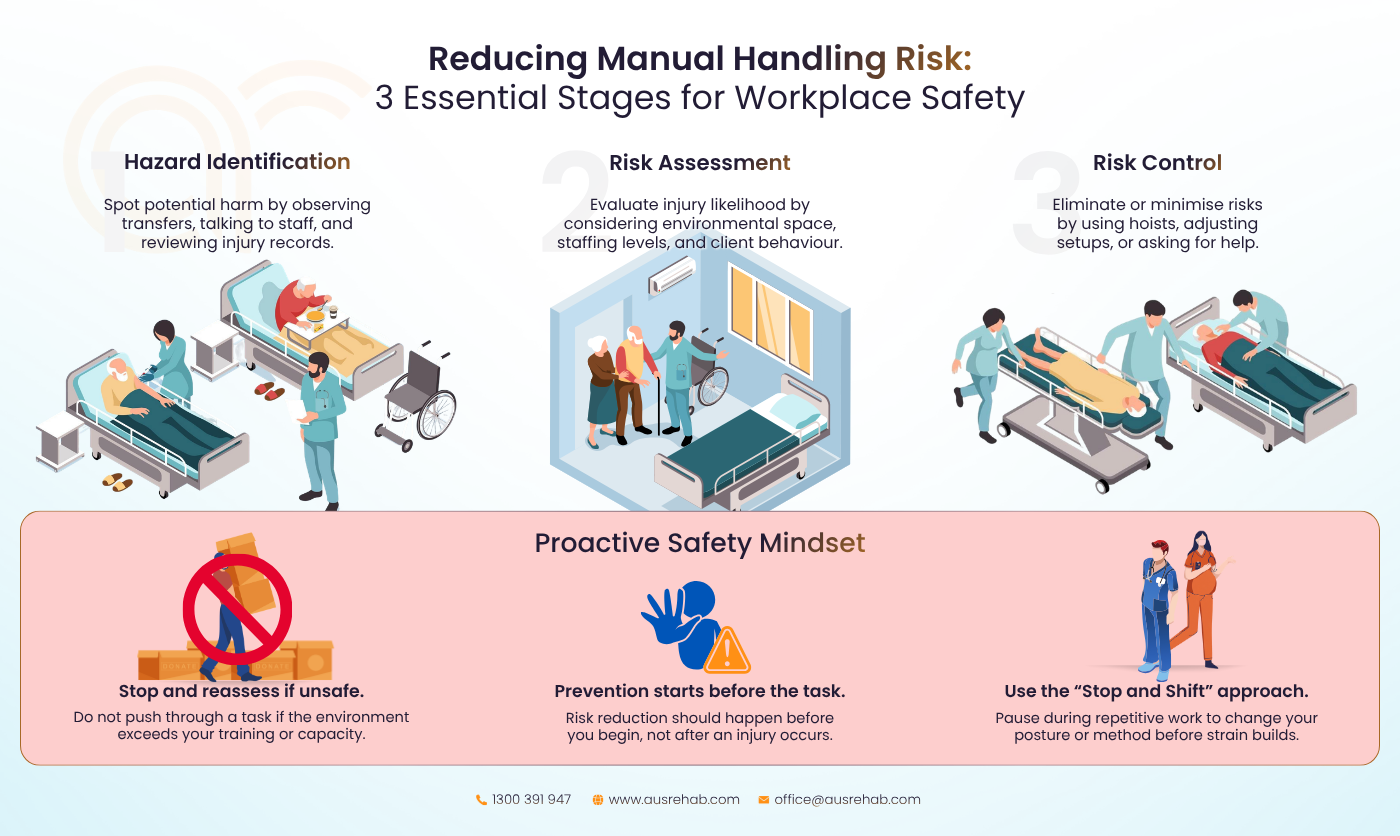
The 3 Stages of Reducing Manual Handling Risk
A manual handling risk assessment should be practical. It should reflect the real task, the real worker, and the real environment.
| Stage | What It Means | Aged Care Example | Who Is Responsible |
|---|---|---|---|
| Hazard Identification | Spot anything that could cause harm before the task begins. | Observe transfers, check equipment, review injury records, identify unsafe layouts. | Worker and supervisor |
| Risk Assessment | Assess how likely injury is and how serious it could be. | Consider space, staffing, client mobility, behaviour, and equipment availability. | Employer and WHS or OHS team |
| Risk Control | Remove or reduce the risk wherever possible. | Use hoists, adjust setup, change technique, provide assistance, improve workflow. | Employer has primary responsibility |
Safe Patient Transfers in Aged Care
Safe patient transfers in aged care should start before movement begins. Before any transfer, check the care plan, person’s current ability, space, equipment, and your own position.
Bed to Wheelchair Transfers
Before the transfer:
- Position the wheelchair close to the bed
- Lock the brakes
- Move footrests out of the way
- Help the person sit at the edge of the bed
- Give them time if they feel dizzy
- Stand close with a stable base
- Use clear verbal cues
- Step and pivot instead of twisting
- Lower the person with control
Do not lift under the arms. This can injure the person and strain your own back or shoulders.
Wheelchair to Toilet Transfers
Wheelchair to toilet transfers can be difficult because bathrooms are often tight.
Before the transfer:
- Lock the brakes
- Check for water on the floor
- Use rails where available
- Keep the person’s feet stable
- Give one instruction at a time
- Avoid twisting
- Follow the care plan
If the care plan says two workers or equipment are required, do not attempt the transfer alone.
Car Transfers
For car transfers:
- Park on level ground
- Move the seat back
- Clear trip hazards
- Ask the person to back up until they feel the seat
- Help them sit with control
- Assist one leg at a time if needed
- Secure the seatbelt
Do not pull a person by the arm into the car. This can injure them and place strain on your shoulder and back.
Wheelchair Curbs and Obstacles
Wheelchair movement can create serious strain, especially over curbs, thick carpet, soft ground, ramps, and uneven surfaces.
For curbs:
- Approach straight.
- Keep both hands on the handles.
- Use the tipping bar if trained.
- Move slowly.
- Keep communication clear.
- Avoid jerky movements.
Going down a curb backwards may give more control in some trained methods. Follow your organisation’s procedure and training.
Hoisting in Aged Care
Hoisting in aged care can reduce manual handling risk when used correctly.
Before using a hoist:
- Check the care plan
- Confirm the correct sling
- Inspect the sling, straps, and loops
- Clear the space
- Explain the process
- Stop if the person becomes distressed
- Use two workers if required
A hoist is only safe when the worker is trained and the equipment is suitable for the person and task.
What to Do After a Manual Handling Injury in Aged Care
A manual handling injury should be reported early. Do not wait until the pain becomes severe. Early reporting helps create a clear record. It also helps employers review the task, provide support, and reduce risk for others.
What to Do After a Manual Handling Injury at Work
| Step | Action | Why It Matters |
|---|---|---|
| 1 | Stop the activity and remove yourself from further risk. | Continuing the task can worsen the injury and increase risk to both you and the client. |
| 2 | Report the incident to your employer or supervisor. | Early reporting creates a formal record of the injury. |
| 3 | See your GP or treating doctor. | Medical assessment helps identify the extent of the injury and begin treatment. |
| 4 | Ask about a Certificate of Capacity if work is affected. | This supports treatment planning and return-to-work discussions. |
| 5 | Start treatment and rehabilitation early. | Early support can improve recovery outcomes and reduce long-term issues. |
| 6 | Ask about workplace rehabilitation and return-to-work support. | Structured support can help you return to work safely and gradually. |
| 7 | Keep copies of all paperwork. | Documentation can help avoid delays or confusion during the claim process. |
Is Aged Care Manual Handling Covered by Workers Compensation?
A manual handling injury may be covered by workers compensation when work contributed to the injury.
Workers compensation in NSW is generally a no-fault system. This means a worker usually does not need to prove that the employer intended harm. The focus is on the connection between work and the injury.
Support may include treatment, income support, rehabilitation, suitable duties, and return-to-work planning. A treating doctor, employer, insurer, and rehabilitation provider may all be involved.
What Does a Return to Work Coordinator Do After a Manual Handling Injury?
A return-to-work coordinator helps organise communication between the worker, employer, doctor, insurer, and rehabilitation provider. The goal is to help the worker recover safely while staying connected to suitable work.
How AusRehab Supports Aged Care Workers Through Injury and Recovery
AusRehab supports aged care and community care workers recovering from manual handling injuries with practical rehabilitation support.
Our manual handling training focuses on safer movement during everyday care tasks. It covers lifting, pushing, carrying, risk identification, posture, repetitive movement, injury prevention, and practical demonstrations that workers can apply on the job.
When an injury affects work capacity, our functional capacity evaluations assess key physical demands such as lifting, carrying, squatting, pushing, pulling, and task tolerance.
We can also complete workplace assessments to compare a worker’s current capacity with available duties and recommend suitable tasks, safe upgrades, and graded hours.
Our return-to-work plans help workers, employers, doctors, and insurers move in the same direction. These plans support safe workplace adjustments and sustainable recovery at work.
For injuries that affect daily life outside the workplace, our occupational therapists can complete ADL assessments. These assessments look at how an injury affects personal care, home tasks, mobility, and daily routines, then help guide rehabilitation planning.
Support After a Manual Handling Injury
If a manual handling injury has taken you away from the work and people you care about, the next step should feel clear.
The sooner you get the right support, the better your recovery tends to look. Practical rehabilitation, proper assessment, and return-to-work planning can help you rebuild confidence and move forward safely.
If you are unsure where to start, a conversation with us can help you understand your options.
Frequently Asked Questions (FAQs)
What is manual handling in aged care?
Manual handling in aged care means using your body to lift, lower, push, pull, carry, move, hold, support, or restrain a person or object. It includes resident transfers, repositioning, wheelchair handling, toileting support, domestic tasks, and equipment use.
What are the 5 P’s of manual handling?
The 5 P’s are Plan, Position, Pick, Proceed, and Place. They help workers slow down, assess the task, set up safely, move without twisting, and lower or position with control.
What is the most common manual handling injury in aged care?
Back injuries are common because aged care tasks often involve bending, reaching, twisting, pushing, and supporting body weight. Shoulder, wrist, neck, knee, and hip injuries are also common forms of musculoskeletal injury.
Does my employer have to provide manual handling training in aged care?
Employers must manage hazardous manual task risks. This includes providing safe systems of work, suitable equipment, consultation, and training that helps workers perform tasks safely. SafeWork NSW states that workplaces must put measures in place to protect workers from hazardous manual task injuries.
How can aged care workers reduce manual handling risk?
Workers can reduce risk by following the care plan, checking the environment, using suitable equipment, communicating clearly, avoiding twisting, asking for help, reporting hazards, and stopping when a task feels unsafe or exceeds training.
How long does it take to recover from a manual handling injury?
Recovery time depends on the injury, treatment, work demands, early reporting, and rehabilitation support. Some workers recover quickly. Others need modified duties and a gradual return-to-work plan.
What should I do after a manual handling injury at work?
Stop the task, report the incident, seek medical care, ask about a Certificate of Capacity if work is affected, keep records, and ask about workplace rehabilitation or return-to-work support.
How does AusRehab help with manual handling injuries?
AusRehab helps through manual handling training, workplace rehabilitation, functional capacity evaluations, ADL assessments, ergonomic support, and return-to-work planning. The focus is practical support that matches the worker’s capacity, duties, and workplace demands.