
Prefer to Listen? Play this quick summary instead!
“It comes with the territory“, but does it really have to?
Most aged care workers who get hurt at work assume the injury was completely unavoidable. They assume that strained shoulders, aching lower backs, and overwhelming mental stress are just the inevitable price of doing this type of work.
This assumption is incorrect. These injuries are predictable, they follow clear patterns, and in many cases, they’re entirely preventable.
⚡ Quick Answer
Aged care workers experience some of the highest rates of workplace injury in Australia, but many of these injuries are preventable. If you’re injured at work, you may be eligible for workers compensation, including treatment, income support, and rehabilitation.
If these injuries are highly preventable, we must ask why so many dedicated workers continue to get hurt. Furthermore, we need to understand exactly what happens to a worker when an injury forces them off the floor.
The aged care sector is physically demanding, emotionally draining, and structurally complex. Workers are constantly balancing the immediate needs of vulnerable residents against strict operational timelines and staffing challenges.
This environment creates the perfect storm for physical and psychological harm. But accepting this harm as a standard part of the job is a dangerous mindset that ultimately hurts the very people trying to provide the care.
Aged Care Is One of Australia's Most Injury-Prone Industries
Aged care workers face a disproportionately high rate of workplace injury compared to most other modern industries, particularly in roles involving manual handling and direct patient care.
The statistics surrounding an aged care worker injury are staggering. In just a three year period to 2014, more than 12,000 workers compensation claims were lodged within the aged care sector alone, according to historical data from SafeWork NSW.
This high volume of claims highlights a systemic vulnerability within the profession. The demand for aged care services is growing rapidly, and with it, the intense physical pressure placed on workers.
Alongside this general population growth, there’s a sharp increase in the prevalence of complex neurodegenerative diseases. By the year 2050, almost 900,000 Australians are expected to be living with dementia, according to Alzheimer’s Australia.
This dramatic rise in cognitive impairment fundamentally changes the nature of daily care work. It increases the complexity of routine tasks and significantly elevates the risk of harm to the staff providing that care.
When we look closely at the data from regulatory bodies, it becomes very clear exactly where these injuries are occurring on the body. Physical trauma is heavily concentrated in the major load-bearing joints and the structural columns of the body. The most frequent physical injuries are sprains and strains, primarily affecting the back, shoulder, and neck.
The infographic below breaks down the most frequent injury locations –
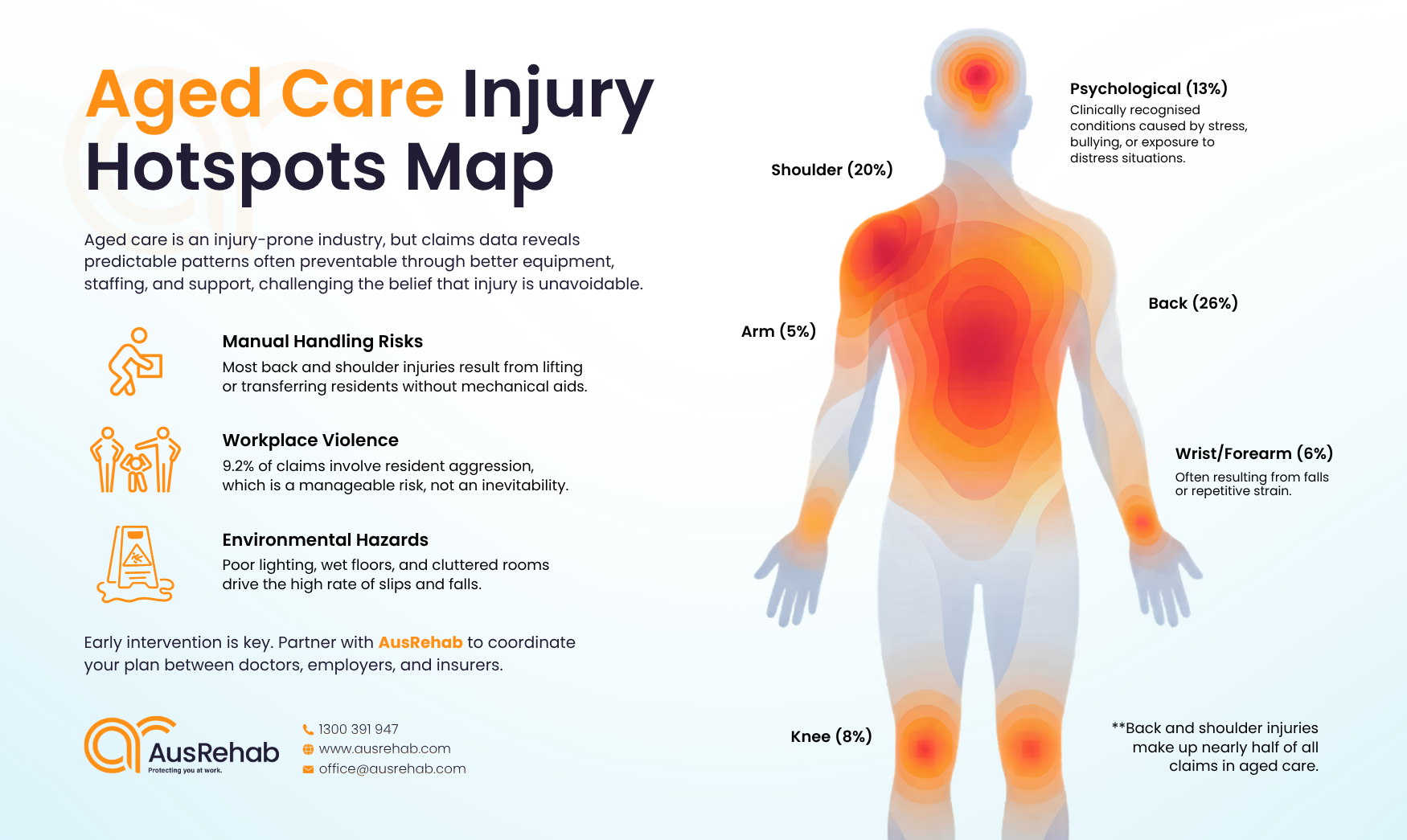
The data from the WorkSafe Victoria injury hotspots data is exceptionally clear. Back and shoulder injuries dominate the claims landscape. This statistical reality proves that the physical deterioration of staff isn’t random. It’s the direct result of the physical movements required to perform the job daily.
Understanding the most common workplace injuries in Australia is the first step in recognising why the aged care sector requires specialised prevention strategies.
The Most Common Injuries and What's Actually Causing Them
To prevent harm, we must look past the symptoms and understand the root causes of the most prevalent injuries. The causes of manual handling injuries experienced by aged care staff are deeply embedded in their daily routines.
These injuries rarely result from a single freak accident. Instead, they’re usually the culmination of repeated and unsafe physical strain over weeks, months, or even years of dedicated service.
Lifting and Assisting Residents
The single biggest source of physical injury in the aged care sector is the direct manual handling of residents.
Activities such as lifting, supporting, and moving residents or heavy equipment like beds and wheelchairs account for approximately 58% of all injuries. Back injuries make up 26 percent of claims, and shoulder injuries make up 20 percent. The underlying cause for almost all of these claims is hazardous manual handling.
💡 What is manual handling?
Manual handling means moving, lifting, or supporting another person using your body rather than a mechanical aid.
When a worker attempts to manually bear the weight of another adult human being, the physical forces generated are immense. This extreme pressure leads to microscopic tears in the spinal structures that accumulate over time.
Mechanical aids like hoists, slide sheets, and adjustable trolleys exist specifically to eliminate manual lifting and reduce this risk. However, these crucial safety devices aren’t always available or used correctly.
Workers often push through the pain and skip safety protocols because there simply aren’t enough staff members on the floor to assist them safely, or the correct equipment isn’t close at hand.
This is why comprehensive manual handling training is so critical. Proper training emphasises that the use of mechanical aids is a non-negotiable safety requirement, and it helps you understand the different categories of manual handling hazards you face daily.
Pushing and Pulling Equipment
While lifting residents is the primary hazard, the continuous manipulation of heavy equipment serves as a major secondary cause of severe musculoskeletal deterioration.
Aged care workers spend a significant portion of their shifts pushing medication trolleys, manoeuvring weighted wheelchairs, and repositioning specialised bariatric beds.
The physical exertion required to move these heavy items adds up significantly over the course of a long shift. Repeated strain placed on the same muscle groups and joints, especially the shoulders, wrists, and knees, is highly cumulative.
Navigating a heavy medication trolley over poor floor surfaces, tight corridors, and bumpy doorways actively worsens this physical strain.
The fix isn’t overly complicated. It requires better, lighter equipment, better facility design, and ensuring enough workers are available to safely perform resident transfers and share the load.
Slips, Trips, and Falls
The third major category of physical trauma involves environmental hazards that cause workers to lose their balance and fall.
When examining facility hazards such as slips, trips and falls, aged care incidents are responsible for a significant number of injuries within the sector. Cluttered pathways, slick floors, and poor lighting frequently lead to slips, trips, and falls.
These events are rarely freak accidents. Instead, they’re the highly predictable results of working in understaffed and under-resourced environments where proper housekeeping can’t be maintained.
These incidents frequently lead to traumatic injuries, including bruises, cuts, and fractures. Injuries from falls frequently affect knees (8%), forearms and wrists (6%), and arms (5%).
It’s also important to note that the aged care workforce itself is ageing. Falls are often significantly more severe for older workers, who make up a very large proportion of the dedicated aged care workforce.
Workplace Violence Is Not Part of the Job
One of the most complex and distressing hazards in the sector is occupational violence. Facing workplace violence is a daily reality for many aged care staff, but it must never be accepted as normal.
According to data from SafeWork NSW, workplace violence makes up approximately 9.2 percent of all workers compensation claims in the aged care industry. The frequency of serious claims due to assault in this sector is 6.5 times higher than in other occupations.
This isn’t a small number, and the frequency of these violent incidents is growing steadily as the proportion of residents living with complex dementia increases.
Violence in aged care is most prevalent in secure dementia units. In these environments, workers are frequently exposed to aggressive behaviour during intimate personal care tasks, such as bathing, dressing, and feeding.
What Are Challenging Behaviours?
To understand the violence, we must understand the terminology used in facility care plans and handover meetings.
These behaviours are physical manifestations of severe internal distress, confusion, and fear. Mental illness can further complicate behaviour management.
💡 “Challenging behaviours” is the clinical term used to describe actions like hitting, biting, scratching, spitting, or yelling that can occur when a person’s cognitive function has declined.
Why This Is Preventable
This is where we must gently challenge a deeply held industry belief. These violent incidents aren’t entirely random, nor are they inevitable.
We must recognise that these events are manageable, provided the facility has the right safety systems and staffing structures in place.
SafeWork NSW explicitly states that violence must be treated as a preventable workplace hazard.
Prevention relies heavily on systemic changes. A highly effective safety strategy is to mandate that staff work in pairs when performing care tasks for residents with known aggressive tendencies. Facilities must also provide regular instruction on de-escalating violent situations.
Furthermore, meticulous record-keeping is vital. Documenting exactly what triggers a resident’s aggression allows the facility to create highly individualised care plans that avoid those specific triggers altogether.
The Psychological Side: When the Work Gets Under Your Skin
While physical injuries are highly visible, the internal mental deterioration experienced by workers is often hidden. A psychological injury that an aged care worker sustains can be just as debilitating as a severely fractured spine.
There is a rising trend in mental health claims in the sector, which have almost doubled over the last 10 years. Currently, 13 percent of claims in aged care involve psychological injury, a figure that is likely undercounted because many workers simply don’t report it.
The aged care environment is saturated with hazards, and understanding The Hidden Cost of Psychosocial Hazards at Work is essential. Psychosocial hazards such as low job control, high workloads, bullying, and emotional exhaustion contribute significantly to stress and burnout.
Aged care workers regularly witness human suffering, physical decline, death, and family grief as part of their everyday professional role. This continuous exposure builds up significantly over time, leading to profound emotional exhaustion.
Stress vs Psychological Injury
It’s crucial to understand the difference between feeling stressed and sustaining a compensable psychological injury.
Stress is a common physiological reaction to feeling under pressure. However, a psychological injury is a clinically recognised psychiatric condition requiring a formal medical diagnosis. Common conditions include anxiety, depression, and PTSD.
To learn more about how these specific conditions are classified and managed, you can read our detailed guide on what is a psychological injury claim.
Why Many Workers Don't Report
Despite the high prevalence of psychological trauma, many workers choose to suffer in silence.
The stigma surrounding mental health claims in the aged care sector is incredibly real and damaging. Many workers fear that they won’t be believed by management or that their professional reputation will be ruined if they admit they’re struggling mentally.
There’s also a very important, often overlooked link between physical injuries and mental health. Workers who are already dealing with a physical injury are at a substantially higher risk of developing secondary psychological conditions during their recovery.
Treating the physical body without addressing the resulting mental health impact almost guarantees a delayed return to work. Finding ways to manage fatigue and stress is essential for total recovery.
"It's Just Part of the Job" - Why This Belief Is Dangerous
Throughout this article, we’ve explored the tension between the reality of the hazards and the assumptions of the workforce. It’s time to resolve that tension and address why this belief is so incredibly dangerous.
The assumption that physical pain and verbal abuse are inevitable creates a toxic culture where workers don’t report hazards, they don’t lodge claims for support, and consequently, they never recover properly.
SafeWork NSW and other regulatory bodies are explicitly clear on this matter. Workplace violence in aged care should never be viewed as a normal or natural part of the job.
The same principle applies to severe musculoskeletal injuries.
💡 What are musculoskeletal injuries?
These are injuries to the muscles, joints, tendons, and bones, most often caused by repeated physical strain.
These injuries are predictable, and they’re entirely preventable, not unavoidable. Normalising injury means workers delay seeking medical treatment, push through agonising pain, and end up with much longer recovery times and significantly worse long-term health outcomes.
Furthermore, normalising harm completely ignores the legal reality of the workplace. Employers are legally required to provide a safe workplace under laws like the NSW’s Work Health and Safety Act 2011.
The Australian Government guidelines on duty of care outline these responsibilities clearly. If a hazard is known, the employer must fix it.
Every worker has a fundamental right to expect a safe working environment, which is why understanding what employers need to know about workplace mental health is so important for systemic change. Accepting injuries as part of the job lets employers off the hook for failing their legal duties.
💡 What is duty of care?
Duty of care means your employer has a strict legal responsibility to take all reasonable and practical steps to keep you safe from harm while you’re at work.
What Happens If You're Injured at Work in Aged Care?
When prevention fails and you sustain an injury on the floor, you have the right to report your injury and make a workers compensation claim. Navigating workers’ comp aged care frameworks is your legal right.
The most critical step is understanding that you don’t have to navigate the aftermath of a workplace injury alone.
You Have the Right to Claim
The workers compensation system in Australia is designed as a no-fault system. This means you don’t need to hire a lawyer to prove your employer did something intentionally wrong or negligent.
The only fact you need to prove is that your physical or psychological injury happened at work, or that a pre-existing condition was significantly made worse by your work duties.
Many workers also worry about their job security during this time. It is important to know your protections and understand the rules around whether you can fire an injured worker to ensure you are treated fairly.
If you suffer an injury at work, follow these steps to protect your health and rights:
- Notify Your Employer: Report the incident as soon as possible.
- Seek Medical Attention: Visit a GP to obtain a Certificate of Capacity, which is required for workers compensation claims.
- Gather Evidence: Keep copies of all medical records, receipts, and photos related to the injury.
- File a Claim: Submit a Workers Compensation Claim Form promptly through your state or territory’s workers compensation authority.
What Workers Compensation Covers
The compensation system is designed to provide a comprehensive safety net. You may be entitled to several different avenues of support to aid your recovery.
Key Supports Available Through Workers Compensation
| Support | Description |
|---|---|
| Income support | If you're unable to work |
| Treatment | Medical costs and necessary therapy |
| Rehabilitation | Professional return-to-work support |
You should also be aware that the processing time for your entitlements can vary. Learning how long workers comp takes to pay can help you plan your finances during recovery.
Physical vs Psychological Claims
There’s a brief but important difference between filing a physical claim and a psychological claim. Both types of claims are completely valid, and both require a formal medical diagnosis and a Certificate of Capacity from your treating doctor.
However, in many Australian states, specific legislative rules apply to psychological injury claims. For example, insurers may try to decline a stress claim by arguing the stress was caused by a reasonable management action, such as a standard performance review.
Because of these nuances, it’s highly recommended to seek professional advice when navigating a psychological claim.
What Does Recovery Actually Look Like?
A workplace injury recovery journey in aged care is complex. It’s not just about waiting for the biological injury itself to heal.
True recovery is about regaining the specific physical and mental capacity required to get back to a highly demanding, unpredictable job safely. Return to work in aged care requires careful planning, modified duties, graduated return schedules, and constant coordination with treating providers.
Physical Recovery
For physical injuries, the clinical rehabilitation phase focuses heavily on restoring muscular strength, joint movement, and overall physical confidence to return to manual handling tasks safely.
Physiotherapists must tailor your exercises to mimic the exact movements required in an aged care facility. This ensures you can return to your lifting tasks safely without risking an immediate re-injury.
Psychological Recovery
For psychological injuries, the recovery pathway looks very different. Recovery here involves intensive therapy to build strong emotional coping strategies, directly addressing the workplace factors that caused the burnout, and a highly structured return-to-work plan.
Return-to-Work Planning
Early intervention makes a real difference in both scenarios. The longer a torn muscle or an acute stress response goes untreated, the harder the eventual recovery becomes.
During this stage, understanding the concept of light duties is essential, as it helps you transition back to work without re-injury.
Understanding what are suitable duties in workers compensation is also critical because it allows you to maintain your connection to the workplace, doing lighter tasks while your body finishes healing.
Sometimes, injuries are so severe that you can’t physically return to your pre-injury role at all. In these cases, vocational rehabilitation helps you retrain and find a job after a work injury in a completely different, safer industry.
How AusRehab Can Help
Navigating the medical systems, insurance companies, and employer expectations all at once is overwhelming. This is where professional workplace rehabilitation services step in to manage the chaos.
At AusRehab, we work with injured aged care workers to support practical, sustainable recovery.
Our focus is not just on the injury itself, but on helping you return to work safely, with the right structure and support in place.
We work alongside your treating providers, employer, and insurer to make sure your recovery is coordinated, realistic, and built around your capacity.
The goal is simple. Help you get back to the work you care about, safely and with confidence.
Key Takeaways
Understanding the landscape of workplace injuries aged care facilities experience is essential for protecting yourself and asserting your rights. Keep the following points in mind:
- Injuries in aged care are common, but they aren’t something you simply have to accept as part of the job.
- Most injuries, from back strain to workplace violence, follow clear patterns and are often preventable with the right systems and support.
- Pushing through pain or staying silent can lead to longer recovery times and more serious long-term issues.
- You have the right to report your injury and access workers compensation, whether it’s physical or psychological.
- Early support, including treatment and rehabilitation, can make a significant difference to how well and how quickly you recover.
- Recovery isn’t just about healing the injury. It’s about being able to return to your role safely and with confidence.
- If you’ve been injured or are unsure about your situation, understanding your options early can help you make better decisions and avoid unnecessary setbacks.
If you’ve been telling yourself it’s just part of the job, it might be time to look at it differently.
Support After an Injury in Aged Care
If you’re an aged care worker who’s been hurt, or someone who has been pushing through pain because you thought it was just part of the job, you deserve proper support.
If you’re not sure where to start, reaching out for a conversation with AusRehab costs nothing and knowing your options is always worth it.
Frequently Asked Questions (FAQs)
Are injuries in aged care preventable?
Yes. While the aged care environment is challenging, the vast majority of workplace injuries aged care workers face are predictable and preventable. Using proper mechanical hoists, enforcing safe manual handling techniques, maintaining clear walkways, and implementing strict behavioural management plans drastically reduces the risk of physical and psychological harm.
Can aged care workers claim workers compensation?
Absolutely. Aged care workers have the legal right to claim workers comp aged care benefits if they suffer a physical or psychological injury during the course of their employment. This no-fault system provides essential income support, covers medical treatment costs, and funds professional rehabilitation services to help you return to work safely.
What causes most injuries in aged care workers?
The single largest cause of physical trauma is hazardous manual handling. Manual handling injuries frequently occur when staff lift, transfer, or reposition residents without using proper mechanical aids like hoists or slide sheets. Pushing heavy equipment and slips or trips are also leading causes of musculoskeletal injuries.
Is workplace violence part of aged care work?
No. Workplace violence experienced by aged care staff must never be accepted as just part of the job. While aggression from residents is often linked to complex conditions like dementia, employers have a strict legal duty of care to manage this known hazard. Implementing safe work systems, specialised training, and working in pairs can effectively prevent violent incidents.
What support does AusRehab provide?
AusRehab provides comprehensive rehab services that aged care workers need to recover and return to work safely. This includes return-to-work planning, functional capacity assessments, coordination with doctors and insurers, and tailored job-seeking support if you’re unable to return to your previous demanding role.
What should I do if I'm injured working in aged care?
If you’re injured, you must immediately report the incident to your supervisor or manager. You should then seek urgent medical attention from a GP to obtain a Certificate of Capacity. Once you have this medical evidence, you can formally lodge your workers compensation claim to access immediate treatment and support.