
Prefer to Listen? Play this quick summary instead!
What Is a Pre-Employment Medical Check and What Can You Expect?
A pre-employment medical check is an assessment used during recruitment to confirm whether a candidate can safely perform the inherent requirements of a role. Employers often arrange screening before employment begins, which can help identify health factors, physical limitations, or workplace risks that may need support or adjustment.
For employers, a pre-employment health check supports safer hiring and workplace injury prevention and also provides useful information for WHS planning.
For candidates, the assessment focuses on the specific demands of the job.
The exact tests depend on the role and industry, which may include a health questionnaire, physical testing, hearing checks, vision testing, lung function testing, or drug and alcohol screening.
🗒️ What Is a Pre-Employment Medical Check?
A pre-employment medical check is a health and functional assessment conducted during recruitment. It helps determine whether a candidate can safely perform the inherent requirements of a specific role.
Why Employers Use Pre-Employment Medical Checks
Employers use pre-employment medicals to understand whether a candidate can safely perform the inherent requirements of a role. A workplace health assessment helps identify any support, adjustments, or safety controls that may be needed before employment begins.
A role-specific occupational health assessment can also help employers compare physical demands with a candidate’s current capacity, designed not to exclude candidates. For employers, employee health screening can strengthen WHS planning, improve long-term role suitability, and support more informed recruitment decisions.
| Employer Objective | How Pre-Employment Screening Helps |
|---|---|
| Reduce workplace injuries | Assesses whether candidates can safely perform job demands. |
| Support WHS compliance | Demonstrates a proactive approach to workplace safety. |
| Match candidates to suitable roles | Aligns job demands with individual capabilities. |
| Identify potential health risks | Helps manage workplace risks appropriately. |
| Reduce absenteeism | Identifies factors that may affect attendance or performance. |
| Improve retention | Supports better long-term role suitability. |
| Reduce compensation claims | Helps minimise preventable workplace injuries. |
Pre-employment medical checks help employers make informed hiring decisions while supporting workplace safety, workforce wellbeing, and long-term business outcomes.
💡 Pre-employment medicals are about role suitability, not excluding candidates.
The goal is to determine whether a candidate can safely perform the inherent requirements of the role, and identify reasonable adjustments, workplace support, or risk controls that could help the candidate work safely.
📝 Tip for Safety Managers
Screening findings can support your WHS risk register and health-monitoring program. They provide practical information about role demands, exposure risks, and possible controls. This can help demonstrate a proactive approach to due diligence under workplace health and safety requirements.
What Happens During a Pre-Employment Medical?
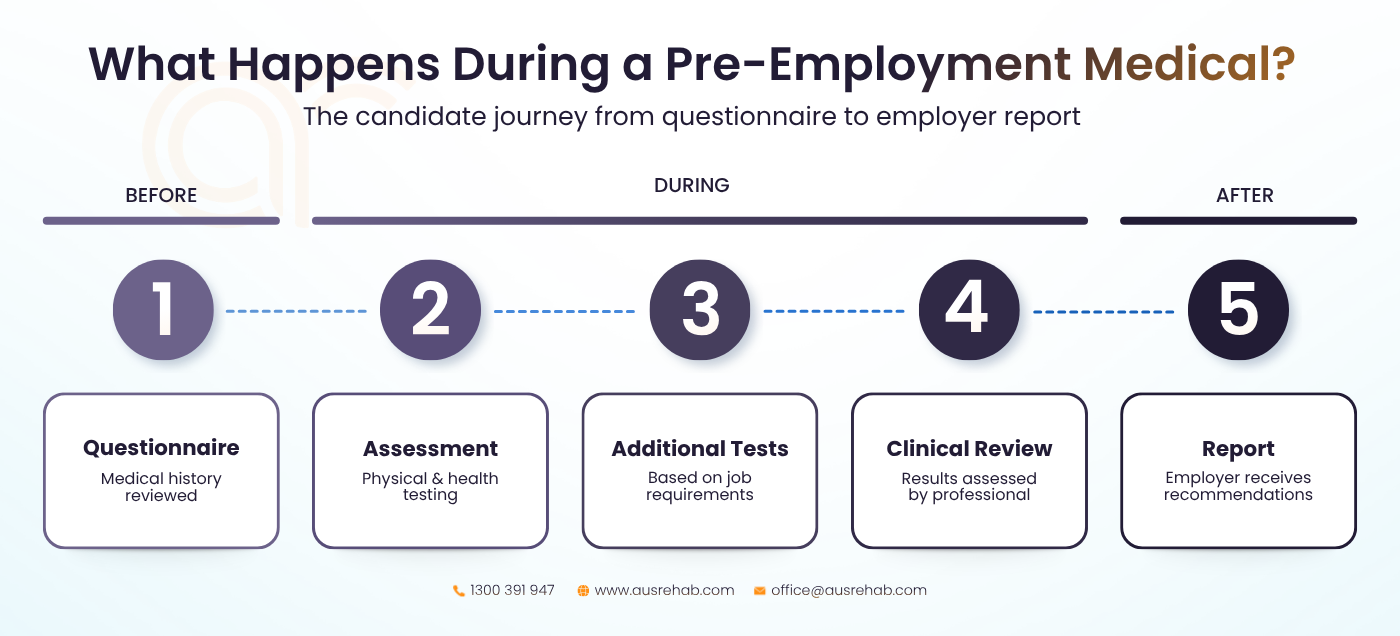
A pre-employment medical assessment usually follows a simple process.
The candidate first completes a health questionnaire. The assessor then carries out the tests required for the role. After reviewing the results, the health professional prepares recommendations for the employer.
| Step | What Happens |
|---|---|
| Questionnaire | Medical history, previous injuries, medications, and current health factors are reviewed. |
| Assessment | Physical and health testing is completed based on the role requirements. |
| Clinical Review | The assessor reviews the results and considers the job demands. |
| Report | The employer receives relevant recommendations through the reporting portal. |
The exact process varies depending on the role, workplace risks, and employer requirements.
What Tests May Be Included in a Pre-Employment Medical?
The tests included in pre-employment screening vary by role, industry, and workplace risk. A construction role may need very different testing from an office-based role. The purpose is not to label someone as a simple pass or fail, but to assess whether the person can safely perform the inherent requirements of the role and whether any workplace risks need to be managed.
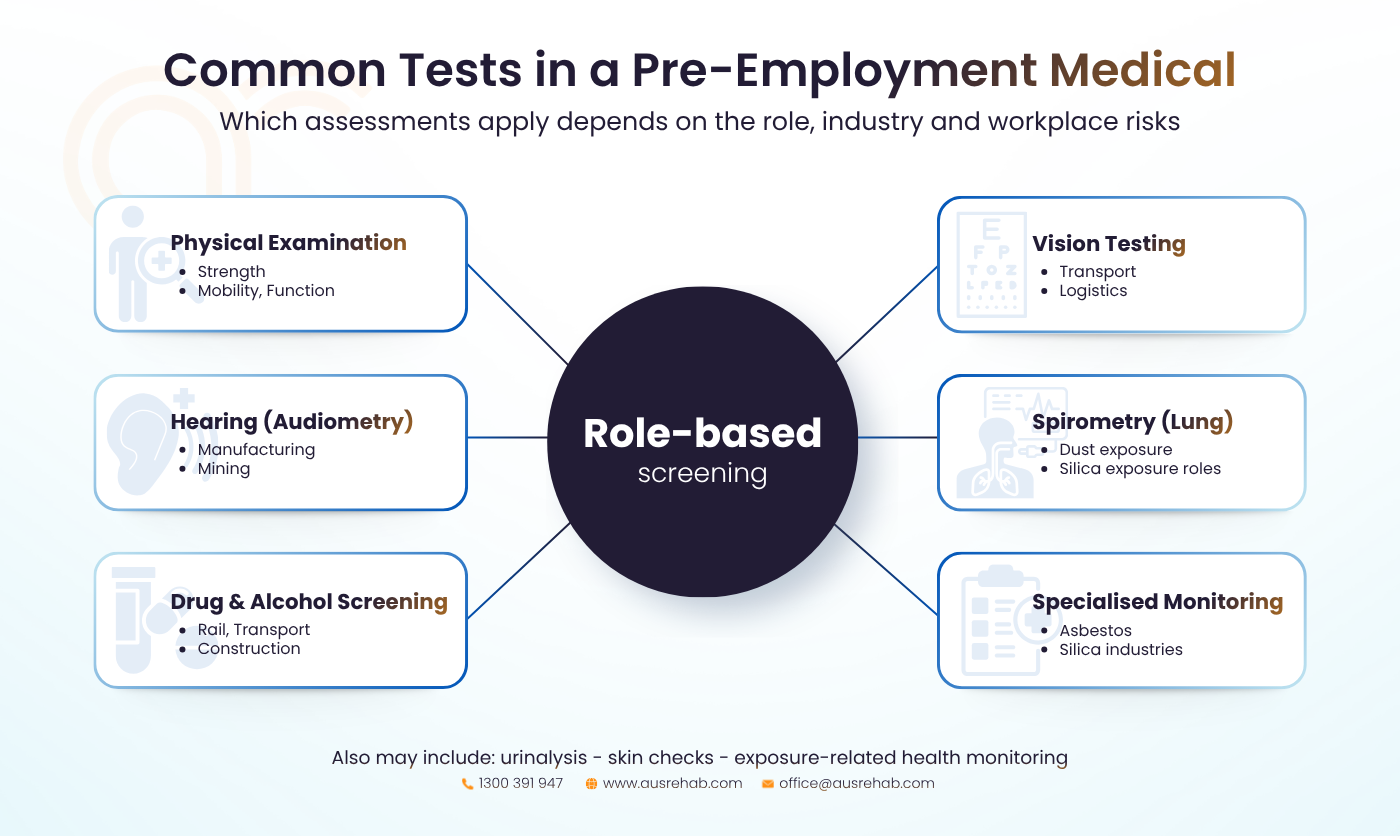
Common Pre-Employment Medical Assessments
| Assessment | What It Assesses | Common Industries |
|---|---|---|
| Physical Examination | Strength, mobility, and physical function | Construction, healthcare |
| Hearing Test (Audiometry) | Hearing ability | Manufacturing, mining |
| Spirometry | Lung function | Mining, construction |
| Vision Testing | Visual acuity and colour perception | Transport, logistics |
| Drug and Alcohol Screening | Workplace safety risks | Transport, rail, construction |
| Urinalysis | General health indicators | Various industries |
| Skin Checks | Occupational skin conditions | Outdoor and industrial work |
| Specialised Monitoring | Exposure-related risks | Mining, asbestos, silica industries |
Physical Examination
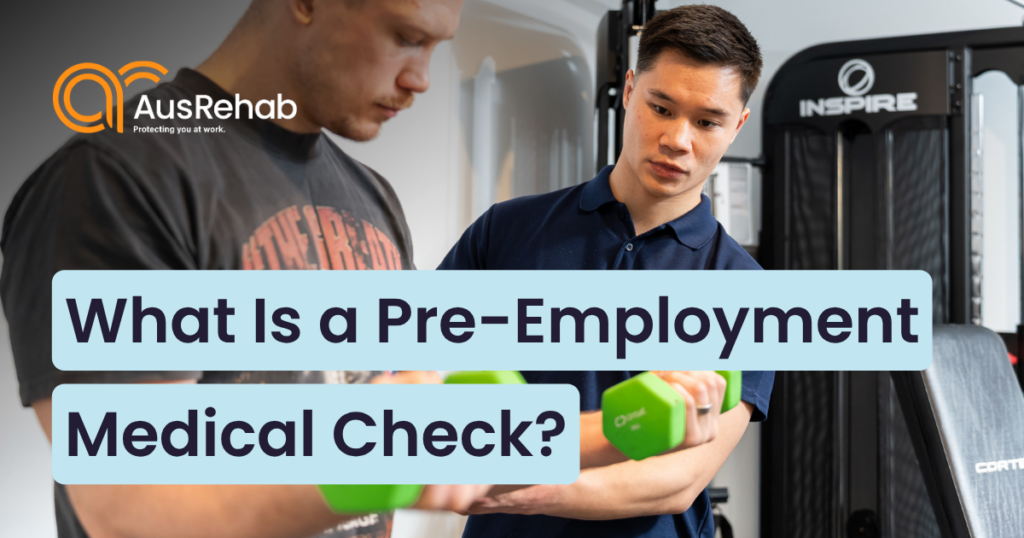
A pre-employment functional assessment may include a physical examination. This can assess range of motion, lifting ability, flexibility, balance, and general physical function. These tests help determine whether a candidate can safely manage the physical demands of the role.
Example: A warehouse role with frequent lifting may require a more detailed physical assessment than a desk-based administrative position.
Workplace Hearing Test (Audiometry)
A workplace hearing test measures hearing ability and may identify possible hearing loss. It is commonly used for roles with regular exposure to machinery noise, industrial equipment, and loud work environments such as construction and manufacturing. This aligns with Safe Work Australia Noise Guide on managing workplace noise risks.
💡 What is Audiometry?
Audiometry is a simple hearing test that measures how well a person hears sounds at different pitches and volumes. It is commonly required for roles with exposure to workplace noise. You can also learn more about workplace hearing tests.
Lung Function Test (Spirometry)
Spirometry measures lung function and breathing capacity. It is often used where workers may be exposed to dust, silica, fumes, or airborne contaminants. This is common in mining, construction, and other higher-exposure industries.
💡 What is spirometry?
Spirometry is a breathing test that measures how well the lungs are functioning.
Vision Testing
Vision testing may assess visual clarity, colour perception, and depth perception. This helps determine whether a candidate can identify hazards, read instruments, and perform visually demanding tasks safely.
Drug and Alcohol Screening
Drug and alcohol screening is common in safety-sensitive industries where impairment can create serious risks. This includes transport, logistics, rail, construction, and mining.
📝 Myth vs Reality
Myth: Every pre-employment medical includes drug testing.
Reality: Drug and alcohol testing depends on the employer’s policy and the requirements of the role.
Urine Analysis
Urinalysis may be included to identify general health factors that could affect workplace safety or fitness for work. The exact use of this test varies between employers and industries.
Skin Checks
Skin checks may identify irritation, occupational dermatitis, or abnormal skin changes. They are often relevant for workers exposed to chemicals, hazardous substances, or outdoor conditions.
Specialised Health Monitoring
Some roles need additional monitoring because of specific workplace exposures. This may include asbestos-related screening, silica-related testing, or other exposure-based checks. These assessments help employers meet health-monitoring duties under workplace health and safety requirements.
Do All Pre-Employment Medicals Include the Same Tests?
No. The assessments included depend on the role, workplace risks, industry requirements, and employer policies. Some roles only need a basic assessment. Others may require hearing tests, lung function testing, drug screening, or specialised health monitoring.
Industry and Typical Test Requirements
Pre-Employment Medical Tests by Industry
| Industry | Tests Commonly Included |
|---|---|
| Construction | Physical examination, spirometry, drug and alcohol screening, and vision testing |
| Mining and Resources | Audiometry, spirometry, drug and alcohol screening, and specialised health monitoring |
| Manufacturing | Physical examination, audiometry, and drug and alcohol screening |
| Transport and Logistics | Vision testing, drug and alcohol screening, and physical examination |
| Rail | Drug and alcohol screening, vision testing, and audiometry |
| Healthcare and Aged Care | Physical examination, manual handling assessment, and vaccination or health review where required |
| Office and Administrative Roles | Basic health questionnaire and limited physical assessment where role demands require it |
| Outdoor and Industrial Work | Skin checks, physical examination, and specialised monitoring where exposure risks apply |
How to Prepare for a Pre-Employment Medical
Preparing for a pre-employment health check is usually straightforward.
Before an AusRehab assessment, you may need to complete a questionnaire about your medical history, previous injuries, current conditions, medications, and any health factors that could affect the physical demands of the role. To learn more about what to expect and how to prepare, read How do I prepare for my pre-employment screening?
📝 Completing Your Questionnaire Matters
The information you provide before the appointment helps the assessor understand your health history and the requirements of the role. Accurate answers support a smoother assessment and reduce the risk of delays or requests for further information.
| Before Your Appointment | Why It Matters |
|---|---|
| Complete the questionnaire | Helps the assessor understand your health history. |
| Bring photo identification | Confirms your identity. |
| Bring prescription glasses or hearing aids | Ensures testing reflects your usual working conditions. |
| Bring details of relevant medications | Provides important health context. |
| Arrive on time | Allows enough time to complete the assessment. |
| Follow any clinic instructions | Helps prevent delays or rescheduling. |
Most pre-employment medicals require very little preparation. Completing the requested paperwork and bringing relevant information is usually all that is needed.
Do I Need to Prepare for a Pre-Employment Medical?
In most cases, preparation is simple. You may need to complete a health questionnaire, bring photo identification, and follow any instructions provided before the appointment. Bring any glasses, hearing aids, medication details, or medical documents requested by the clinic.
What Should I Bring to a Pre-Employment Medical?
Use this checklist before your appointment to make sure you have the required identification, health information, medications, and personal supports ready.
Will a Pre-Employment Medical Affect Your Job Application?
One of the most common concerns is whether pre-employment medical results can prevent someone from getting a job.
The assessment is only one part of the recruitment process. The health professional reviews the candidate’s capacity and provides recommendations. The employer makes the final decision based on the role requirements, workplace risks, and other recruitment information.
Some candidates may be suitable without changes. Others may need reasonable adjustments, restrictions, or additional support to perform the role safely.
Roles and Responsibilities in a Pre-Employment Medical Assessment
| Role | Responsibility |
|---|---|
| Health Professional | Conducts the assessment and provides recommendations. |
| Employer | Reviews the assessment alongside other recruitment factors. |
| Candidate | Provides accurate health information and participates in the assessment. |
Fair Work protections apply to prospective employees. Employers cannot lawfully refuse employment for a discriminatory reason. Australian Human Rights Commission also explains that reasonable adjustments may help a candidate perform the inherent requirements of a role; therefore, the circumstances of each case still matter.
💡 A pre-employment medical is designed to support safe job placement. It does not automatically exclude someone from employment. The focus is whether the candidate can perform the inherent requirements of the specific role safely.
📝 Myth vs Reality
Pre-Existing Conditions
Myth: A pre-existing condition means you’ll automatically fail.
Reality: The assessment looks at whether you can safely perform the specific role, often with reasonable adjustments. A condition rarely rules a candidate out on its own.
How Long Does a Pre-Employment Medical Take?
The appointment length depends on the assessment package selected by the employer. A basic screening may only involve a questionnaire and general health review. A safety-sensitive role may require physical testing, audiometry, spirometry, vision checks, or drug and alcohol screening.
How Much Time Does a Pre-Employment Medical Usually Take?
Most pre-employment medical assessments take between 30 and 60 minutes. More detailed screening may take longer, depending on the number of tests required and the physical or safety demands of the role.
| Assessment Type | Typical Duration |
|---|---|
| Basic Medical Screening | 30 to 60 minutes |
| Physical Assessment | 45 to 60 minutes |
| Hearing Test / Audiometry | Additional 10 to 20 minutes |
| Spirometry | Additional 10 to 15 minutes |
| Drug and Alcohol Screening | Additional time may apply |
| Comprehensive Screening Package | 60 to 90 minutes or longer |
Assessment times vary depending on the role, industry, and screening requirements.
AusRehab appointments are typically available within three business days. Reports are generally delivered within 48 hours after the assessment is completed.
Can You Fail a Pre-Employment Medical?
Some candidates may be suitable without changes. Others may need minor adjustments, monitoring, restrictions, or modified duties. In some cases, the assessor may request more medical information before making a recommendation.
Can a Pre-Employment Medical Affect Your Job Offer?
A pre-employment medical is not usually a simple pass-or-fail test. It assesses whether you can safely perform the inherent requirements of the role. The health professional provides recommendations, while the employer makes the final hiring decision. The goal is to match the right person to the right role while maintaining workplace safety. A health condition does not automatically make someone unsuitable.
| Outcome | What It Means |
|---|---|
| Fit for Role | The candidate can safely perform the job requirements. |
| Fit With Recommendations | Minor adjustments, restrictions, or monitoring may be required. |
| Further Information Required | Additional medical information may be needed. |
| Unable to Meet Role Requirements | Significant safety concerns exist for that specific role. |
Assessment outcomes are based on the requirements of the role rather than a person’s general health.
Are Pre-Employment Medicals Mandatory or Legal?
Pre-employment medicals are generally lawful when the assessment is relevant to the role. Medical testing should focus on genuine job requirements, workplace safety, and any reasonable adjustments that may support the candidate.
Employers should avoid broad or intrusive questions about health conditions that do not affect the role. Assessment results should also remain confidential.
A medical condition should not be used as an automatic reason to reject someone. Fair Work protections extend to prospective employees, including protection from discrimination based on physical or mental disability. Decisions may consider the inherent requirements of the position.
Pre-employment medicals are not required for every job. Employers are more likely to use them where work involves manual handling, machinery, driving, hazardous substances, noise exposure, or other significant safety risks. WHS duties require businesses to identify hazards and control risks so far as is reasonably practicable.
Are Pre-Employment Medicals Mandatory?
Not universally. A pre-employment medical requirement in NSW depends on the role, industry, workplace risks, and employer obligations. These assessments are most common in physically demanding or safety-sensitive work, where they help confirm whether a candidate can perform the inherent requirements safely.
What Jobs Require a Pre-Employment Medical?
Jobs requiring a pre-employment medical are usually physically demanding, safety-sensitive, or linked to workplace exposure risks. Employers may use screening where a worker needs to lift, drive, operate machinery, work at heights, or manage other tasks with a higher risk of injury.
Industries That Commonly Use Pre-Employment Medical Screening
| Industry | Why Screening Is Used |
|---|---|
| Construction | Manual handling, physical demands, and work at heights |
| Mining and Resources | Safety-critical duties and exposure risks |
| Manufacturing | Machinery operation and repetitive physical work |
| Transport and Logistics | Driving safety, fatigue management, and vehicle operation |
| Security Services | Physical capability and emergency response requirements |
| Healthcare and Aged Care | Manual handling, patient transfers, and care-related tasks |
What Types of Job Tasks Usually Trigger Screening?
Screening is often used when a role includes:
- manual handling or frequent lifting
- repetitive physical tasks
- operating machinery or heavy equipment
- driving vehicles
- working at heights
- exposure to dust, noise, chemicals, or hazardous substances
- safety-critical responsibilities
How AusRehab Supports Safer Hiring Decisions
AusRehab works with employers across Sydney and NSW to deliver tailored assessments that support workplace safety, compliance, and informed recruitment decisions.
Candidates searching for a pre-employment medical near Sydney and NSW can access multiple screening locations. Employers can also manage bookings and reports through AusRehab’s online portal.
| AusRehab Capability | Employer Benefit |
|---|---|
| Role-specific assessments | Supports better hiring decisions. |
| Qualified assessors | Provides consistent and reliable evaluations. |
| Multiple screening locations | Offers convenient access across Sydney and NSW. |
| Online PES Portal | Streamlines booking and reporting. |
| Reports within 48 hours | Helps recruitment progress faster. |
| Bulk booking options | Supports efficient high-volume hiring. |
AusRehab helps employers coordinate role-specific screening with convenient bookings, clear reporting, and practical support across Sydney and NSW.
📝 Tip for Operations Managers
Bulk bookings and a 48-hour reporting turnaround can keep high-volume onboarding moving without unnecessary bottlenecks, useful when scaling a workforce across several roles or locations.
Not Sure Which Assessments Your Roles Need?
AusRehab can tailor a screening package around your industry, job demands, and workplace risks. Employers can book through the PES Portal for streamlined appointments and reporting.
Building a Safer Workforce Starts Before Day One
Pre-employment medical screening is more than a recruitment formality. It helps employers understand whether candidates can safely perform the role, identify workplace risks early, and make informed hiring decisions.
AusRehab provides tailored pre-employment screening that NSW employers can rely on. Assessments are aligned with the physical demands, safety requirements, and workplace exposures associated with each role. AusRehab offers convenient screening locations and streamlined online reporting.
Speak With AusRehab
✅ Appointments typically available within three business days
✅ Reports delivered within 48 hours
✅ Online PES Portal for streamlined bookings and reporting
✅ Multiple screening locations across Sydney and NSW
✅ Bulk booking options for employers hiring at scale
Frequently Asked Questions (FAQs)
What happens during a pre-employment medical?
The candidate usually completes a health questionnaire before attending physical or health testing. A qualified assessor reviews the results against the demands of the role. The employer then receives a report with relevant findings and recommendations.
Do pre-employment medicals include drug and alcohol testing?
Not every pre-employment medical includes drug and alcohol testing. It is generally included when required by the employer’s policy or the safety demands of the role. Testing is common in transport, rail, construction, mining, and other safety-sensitive industries.
What should I bring to a pre-employment medical?
Bring valid photo identification and any documents requested before the appointment. You should also bring prescription glasses, hearing aids, medication details, and relevant medical information when applicable. Complete any health questionnaire honestly before attending.
Who pays for a pre-employment medical?
In most cases, the employer arranges and pays for the medical because it forms part of the recruitment and workplace safety process. Candidates are not usually expected to pay. AusRehab’s PES Portal allows the booking party to select and prepay for the required assessments.
How much does a pre-employment medical cost?
The cost depends on the tests required. A basic medical or functional assessment may cost less than a screening package with hearing, lung function, drug and alcohol, or specialised exposure testing. AusRehab publishes current pricing on its pre-employment screening service page.
What happens if I have a pre-existing condition?
A pre-existing condition does not automatically make you unsuitable for a role. The assessor considers your current capacity and whether the condition affects the inherent requirements of the job. You may still be suitable with reasonable adjustments, restrictions, monitoring, or workplace support.
Can an employer withdraw a job offer after a medical?
An employer may reconsider an offer when a role-specific assessment identifies genuine safety concerns or shows that the candidate cannot perform the necessary requirements of the job. However, an offer should not be withdrawn for a discriminatory reason. Reasonable adjustments may also need to be considered. This is general information and not legal advice.
What pre-employment screening services does AusRehab provide?
AusRehab provides physical and functional assessments, audiometry, spirometry, vision testing, skin checks, urine analysis, and drug and alcohol screening. Specialised assessments for silica, asbestos, and other workplace exposures may also be available. Services can be tailored to the role and industry.
Are pre-employment medical results confidential?
Yes. AusRehab’s PES terms state that candidate information is handled in accordance with privacy laws. Assessment results are confidential and shared only with authorised representatives. The booking and consent process determines who receives the role-relevant report.