

Prefer to Listen? Play this quick summary instead!
What TAC Benefits Can You Claim After a Car Accident in Victoria?
Many Victorians walk away from a transport accident assuming they either don’t qualify for Transport Accident Commission (TAC) support or that the scheme only applies to severe injuries. In many cases, that isn’t true.
A TAC claim after a car accident may provide support for treatment, recovery, lost income, daily activities, and return to work. The available help depends on the accident, the injury, and how it affects your life. Delayed treatment or rehabilitation can make recovery harder, and it can also leave you managing costs and decisions without enough support.
🗒️ What TAC Benefits Can You Claim After a Car Accident?
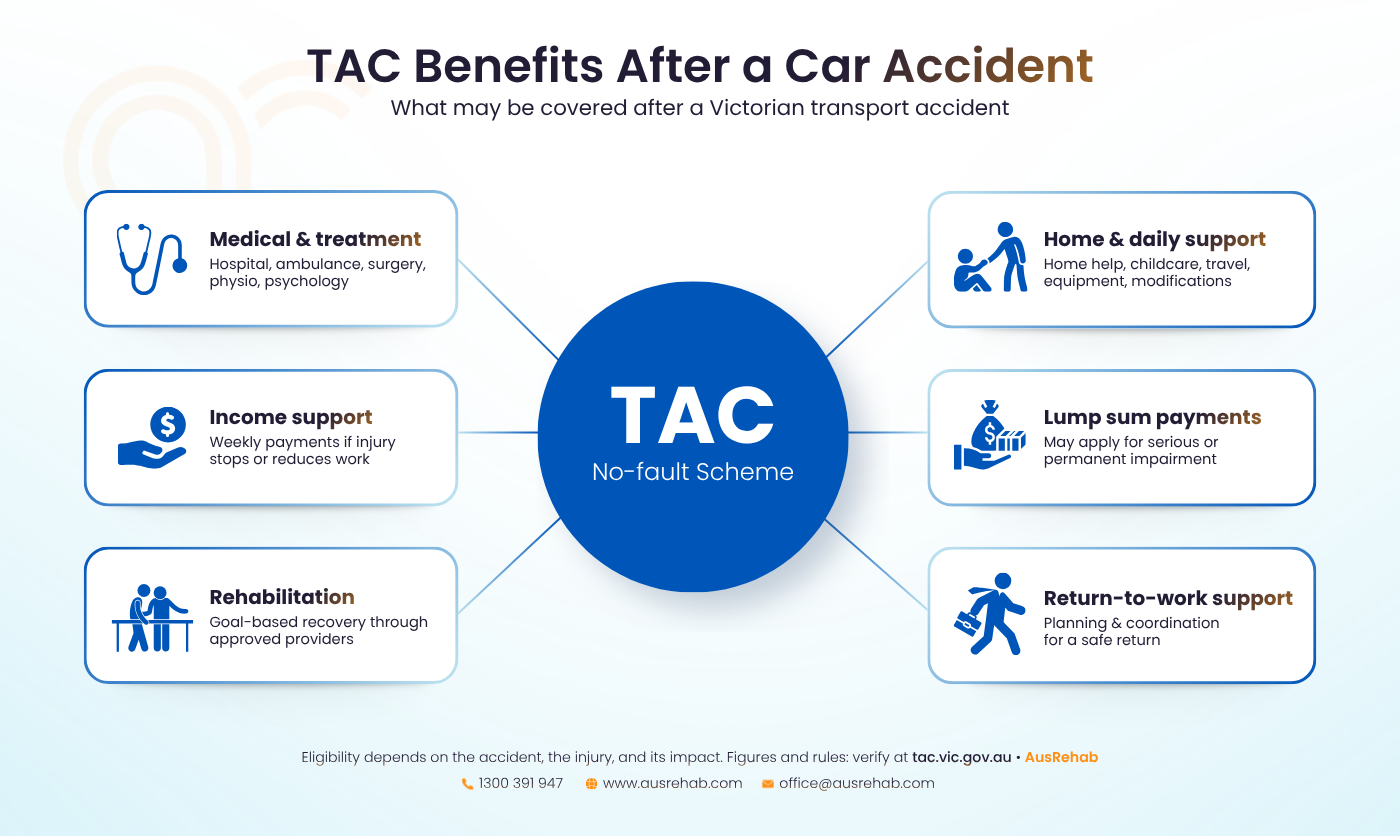
TAC benefits may include medical costs, income support, rehabilitation, return-to-work support, home help, travel to treatment, and some lump sum payments. Eligibility depends on the accident, the injury, and how it affects your work, daily life, and recovery.
What Is the TAC and Who Does It Cover?
A Transport Accident Commission (TAC) claim is an insurance claim that Victoria residents make for injuries caused by a transport accident. The injury may be physical or psychological. It must also meet the scheme’s eligibility requirements.
📖 What Is the TAC?
The Transport Accident Commission (TAC) is a Victorian Government-owned organisation that manages injury claims from transport accidents. It may support eligible drivers, passengers, motorcyclists, cyclists, pedestrians, and public transport users. TAC operates as a no-fault scheme, so eligibility is generally not determined by who caused the accident.
Does Fault Matter in a TAC Claim?
TAC generally operates under a no-fault system. This means you may still be eligible for support even if you caused or contributed to the accident.
Eligibility usually focuses on whether a transport accident occurred and whether it caused your injury. Drivers, passengers, pedestrians, motorcyclists, and some cyclists may all qualify for TAC benefits in Victoria.
⚠️ Fault doesn’t automatically stop you from claiming. Many people avoid claiming because they believe the accident was their fault. Fault does not generally determine eligibility for TAC benefits. You may still be able to make a claim if the accident and injury meet TAC requirements.
Who Can Be Covered by TAC?
| Person Involved | May Be Covered? |
|---|---|
| Driver | Yes, where eligibility requirements are met. |
| Passenger | Yes, where eligibility requirements are met. |
| Motorcyclist | Yes, where eligibility requirements are met. |
| Cyclist | Yes, in eligible accidents involving a motor vehicle, motorcycle, bus, train, or tram. |
| Pedestrian | Yes, in eligible accidents involving a motor vehicle, motorcycle, bus, train, or tram. |
| Bus, tram, or train passenger | Yes, where the injury results from an eligible transport accident. |
TAC may cover a wide range of people injured in Victorian transport accidents, not only drivers.
Does TAC Cover Interstate and Non-Victorian Residents?
A non-Victorian resident may be eligible for TAC support after an accident in Victoria. This can apply regardless of whether the vehicle involved was registered in Victoria or interstate.
Some interstate accidents may also qualify. TAC may cover a Victorian resident injured in an interstate accident involving a Victorian-registered vehicle. A non-Victorian resident may also qualify if they were driving or travelling in that vehicle.
Interstate eligibility depends on the people, vehicles, and circumstances involved. Anyone unsure about a transport accident claim in Victoria should confirm their eligibility directly with TAC.
How Long Do You Have to Lodge a TAC Claim?
The TAC claim time limit depends on when the accident occurred and when the injury first became apparent.
| Situation | General Timeframe |
|---|---|
| Standard TAC claim | Within 12 months of the accident or when the injury first becomes apparent. |
| Late claim | Between one and three years, where reasonable grounds explain the delay. |
| Person injured before age 18 | May lodge a claim until the day before turning 21 if a parent or guardian did not claim within the standard period. |
| More than three years after the accident | Generally outside the standard claim period. Specific advice may be needed. |
TAC claim time limits vary by circumstance. Lodging early can reduce delays and make it easier to gather relevant information.
How Long Do You Have to Lodge a TAC Claim?
In most cases, TAC claims must be lodged within 12 months of the accident or when the injury first becomes apparent. TAC may consider a claim lodged within three years if reasonable grounds explain the delay. Special timing rules apply to people injured before turning 18.
What TAC Benefits Can You Actually Claim?
If you are wondering what TAC benefits you can claim, the answer may be broader than expected. Below is a summary of the types of benefits and their corresponding coverage.
| Benefit Type | What It May Cover |
|---|---|
| Medical and treatment costs | Hospital care, ambulance transport, GP appointments, surgery, physiotherapy, psychology, and other approved treatments. |
| Income support | Payments for accident injuries that stop you from working or reduce your work capacity. |
| Rehabilitation | Goal-based support to improve movement, function, independence, and recovery. |
| Home and daily support | Cleaning, childcare, gardening, travel, equipment, or modifications in eligible cases. |
| Lump sum payments | Compensation where eligibility requirements for permanent impairment are met. |
| Return-to-work support | Planning and coordination to help you and your employer manage a safe return. |
TAC benefits can support more than immediate medical treatment. Depending on your injury and circumstances, TAC benefits in Victoria may also include income support, rehabilitation, household assistance, travel, equipment, and return-to-work planning.
💡 Many people do not realise the full range of TAC benefits. Treatment costs are often the first benefit people think about, but TAC support may also include income replacement, rehabilitation, home assistance and return-to-work support depending on individual circumstances.
Medical and Treatment Costs
TAC medical expenses may include:
- hospital and emergency treatment
- ambulance transport
- GP and specialist consultations
- surgery, scans, and prescribed medication
- physiotherapy and chiropractic care
- psychology and counselling
- occupational therapy and exercise physiology
- approved travel to treatment
Many common services may be accessed during the first 90 days without prior approval. The service must be recommended by a health professional and related to the accident injury. Approval may be required after 90 days or for services outside TAC’s approved list.
Does TAC Cover Medical Treatment After an Accident?
TAC may cover reasonable medical, hospital, rehabilitation, and ambulance costs related to your transport accident injuries. The treatment must be necessary, appropriate, and provided by a qualified professional. Approval requirements may depend on the service and how much time has passed since the accident.
Medical Excess and Submission Rules
For accidents on or after 14 February 2018, the medical excess is $0. TAC may begin paying reasonable accident-related treatment costs once the claim is accepted.
For earlier accidents, a medical excess may apply to treatment outside the hospital. The current listed amount is $651 for accidents from 1 July 2017 to 13 February 2018. Different amounts apply to earlier accident dates. The excess does not apply when the injured person or an immediate family member involved in the same accident was admitted as an inpatient.
Applications for medical and related expenses generally need to be submitted within three years of the accident. For expenses incurred later, the request generally needs to be submitted within two years of receiving the service or incurring the cost, as limited exceptions may apply.
💡 TAC treatment costs are paid according to TAC rates. A provider may charge more than that rate, which could leave you with a gap payment. It is worth confirming fees before treatment begins.
What If You Need Ongoing Treatment?
TAC-funded treatment may continue when it remains related to your accident and supports your recovery. TAC may review your progress or ask for more information before approving ongoing services. Your provider may need to request approval when treatment continues beyond the first 90 days. Approval may also be required after a six-month break in TAC-funded care.
Lost Income and Earnings Support
The amount you may receive depends on your pre-accident earnings, current work capacity, dependents, and any income earned after the accident. Income support is generally taxable during the first 18 months
Does TAC Pay Lost Income After a Car Accident?
If your accident injuries reduce or stop your ability to work, TAC income support may help replace part of your lost earnings. In most cases, TAC pays 80% of gross pre-accident income, up to $1,730 per week for accidents on or after 1 July 2026.
TAC Income Support Payments Explained
| Situation | What TAC May Pay |
|---|---|
| First five days of lost earnings | TAC generally does not pay income support for this period. The waiting period may be waived in cases of acute financial hardship. |
| Unable to work at all | Generally, 80% of pre-accident weekly earnings, subject to prescribed minimums and a maximum of $1,730 per week. |
| Working reduced hours | Generally, 85% of the difference between pre-accident earnings and current earnings, subject to statutory limits. |
| After 18 months | Payments may move from Loss of Earnings to Loss of Earning Capacity if the injury still reduces your capacity to work. |
| LOEC payments | Based on the difference between your earning capacity before and after the accident. These payments are generally not taxable. |
| Ongoing severe impairment | LOEC may continue beyond three years if impairment is assessed above 50% and reduced work capacity continues. |
Certificate of Capacity
To receive and continue income support, you will usually need a Certificate of Capacity from your doctor. This certificate explains how your accident injuries affect your ability to work and also records what duties you may be able to perform safely.
TAC advises clients to provide an updated certificate before the current one expires to avoid payment delays. AusRehab can help connect you with a workers’ compensation doctor who can assess your work capacity and support appropriate recovery planning.
TAC Rehabilitation Support
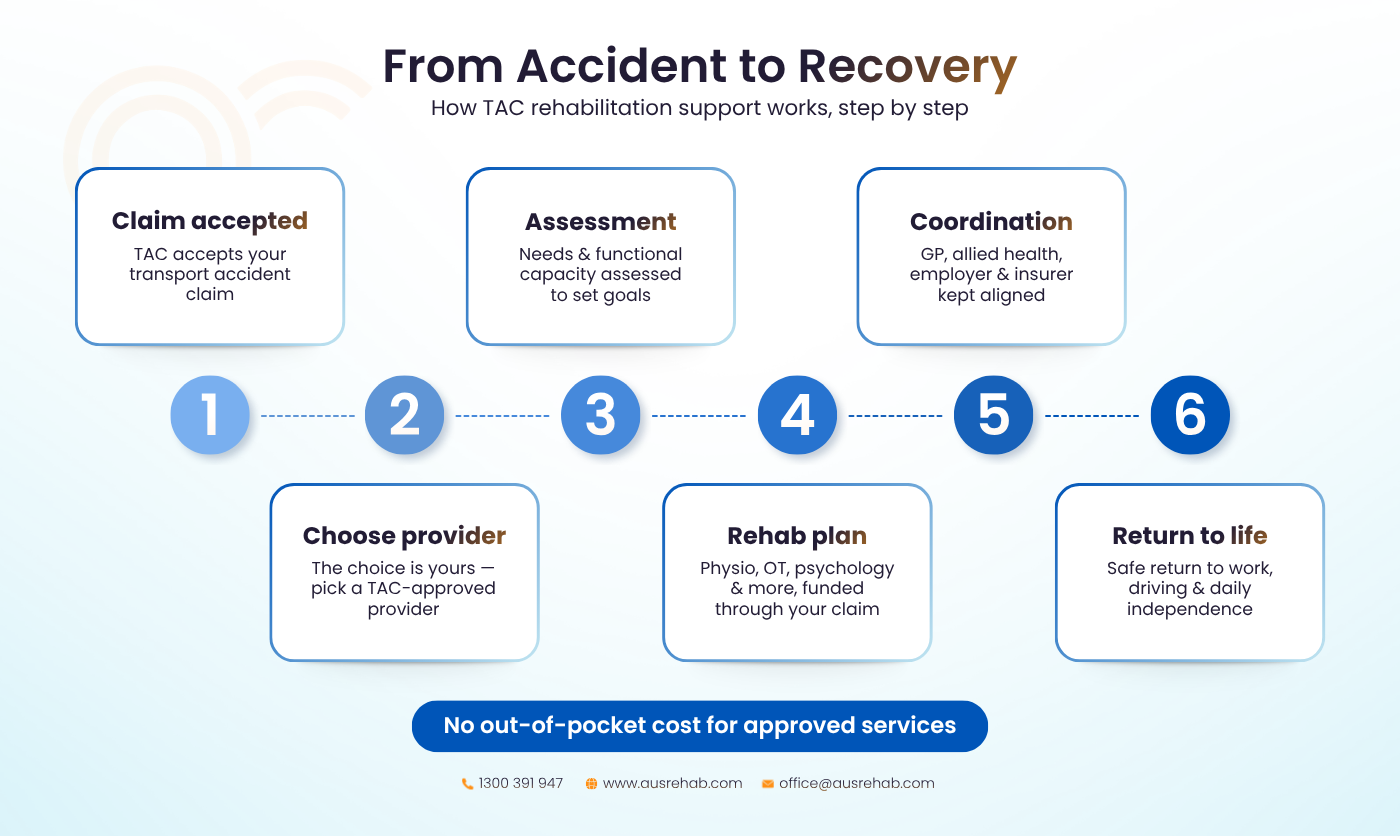
Rehabilitation may begin after hospital discharge or at another stage of recovery. The right support depends on your injuries, daily needs, and recovery goals. A rehabilitation plan should focus on practical outcomes, which may include better movement, improved independence, greater confidence, and a safe return to work.
Are TAC Rehabilitation Services Funded?
Yes. Approved TAC rehabilitation services may be funded through an accepted claim when they are related to your accident injuries. TAC usually pays the provider directly at the applicable rate once your claim details are supplied, but some services require prior approval.
| Rehabilitation Support | How It Helps |
|---|---|
| Physiotherapy | Supports movement, strength, and physical recovery. |
| Occupational therapy | Helps with daily activities, independence, and home needs. |
| Psychology or counselling | Supports emotional recovery after an accident. |
| Speech pathology | Helps with communication or swallowing concerns where relevant. |
| Social work | Supports adjustment, family needs, and access to services. |
| Return-to-work support | Helps plan a safe and realistic return to employment. |
TAC rehabilitation is designed to support practical recovery, not just treatment. The right plan may help rebuild independence, daily function, and work capacity.
Does TAC Cover Rehabilitation at Home?
TAC may cover rehabilitation at home for eligible clients who are medically stable and able to complete part or all of their program outside the hospital. The service is designed as a short-term alternative to inpatient rehabilitation.
If services begin within the first 90 days after the accident, TAC may fund up to eight weeks or $3,000, whichever limit is reached first. Prior approval is not required before services begin. The program must be recommended by a health professional or hospital team and relate to the accident injuries.
Approval is generally required when a new program starts more than 90 days after the accident. Approval is also needed when support must continue beyond the initial duration or funding limit.
Your Provider Choice Matters
Once you know which services TAC has approved, you may choose a suitable provider. Some services require the provider to be registered with TAC.
You also have the right to change providers if the service is not meeting your needs. TAC recommends discussing approved services, payment rates, and possible gap fees before treatment starts.
A TAC-approved provider should work alongside your GP, hospital team, allied health professionals, and case manager to keep treatment connected to your recovery goals.
Early Rehabilitation Matters
Early TAC recovery support can help identify your needs before problems become harder to manage. It can also reduce delays between hospital care, home support, treatment, and return-to-work planning.
GPs and allied health professionals can recommend suitable rehabilitation services. Case managers can help coordinate referrals, approvals, and communication with the wider treating team.
Home Help, Daily Support, and Modifications
Accident injuries can affect more than medical appointments. They may also make household tasks, childcare, travel, or safe movement around the home difficult.
TAC home help may be available when your injuries prevent you from completing tasks you managed before the accident. TAC approval is usually required. A treating health professional must also recommend the support.
TAC Home and Daily Living Support
| Support Type | How It May Help |
|---|---|
| Home help | Assistance with cleaning and essential household tasks |
| Childcare | Support when your injuries limit usual caring responsibilities |
| Gardening assistance | Help with outdoor tasks you previously completed |
| Home modifications | Changes that improve safety, access, and independence |
| Vehicle modifications | Equipment or structural changes that support safer access or driving |
| Travel to treatment | Assistance with transport costs for approved treatment and rehabilitation |
Can You Claim a TAC Lump Sum Payment?
A TAC lump sum payment may be available if your transport accident caused a permanent physical or psychological impairment.
TAC calls this an impairment benefit, which is a one-off payment based on the assessed level of permanent impairment. For adults, TAC generally requires an impairment rating of at least 11%. The amount depends on the final assessment and the rules that apply to the accident
💡 Not every claim involves a lump sum. A lump sum is not included in every TAC claim, and eligibility usually depends on the severity and lasting impact of the injury. Treatment, income support, and rehabilitation may still be available even when the impairment threshold is not met.
What If Your TAC Claim Is Rejected or You’re Entitled to More?
A decision may affect access to treatment, rehabilitation, income support, or an impairment benefit. Read the decision letter carefully. It should explain the outcome and the available review options.
TAC generally allows you to request an informal review within 12 months of becoming aware of the decision. This process does not pause the separate 12-month time limit for applying to VCAT (independent dispute resolution body in Victoria).
If you have legal representation, your lawyer may use TAC’s formal dispute resolution process. This allows both sides to review the available information before the matter progresses further.
Why You Should Review Your Options
A TAC claim-rejected decision may result from missing information, misunderstood eligibility, or insufficient medical evidence. It does not always mean no support is available.
A TAC claim review may also be worth considering if your approved benefits do not reflect how the injury affects your recovery, work capacity, or daily life.
Professional advice can help you understand the decision and what evidence may be needed. A rehabilitation provider can explain your functional needs and provide relevant assessments. They cannot determine eligibility or overturn a TAC decision.
What Happens If My TAC Claim Is Rejected?
A rejected claim or low TAC assessment isn’t necessarily final. You may request an informal review, use the dispute resolution process through a lawyer, or apply for a review through the Victorian Civil and Administrative Tribunal (VCAT). Review time limits usually apply.
TAC, WorkCover or Both? If the Accident Happened While Working
A transport accident during work duties is generally managed through WorkCover. This may include driving between job sites, making deliveries, visiting clients, or travelling because your employer requires it. WorkSafe treats required work travel as part of employment.
An ordinary trip between home and work is usually different. TAC may pay compensation for an eligible accident during that journey unless another compensation scheme applies.
Some incidents can involve TAC and WorkCover in different ways. In most work-related transport accidents, WorkCover manages the worker’s no-fault benefits. TAC may still have a role in certain common law matters. TAC may also consider a claim if the WorkCover claim is rejected.
For employers, identifying the correct scheme early can reduce delays in treatment, income support, and rehabilitation. A rehabilitation provider can coordinate with the worker, employer, doctor, insurer, and relevant scheme once the appropriate pathway is confirmed.
What If My Car Accident Happened While I Was Working?
A transport accident at work may fall under WorkCover rather than TAC. An accident during your ordinary journey to or from work may fall under TAC. The correct pathway depends on when, where, and why you were travelling.
How AusRehab Can Help After a TAC Claim
AusRehab works with injured people, treating professionals, employers, and insurers to keep recovery organised. Support may focus on daily independence, physical capacity, safe driving, and returning to meaningful work.
As a TAC-approved rehabilitation provider, AusRehab can coordinate approved services around your current needs and recovery goals. We also provide motor accident rehabilitation across Victoria and work with TAC insurers and treating teams.
How AusRehab Supports Your TAC Recovery
| Service | What It Means for You |
|---|---|
| Initial Needs Assessment | Assesses your injuries, living situation, and immediate support needs so suitable services can be identified early. |
| Functional Capacity Evaluation | Reviews your current physical function and activity tolerance to guide treatment and rehabilitation planning. |
| Return-to-Work Planning | Creates a practical plan based on your capacity, duties, hours, and workplace support needs. |
| ADL Assessment and Domestic Assistance | Identifies how your injury affects daily activities and recommends strategies, equipment, or support to improve independence. |
| Vehicle Ergonomic Assessment | Reviews posture, seating, vehicle access, and physical concerns that may affect safe or comfortable driving. |
| Driving Rehabilitation Programs | Provides structured assessment and support to rebuild function, confidence, and safe driving capacity. |
| Coordination of Care | Keeps communication clear between you, your GP, allied health providers, employer, and insurer. |
Your Choice of Provider
Once you understand which services TAC has approved, you can generally choose a suitable provider. TAC encourages clients to select providers based on their needs and approved supports.
No Separate Payment for Approved TAC Rehabilitation Services
Approved TAC rehabilitation services may be paid through your accepted claim. TAC pays for treatment and services according to its published rates. A provider may charge above those rates, so it is important to ask about possible gap fees before the service begins.
How AusRehab Can Help After a TAC Claim
Early TAC rehabilitation can help identify what you need before pain, reduced mobility, or uncertainty becomes harder to manage. Support may include treatment coordination, daily activity assessment, home-based strategies, and return-to-work planning. Starting these conversations early can give everyone a clearer direction.
The Victorian Department of Health states that people are more likely to remain at work or return when risks are identified early, needs are assessed, and treatment or rehabilitation begins as soon as possible.
The Australian Rehabilitation Providers Association also links delayed rehabilitation referrals with weaker return-to-work outcomes. It recommends early referral when barriers to recovery or employment begin to appear.
| Early Rehabilitation Support | Delayed Support |
|---|---|
| Needs are identified sooner | Issues may become harder to manage |
| Treatment and rehabilitation can be coordinated | Care may feel fragmented |
| Return-to-work planning begins early | Returning to work may become harder |
| Daily activity needs are assessed | Independence may be affected for longer |
| Confidence can be rebuilt gradually | Pain, fear, or uncertainty may increase |
Early rehabilitation can help injured people recover with more structure, confidence, and practical support.
Find Out What Support You May Be Entitled To
Recovering after a transport accident can feel overwhelming, but understanding what support may be available can make the next steps clearer. Approved rehabilitation may help you manage daily activities, rebuild physical capacity, and prepare for a safe return to work.
TAC-funded rehabilitation through AusRehab can help you understand your needs, plan your recovery and access practical support without paying separately for approved services. If you’re unsure where to start, we can help you understand what recovery support may look like for your situation.
Frequently Asked Questions (FAQs)
Is TAC no-fault in Victoria?
Yes. TAC generally provides no-fault benefits. This means your eligibility is based on whether you sustained an injury in an eligible transport accident, not on who caused the crash. Other compensation pathways may apply different rules.
Is TAC rehabilitation free?
Approved rehabilitation may be paid directly by TAC at its published rates. You may still face a gap payment if your provider charges more than the TAC rate. Confirm the provider’s fees before treatment begins.
Can I choose my own TAC rehabilitation provider?
Yes. Once you understand which services TAC has approved, you can generally choose a suitable provider. Some services require TAC registration. You also have the right to change providers if the support no longer meets your needs.
How does AusRehab help after a TAC claim?
AusRehab can assess your rehabilitation needs, coordinate with your insurer and treating team, and support daily independence or return-to-work planning. Available services may include functional assessments, ADL assessments, driving support, and structured motor vehicle rehabilitation.
Is there an excess to pay for TAC medical treatment?
The medical excess is $0 for accidents on or after 14 February 2018. Some non-hospital treatment costs from earlier accidents may remain subject to an excess. The applicable amount depends on the accident date and circumstances.
How much does TAC pay for lost income?
TAC generally pays 80% of gross pre-accident earnings, subject to statutory limits. The listed maximum is $1,730 per week from 1 July 2026. Your actual payment may depend on current earnings, work capacity, dependants, and other factors.
What is a Certificate of Capacity?
A Certificate of Capacity is a document completed by your doctor that explains how your accident injuries affect your ability to work and which duties you may perform safely. TAC generally requires a valid certificate when assessing or continuing income-support payments.
TAC or WorkCover: Which applies if I am injured while working?
WorkCover generally manages accidents that occur during work duties. TAC may apply to an eligible accident during an ordinary journey between home and work. The correct pathway depends on why and where you were travelling, so early guidance may prevent delays.