


Prefer to Listen? Play this quick summary instead!
After a car accident, it is common to feel overwhelmed and unsure about what to do next. You may be wondering whether you qualify, whether fault matters, or whether making a claim will be too complicated.
A TAC claim after a car accident may help you access treatment, income support, rehabilitation, and return-to-work assistance. However, support available depends on your injuries and circumstances.
Lodging the claim is only the first step. What happens after your claim is accepted can have a significant effect on your recovery.
This guide explains who may be eligible for a TAC claim in Victoria, how to lodge a claim, what information you may need, and what happens next. It also explains how rehabilitation support can help you rebuild function, independence, and work capacity.
How Do You Make a TAC Claim?
You can lodge a TAC claim through the TAC’s online form, by phone, or through a hospital Patient Liaison Officer at participating hospitals. You will generally need details about the accident and your injuries, supporting medical documents, and income information if you are claiming lost earnings.
What Is the Transport Accident Commission (TAC)?
What Is the TAC?
The Transport Accident Commission (TAC) is a Victorian Government-owned organisation that manages injury claims arising from transport accidents. It supports eligible people injured in transport accidents in Victoria, regardless of who caused the accident.
The support available through a TAC claim in Victoria may include medical treatment, rehabilitation, income support, and return-to-work assistance. What the TAC can fund depends on the person’s injuries and circumstances.
Is TAC a Government Scheme or an Insurance Company?
The TAC is a government-owned, no-fault insurance scheme. It is not a private insurer. It is funded through the TAC charge that Victorian motorists pay with their annual vehicle registration. This funding helps support people injured in transport accidents and contributes to road-safety programs.
The TAC is separate from WorkCover. When a transport accident happens during the course of employment, WorkCover benefits may apply. The injured person should report the accident to their employer and contact WorkSafe Victoria or the TAC to confirm the appropriate claim pathway.
What Types of Accidents Does TAC Cover?
A TAC claim may apply to injuries directly caused by:
- car accidents
- motorcycle accidents
- bus, tram, or train incidents
- pedestrian accidents involving a vehicle
- certain cyclist accidents involving a vehicle, train, or tram
Eligibility depends on how the accident happened and whether the injury was directly caused by the driving or operation of the vehicle.
Fault Does Not Automatically Stop You From Claiming
Many Victorians assume they cannot make a TAC claim because they caused the accident. In most cases, fault does not determine eligibility.
Who Can Make a TAC Claim?
TAC eligibility is broader than many people realise. It is not limited to drivers involved in car accidents.
Who Can Make a TAC Claim in Victoria?
Anyone injured in a qualifying Victorian transport accident may be eligible to make a TAC claim, including drivers, passengers, pedestrians, cyclists, motorcyclists, and public transport users. Fault does not usually determine TAC claim eligibility.
| Type of Person | Generally Eligible? |
|---|---|
| Driver at fault | Yes |
| Driver not at fault | Yes |
| Passenger | Yes |
| Pedestrian | Yes |
| Cyclist | Yes, for qualifying transport accidents |
| Public transport passenger | Yes, for qualifying bus, tram, or train accidents |
| Victorian injured interstate in an accident involving a Victorian-registered vehicle | Yes |
| Non-Victorian injured in Victoria | Yes |
| Person injured interstate with no Victorian-registered vehicle involved | Generally no TAC claim |
TAC eligibility is broader than many people realise and extends beyond drivers involved in car accidents.
Can Family Members Lodge a Claim?
An immediate family member can lodge a claim on behalf of an injured person using the TAC online lodgement form. A separate form is not required for each family member.
An immediate family member can include a spouse, partner, parent, grandparent, child, grandchild, or sibling of the injured person.
Can Non-Victorian Residents Claim?
A non-Victorian resident may be eligible for TAC support if the transport accident occurred in Victoria. This can apply regardless of whether the vehicle was registered in Victoria or another state.
A non-Victorian resident may also be eligible if the accident occurred interstate and they were travelling in a Victorian-registered vehicle. Interstate eligibility and available benefits depend on the circumstances of the accident.
How Long Do You Have to Make a TAC Claim?
Lodging early can reduce delays in accessing treatment, rehabilitation, and other support that may be available through an accepted TAC claim.
How Long Do You Have to Lodge a TAC Claim?
The standard TAC claim time limit is 12 months from the date of the accident or from when the injury first became evident. The TAC may consider a delayed claim lodged within three years when reasonable grounds explain the delay.
| Situation | Timeframe |
|---|---|
| Standard claim | Within 12 months of the accident or when the injury first becomes evident |
| Delayed claim | Between one and three years may be considered if reasonable grounds exist |
| Person injured while under 18 | May lodge before turning 21 if a parent or guardian did not claim within the usual timeframe |
| More than three years | Generally not accepted, subject to limited exceptions |
Lodging a claim early provides faster access to treatment, rehabilitation, and support services.
What Should You Do Immediately After a Car Accident?
Your first priority after a transport accident is safety and medical care. The steps you take at the scene can also help you gather the information needed for a transport accident claim in Victoria.
Checklist: After a Transport Accident
- Call 000 if anyone is injured or there is an immediate danger.
- Move vehicles out of traffic if it is safe to do so.
- Exchange names, addresses, phone numbers, driver’s licence details, vehicle registration numbers, and insurance details.
- Collect the names and contact details of any witnesses.
- Report the accident to police and obtain a report number or the attending officer’s details.
- If a bus, tram, or train was involved, report the incident to the transport operator and obtain an incident report number.
- Photograph the scene, vehicle damage, road conditions, and relevant signage.
- Seek medical attention as soon as possible, even if your symptoms initially seem minor.
- Ask your doctor whether you need a Certificate of Capacity, particularly if your injuries affect your ability to work.
The TAC generally requires a police report for a transport accident claim. Public transport accidents should instead be reported to the relevant operator. The TAC claim process also asks for details about the vehicles, other people involved, witnesses, and the circumstances of the accident.
Your medical document must clearly describe the injuries caused by the accident. A Certificate of Capacity records information about your transport accident injuries and your capacity for work. It may be required when applying for income support or providing evidence of work restrictions.
| Information | Why It Matters |
|---|---|
| Driver details | Helps verify the people involved |
| Vehicle registrations | Identifies the vehicles involved in the accident |
| Witness information | May provide supporting evidence |
| Police or incident report details | Helps the TAC confirm and assess the accident |
| Photos | Documents the scene and visible damage |
| Medical records | Supports the connection between the accident and your injuries |
Collecting clear information at the scene can make it easier to complete your claim and provide any supporting details requested by the TAC.
How to Lodge a TAC Claim, Step by Step
The process starts with medical care and claim lodgement. If the claim is accepted, treatment, rehabilitation, and return-to-work support may follow.
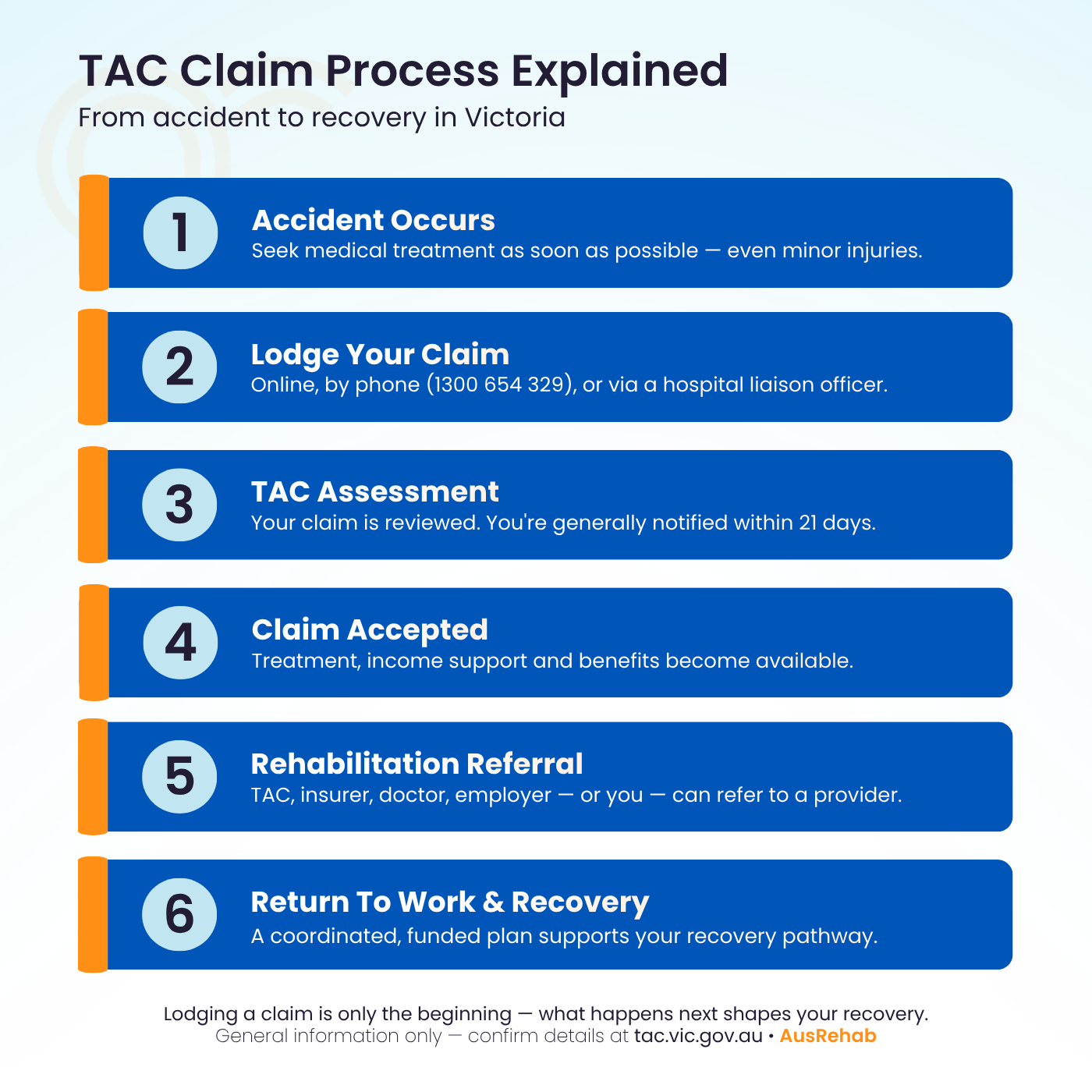
| Stage | What Happens |
|---|---|
| Accident occurs | Seek medical treatment and collect accident details |
| Lodge claim | Submit the TAC claim form and supporting information |
| TAC assessment | The TAC reviews the claim and may request more information |
| Claim accepted | Eligible treatments and benefits may become available |
| Rehabilitation referral | Coordinated recovery support may begin |
| Return to work | A suitable recovery and work pathway may continue |
Understanding the TAC process can make recovery feel less overwhelming.
Lodge Online
You can submit your claim through the TAC’s online lodgement form. The form allows you to save your progress and return later using a link and passcode sent by email.
You have 10 calendar days to complete a saved form. Your claim is not officially lodged until you select Submit and receive an email confirming the submission.
Lodge by Phone
You can lodge a claim by calling the TAC on 1300 654 329. The claims line is available Monday to Friday from 8.30 am to 5.00 pm.
Lodge Through a Hospital
Some hospitals can lodge a claim on behalf of a patient who has been admitted after a transport accident. Ask the hospital’s Patient Liaison Officer whether this service is available.
| Category | What You Need |
|---|---|
| Accident details | Date, location, circumstances, other parties, witnesses, vehicle registrations, and police or public transport incident details |
| Injury information | A hospital discharge summary, signed Certificate of Capacity, medical certificate, or letter from your GP or allied health professional |
| Income details | Employment and income information if the accident has affected your ability to work |
| Bank details | Bank account details for any payments or reimbursements |
Your TAC claim in Victoria may move faster when you provide accurate accident details, medical certificates, employment information, and payment details from the start.
⚠️You Do Not Need to Wait Until Things Get Worse
Early access to treatment and rehabilitation is often linked to better recovery outcomes. Within 21 days of receiving a claim, the TAC must generally accept or reject it, request further information, or ask the injured person to attend a medical examination. For approved treatments and services, the TAC may pay the provider directly at the TAC rate. In other cases, the injured person may pay first and request reimbursement.
What Happens If Your TAC Claim Is Rejected?
A TAC claim rejection does not necessarily mean the process is over. If you disagree with the decision, you can ask the TAC to explain its reasons and explore the available review options. The TAC recommends contacting them first, as some issues may be resolved at this stage.
New medical information can also be considered during an informal review. This may include updated reports or evidence from your treating GP, specialist, or other health professional.
| Step | What You Can Do |
|---|---|
| Contact the TAC | Ask why the claim was rejected and discuss the decision |
| Informal review | Request a review by a TAC Review Manager |
| Additional evidence | Provide relevant medical reports or other supporting information |
| Dispute resolution | If legally represented, discuss the TAC dispute resolution process with your lawyer |
| VCAT review | Apply to VCAT for an independent review of the TAC decision |
The appropriate review pathway depends on your circumstances. TAC review and VCAT applications are also subject to time limits.
An informal review is free and is conducted by a TAC Review Manager who is independent of the area that made the original decision. Requests generally need to be made within 12 months of becoming aware of the decision.
For people with legal representation, the TAC also has a formal dispute resolution process. A VCAT review may be available instead of these processes or when the person remains dissatisfied with the outcome.
💡 The same principle can apply if treatment or support is declined or stopped during recovery. Updated clinical evidence may provide new information for the TAC to consider when reviewing its decision.
*This is general information and is not legal advice.
Can You Claim If the Accident Was Your Fault?
The TAC generally assesses eligibility based on the transport accident and the injuries sustained, rather than who caused the accident. If another person was wholly or partly responsible for the accident, additional compensation may be available in some circumstances.
However, if someone else was fully or partly responsible for the accident, you may be able to claim additional compensation. For example, if you have a serious injury and another person was at fault (or partly at fault), you may be eligible to make a common law claim for further compensation.
⚠️ Can You Claim If the Accident Was Your Fault?
Yes. The TAC is a no-fault scheme, which means being responsible for the accident does not automatically prevent you from making a claim. If you are eligible, you may still receive treatment, rehabilitation, income support, and other TAC benefits.
Fault does not automatically determine whether you can make a TAC claim. It may, however, become relevant when considering certain additional forms of compensation. Contact the TAC directly or seek independent legal advice if you need information about compensation that may apply to your circumstances.
What Support Can TAC Provide?
The support available depends on your injuries, recovery needs, work capacity, and individual circumstances. TAC lists medical treatment, rehabilitation, disability services, income support, travel support, and household support among the areas it may fund.
| Benefit | Examples |
|---|---|
| Medical treatment | Hospital care, GP and specialist appointments, surgery, physiotherapy, psychology, and other approved treatment |
| Income support | Payments that may be available when injuries prevent or reduce your ability to work |
| Rehabilitation | Services designed to improve function, independence, and recovery |
| Home support | Approved help with tasks such as cleaning, gardening, or childcare |
| Modifications | Approved changes to a home or vehicle when required because of transport accident injuries |
| Return to work | Support and coordination to help you safely return to suitable work |
The type and level of support available depends on your circumstances and TAC approval requirements.
TAC income support may also be available to eligible people whose ability to work has been affected by their injuries. The TAC can review a person’s work capacity as recovery progresses and provide return-to-work support where appropriate.
💡 For a more detailed breakdown of available support, including income payments and other compensation, read What TAC Benefits Can You Claim After a Car Accident in Victoria?
What Happens After Your TAC Claim Is Accepted?
The TAC may monitor your recovery and communicate with you or your healthcare providers about your treatment and support needs. If your injuries affect your ability to work, vocational rehabilitation may include workplace assessment, return-to-work planning, suitable duties, or other assistance.
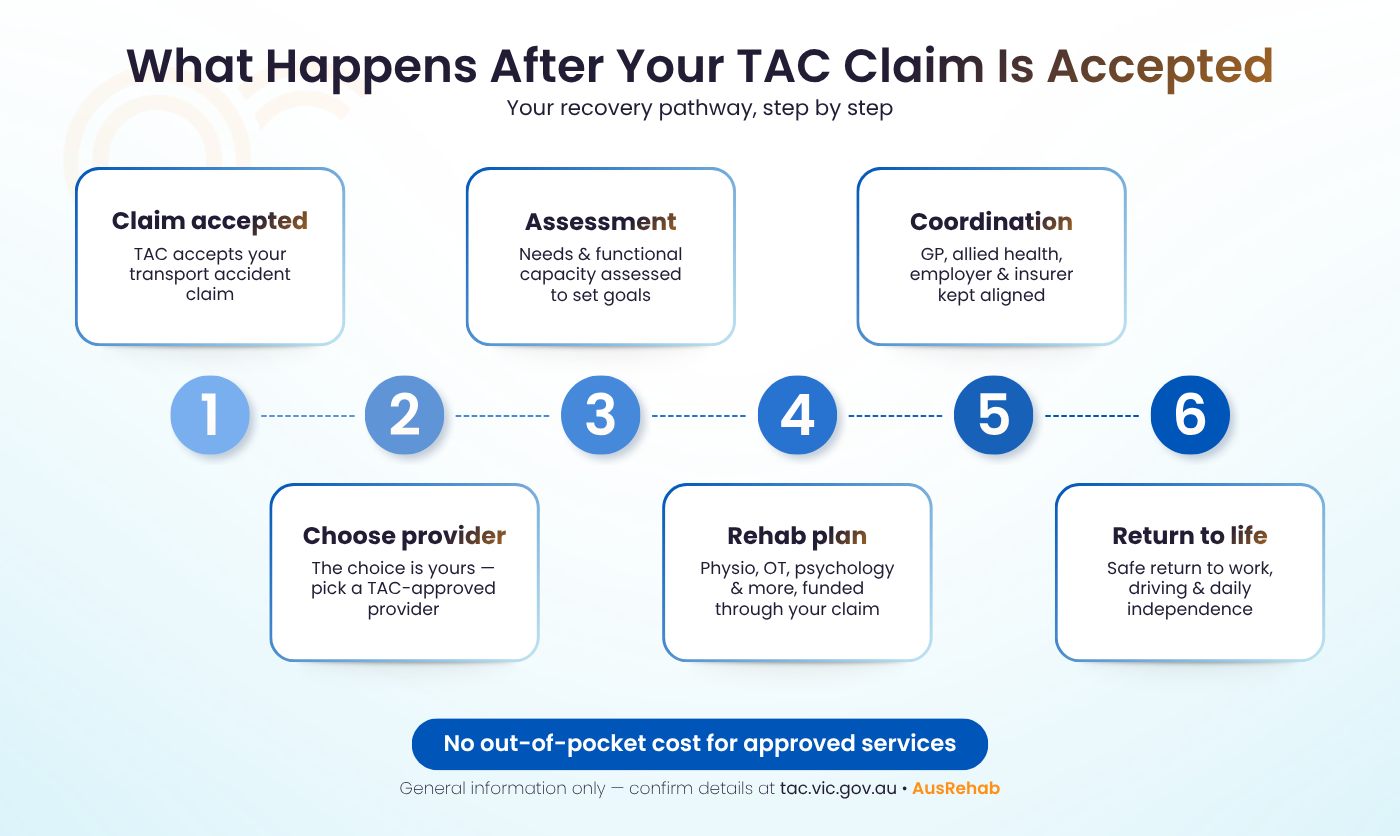
| Stage | Focus |
|---|---|
| Treatment | Address injuries and symptoms |
| Assessment | Understand your current needs and capacity |
| Rehabilitation | Improve function, independence, and confidence |
| Return to work | Rebuild capacity and support a safe return |
| Ongoing review | Monitor progress and adjust support when needed |
Recovery does not follow the same pathway for everyone. The services you receive will depend on your injuries, goals, and individual support needs.
💡What Happens After a TAC Claim Is Accepted?
Once your TAC claim is accepted, you may be able to access treatment, rehabilitation services, income support, and return-to-work assistance depending on your injuries and circumstances. The TAC, the insurer, your doctor, your employer, or you can initiate a referral to an approved rehabilitation provider.
What Does a TAC Rehabilitation Provider Actually Do?
A TAC rehabilitation provider works alongside the treating team to support the injured person’s recovery and practical rehabilitation goals.
💡What Does a TAC Rehabilitation Provider Do?
A TAC-approved rehabilitation provider helps an injured person rebuild capacity and work towards a safe return to work. Depending on the person’s needs, this may include assessment, return-to-work planning, workplace support, vocational guidance, and coordination with the employer and treating health professionals.
Who Can Start the Rehabilitation Referral Process?
A treating health professional may recommend vocational rehabilitation. The injured person can also discuss support with their TAC coordinator and choose a provider from the TAC vocational services panel. The TAC can then arrange the referral.
| Person or Organisation | Role in the Referral Process |
|---|---|
| TAC | Can coordinate and make the formal referral |
| Treating GP or health professional | Can recommend vocational rehabilitation |
| Employer | Can work with the TAC and provider around return-to-work needs |
| Injured person | Can discuss support with the TAC and choose an eligible provider |
| Rehabilitation provider | Works with the parties involved once services are arranged |
The exact referral pathway may depend on the rehabilitation service required and the person’s circumstances.
What Support Can a Rehabilitation Provider Provide?
TAC vocational providers may assess a person’s abilities and workplace, develop a personalised return-to-work plan, recommend workplace changes, organise retraining, and provide job-seeking support where needed.
| Function | Purpose |
|---|---|
| Initial assessment | Understand current capacity and support needs |
| Treatment coordination | Keep rehabilitation goals aligned with the treating team |
| Return-to-work planning | Develop a practical pathway back to suitable work |
| Employer liaison | Explore suitable duties, hours, or workplace changes |
| Progress monitoring | Review progress and adjust the rehabilitation plan |
| Vocational support | Assist with retraining or finding suitable work when returning to the previous role is not possible |
Working with a TAC-approved provider gives you coordinated support across assessment, rehabilitation planning, employer communication, and progress monitoring.
💡 For GPs, allied health professionals, employers, and case managers: Early communication can make the rehabilitation pathway easier to coordinate. The provider works with the injured person’s treating health professionals and employer so that return-to-work plans reflect current capacity and recovery needs.
How AusRehab Works Within the TAC System
You know how to make a claim. The next step is understanding what recovery support may look like once your claim is active.
AusRehab provides motor vehicle rehabilitation and case management support for people with TAC claims in Victoria. The team works alongside doctors, treating providers, insurers, and other people involved in the client’s recovery. The aim is to keep rehabilitation organised around the person’s injuries, daily needs, and recovery goals.
AusRehab’s role is to support rehabilitation, not replace the treating team or make decisions on behalf of the TAC.
| Service | What It Means in Practice |
|---|---|
| Initial Needs Assessment | Assesses injuries, treatment, living situation, and immediate support needs to set priorities from the start |
| Functional Capacity Evaluation | Assesses current physical function and activity tolerance to help guide rehabilitation planning |
| Employer, Insurer & Treating Provider Coordination | Keeps communication clear between the people involved in recovery |
| ADL Assessment & Domestic Assistance | Assesses how an injury affects everyday activities and identifies strategies to improve independence |
| Vehicle Ergonomic Assessment | Reviews seating, posture, comfort, and vehicle access after injury |
| Driving Rehabilitation Programs | Provides structured assessment and support to rebuild function, independence, and confidence with driving |
The services required will depend on the person’s injuries, recovery goals, claim approval, and individual circumstances.
For TAC vocational rehabilitation, clients can choose from providers on the TAC’s vocational services panel. A treating health professional may recommend vocational rehabilitation, or the client can discuss it with their TAC coordinator. The TAC can then arrange the referral to the selected provider.
💡 Approved TAC Rehabilitation May Be Funded Through Your Claim
Approved services may be funded through an accepted TAC claim. In many cases, the provider invoices the TAC directly. If a client pays for an approved service themselves, reimbursement may be available at the TAC rate. Gap costs can apply where a provider charges more than the TAC rate.
Why Early Rehabilitation Matters
Starting TAC rehabilitation early can help identify recovery needs before they become harder to manage. It also gives the injured person, treating team, employer, and rehabilitation provider more time to coordinate practical support around recovery and work capacity.
The Victorian Department of Health describes rehabilitation as supporting independence and quality of life. ARPA highlights the role of workplace rehabilitation providers in achieving timely and sustainable return-to-work outcomes after injury or illness.
| Early Rehabilitation | Delayed Rehabilitation |
|---|---|
| Support needs identified sooner | Needs may go unaddressed for longer |
| Care can be coordinated earlier | Support may become more fragmented |
| Recovery goals are established sooner | Greater uncertainty around next steps |
| Work capacity can be reviewed progressively | Return-to-work planning may begin later |
Early rehabilitation can create a clearer and more coordinated recovery pathway, particularly when an injury affects everyday function or the ability to work.
Your Recovery Starts With More Than Just Making a Claim
Making a TAC claim is often the first step after a transport accident. What happens next can be just as important.
The right rehabilitation support can help you understand your recovery needs, coordinate treatment, rebuild function, and work towards greater independence or a safe return to work.
Speak With AusRehab
If your TAC claim has been accepted and you are unsure what rehabilitation support may be available, AusRehab can help you understand your options and coordinate a practical recovery pathway based on your needs.
Frequently Asked Questions (FAQs)
How do you make a TAC claim after a car accident?
You can lodge a TAC claim through the TAC’s online form, by phone on 1300 654 329, or through a hospital Patient Liaison Officer at participating hospitals. You will generally need details about the accident and your injuries. You may also need supporting medical documents, employment and income information, and bank details.
Is TAC no-fault in Victoria?
Yes. The TAC operates as a no-fault insurance scheme. This means you may be able to make a claim for treatment and support even if the transport accident was your fault.
What documents do I need for a TAC claim?
You will generally need details of the accident and written information about your injuries. This may include a hospital discharge summary, signed Certificate of Capacity, medical certificate, or letter from your doctor or allied health professional. The TAC may also ask for employment, income, and bank details.
Do I need a police report for a TAC claim?
Generally, yes. The TAC asks for the police report number or the details of the officer who received the accident report. For public transport accidents, a police report is not normally required. Instead, you should provide the incident report number from the relevant transport operator.
What if my TAC claim is rejected?
A rejected TAC claim is not necessarily the end of the process. You can contact the TAC to discuss the decision and provide additional information. You may also request a free informal review. Other review options include the TAC dispute resolution process for legally represented clients and an application to VCAT. Review time limits apply.
Can I choose my own TAC rehabilitation provider?
For vocational rehabilitation services, you can choose a provider from the TAC vocational provider panel. Your treating health professional may recommend vocational rehabilitation, or you can discuss it with your TAC coordinator. The TAC can then refer you to your selected panel provider.
⚠️ Disclaimer: This article provides general information only and is not legal advice.