


Prefer to Listen? Play this quick summary instead!
Returning to work after an injury can feel uncertain. Many workers worry they need to be fully recovered before stepping back into the workplace. This is a common misunderstanding.
In most suitable duties in workers compensation programs, a worker does not need to be fully healed before returning. Recovery often happens gradually. Work can be part of that process when the tasks are safe and aligned with medical advice.
Read on to learn what suitable duties are, how they support recovery, who decides what duties are appropriate, and what happens when suitable duties are not immediately available.
💡 REMEMBER!
Returning to safe work in a structured way is often part of recovery. It is not a sign that you are fully healed.
What Are Suitable Duties?
In modified duties workers compensation programs, suitable duties allow a worker to return to the workplace while respecting medical restrictions. These tasks are designed to be safe and manageable. They focus on what the worker can currently do, not on the full demands of their original role.
Suitable duties may include light duties at work, reduced physical tasks, administrative work, or structured responsibilities that avoid movements or activities restricted by a doctor. The plan is usually guided by a Certificate of Capacity provided by the treating doctor. This certificate outlines the worker’s abilities, restrictions, and recommended work hours.
Suitable Duties Can Change Over Time
Suitable duties are not fixed. They evolve as recovery progresses.
As a worker regains strength, mobility, or stamina, the duties may be adjusted. Doctors, employers, insurers, and rehabilitation providers often review the plan regularly. The goal is a gradual and safe return to normal work duties whenever possible.
Why Suitable Duties Matter
A structured return-to-work plan after injury helps workers stay connected to their normal routine. Work provides stability, purpose, and social interaction. These factors can support confidence and reduce the isolation that sometimes follows an injury.
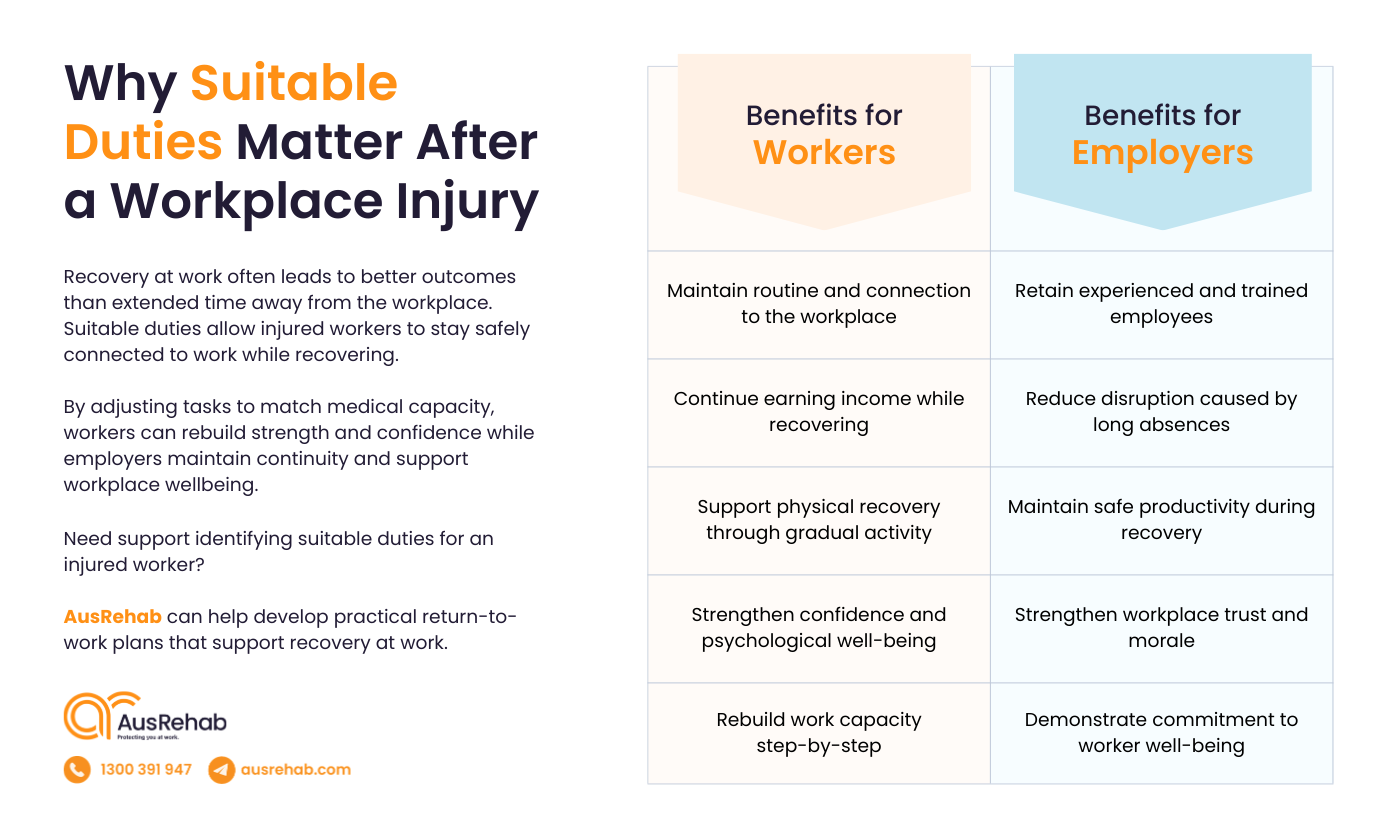
Suitable duties also show a clear commitment to worker well-being. A supportive return-to-work process strengthens trust between workers and employers.
💡 Quick takeaway: Staying connected to safe work is generally better for recovery than unnecessary time away.
Examples of Suitable Duties
Many examples of suitable duties involve modifying how work is performed rather than removing work completely. This may include a reduced hours return to work, lighter physical tasks, or responsibilities that place less strain on the injured area. In some cases, workers may temporarily assist with planning, documentation, or administrative duties.
Workplaces may also adjust equipment or change the work environment to improve safety. Some workers may perform duties in a different department for a short period while they rebuild capacity.
The key principle is alignment with medical guidance. Duties should reflect the worker’s current functional ability and the recommendations in their certificate of capacity.
Suitable Duties Examples by Role
Examples of Suitable Duties for a Safe Return to Work
| Pre-Injury Role | Example Suitable Duties |
|---|---|
| Construction worker | Safety checks, documentation, tool inventory, and planning tasks |
| Warehouse worker | Stock auditing, labelling, scanning, and dispatch administration |
| Nurse | Education tasks, triage administration, patient scheduling, and documentation |
| Office worker | Reduced hours, low-intensity administration, structured breaks, alternate tasks |
| Retail worker | Light stocking, customer service at the counter, pricing tasks, and short shifts |
Who Decides What Duties Are Suitable?
Collaborative Decision-Making
Determining suitable duties is a collaborative process, but it begins with medical advice. The treating doctor provides this guidance through the Certificate of Capacity, which outlines what the worker can safely do during their recovery. This certificate may list specific restrictions, such as limits on lifting, standing, repetitive movements, or work hours, to ensure any assigned duties support safe and gradual rehabilitation.
Employers then review the workplace and identify tasks that match those medical recommendations. The worker provides input about their comfort, limitations, and progress during recovery. Insurers help ensure the duties align with workers compensation requirements. A workplace rehabilitation provider may assist by assessing the work environment and helping translate medical restrictions into practical tasks.
Medical Capacity Comes First
Medical capacity always comes first when deciding who decides suitable duties in a return-to-work plan. Duties must match the restrictions listed on the certificate of capacity. Tasks should not exceed those limits. As recovery improves, duties can be reviewed and progressively upgraded to rebuild capacity safely.
💡 Suggested Reading: To learn more about this medical certificate, read our blog on What is a Certificate of Capacity.
What If Suitable Duties Aren’t Available?
Even with the best intentions, some workplaces can’t always provide adjusted or modified tasks straight away. When this happens, the return‑to‑work process doesn’t stop. It simply requires alternative pathways to keep the worker’s recovery progressing.
When Immediate Duties Aren’t Possible
Not every workplace can provide modified or light duties immediately. Some jobs involve physical demands that can’t be temporarily adjusted, while smaller businesses may not have enough task variety to offer safe work options. When there are no suitable duties available, the worker still continues to receive support.
During this period, the worker can remain engaged in medical treatment, rehabilitation programs, and regular capacity reviews while the insurer, employer, and treating doctor consider possible solutions. The overall goal stays the same: support recovery and prepare for a safe, sustainable return to work.
Alternative Options
When suitable duties are not available within the original workplace, other pathways may be considered. Some workers participate in recovery at work programs that gradually rebuild strength and confidence.
In other cases, the host employer’s workers compensation arrangements may be used. A host employer placement allows a worker to temporarily perform safe duties with another organisation. These duties align with the worker’s medical capacity while recovery continues.
Rehabilitation providers such as AusRehab often help coordinate these options. They assess the worker’s capacity, identify appropriate tasks, and ensure the duties remain safe and structured.
Do Employers Have to Provide Suitable Duties?
Expectations around suitable duties differ between Australian workers compensation schemes, but the aim is consistent: employers are encouraged to support an injured worker’s return to safe, meaningful work whenever possible. Understanding these obligations helps clarify what employers need to consider during recovery planning.
General Obligations
Under employer obligations for workers compensation, workplaces should explore whether temporary or modified tasks can support a safe return to work. Although the requirements to provide suitable duties vary between states and territories, each scheme emphasises the importance of making reasonable efforts to find appropriate work.
The Certificate of Capacity guides what a worker can safely do, and employers should review available roles or adjust tasks where feasible to align with those restrictions.
Employers Should Show
To demonstrate they have met their obligations, employers need to show they genuinely explored potential duties. This involves reviewing the tasks within the business, assessing whether modifications are practical, and consulting with the worker and their treating doctor.
Clear, ongoing communication with the insurer and any rehabilitation provider also plays a key role. Transparent discussions help ensure tasks remain safe, appropriate, and consistent with medical advice.
When employers actively evaluate and communicate about suitable duties, the return‑to‑work process becomes more cooperative, predictable, and supportive for everyone involved.
The Role of Rehabilitation Providers in Suitable Duties
A workplace rehabilitation provider helps translate medical advice into practical duties that can be performed safely at work. This support becomes valuable when medical restrictions need to be applied in a real workplace setting.
Rehabilitation providers review the worker’s Certificate of Capacity and assess the demands of the job. They may conduct workplace assessments to understand the physical tasks, environment, and equipment involved. This helps ensure duties align with current medical restrictions.
A graded return-to-work plan is also often developed. This plan outlines suitable duties, work hours, and progression stages. Duties may start with lighter tasks or reduced hours. They are adjusted gradually as the worker’s capacity improves.
Rehabilitation providers also coordinate communication between the injured worker, employer, treating doctor, and insurer. Clear communication helps avoid misunderstandings and keeps the return-to-work process structured.
Common Challenges and How Rehabilitation Support Helps
Translating Medical Restrictions into Suitable Duties with Rehab Support
| Challenge | Rehab Support |
|---|---|
| Physical restrictions | Match tasks to restrictions and safe movement limits |
| Reduced stamina | Graded hours and a pacing plan that builds capacity over time |
| Manual handling limits | Identify safer alternatives and adjust the task setup |
| Workplace setup issues | Workstation or equipment modifications, where needed |
| Communication gaps | Coordinate between worker, employer, doctor, and insurer |
| Unclear duties plan | Structured return to work plan with regular reviews |
Common Misunderstandings About Suitable Duties
Misconceptions about suitable duties can create uncertainty or hesitation for workers returning after an injury. Addressing these misunderstandings helps build confidence and clarifies how suitable duties support safe recovery.
Myth: “Light duties mean I’m fully recovered.”
Light or suitable duties do not signal full recovery. Instead, they are tailored to a worker’s current medical capacity. Tasks are adjusted so the worker can remain engaged in safe, meaningful work while healing continues.
Myth: “Light duties don’t help.”
In reality, safe work activity often plays an important role in rehabilitation. Structured duties help rebuild physical capacity, re‑establish routine, and support emotional well-being, all while staying within medically approved limits.
Myth: “If I can’t do my old job, I shouldn’t work.”
A worker doesn’t need to return to their full pre‑injury role immediately. Modified duties provide a gradual pathway back to normal work by allowing the worker to participate at a level that matches their abilities at each stage of recovery.
Myth: “Suitable duties are permanent.”
Suitable duties are always temporary. They are reviewed regularly as medical capacity changes and are updated or phased out once the worker is ready to resume their usual tasks.
Support That Helps You Return to Work Safely
Returning to work after an injury can feel overwhelming, especially if you’re unsure what you can safely do. Suitable duties are designed to guide recovery at a manageable pace, helping you rebuild confidence, strength, and work capacity without pressure to be fully healed.
AusRehab supports injured workers and employers through workplace assessments, graded return-to-work planning, and clear coordination with treating doctors and insurers.
If you have questions about suitable duties or returning to work safely, support is available.
Frequently Asked Questions (FAQs)
Are suitable duties permanent?
No. Suitable duties are temporary and designed to support recovery after an injury. They reflect a worker’s current medical capacity and are usually reviewed as recovery progresses. As the worker regains strength, mobility, or stamina, duties may be adjusted or gradually upgraded. The goal is to help the worker safely rebuild capacity and eventually return to their normal role, where possible.
Do light duties actually help recovery?
Yes. Safe, well‑structured duties often support physical healing and help restore routine, confidence, and work capacity. Many workers recover faster when they stay engaged in appropriate tasks rather than staying completely off work.
Are employers required to provide suitable duties?
In most jurisdictions, employers are expected to consider suitable duties where it is reasonable and practical to do so. They must explore options that align with the worker’s medical capacity, but the specific requirements vary between states and territories.
Can I refuse suitable duties at work?
Workers are generally expected to perform suitable duties when the tasks match their medical capacity and are considered safe. Suitable duties are designed to support recovery and maintain connection with work. If a worker has concerns about the duties offered, they should discuss them with their treating doctor, employer, insurer, or rehabilitation provider so the tasks can be reviewed and adjusted if necessary.
How can a rehab provider help with suitable duties?
A rehabilitation provider helps match medical restrictions with safe work tasks, develop return-to-work plans, and coordinate communication between everyone involved in the recovery process.