By
Suzzy at AusRehab
By
Suzzy at AusRehab
Whole Person Impairment (WPI) is a medical rating used in NSW to measure how much an injury affects a person in the long term. It shows the level of permanent impairment after physical or psychological harm. Your WPI rating can guide access to compensation, treatment, and long-term support. AusRehab helps workers and claimants through accurate functional assessments and clear recovery pathways that support better outcomes.
Whole Person Impairment (WPI) shows the percentage of permanent impairment a person experiences after an injury. It explains how much an injury affects physical movement, psychological stability, and day-to-day activities. It also reflects how an injury changes long-term function and quality of life.
A WPI rating provides a structured way to understand the long-term impact of an injury. It guides decisions about compensation, medical treatment, and support services. It also helps insurers, employers, and health professionals plan what a person needs to stay safe, recover well, and maintain independence.
Many people ask what WPI is, because the rating can feel technical. In NSW, doctors must follow the SIRA Guidelines for the Evaluation of Permanent Impairment to ensure a consistent and fair result.Whole person impairment NSW ratings often shape return-to-work plans and long-term care funding. Your rating becomes an objective measure of how your condition affects your mobility, confidence, and daily routine.
💡 Did You Know? WPI captures the real impact of an injury on daily life. It reflects changes in movement, mental health, work capacity, and long-term independence.
WPI is important in how compensation and support are granted in NSW. It provides a clear medical percentage that shows the lasting impact of an injury. This rating helps decide if a person can access lump sum payments or extended weekly payments under workers’ compensation. It also guides what long-term care or rehabilitation may be needed.For Compulsory Third Party (CTP) claimants, WPI defines whether an injury is minor or non-minor. This classification affects access to ongoing income support, treatment, and long-term services. WPI also helps insurers and medical specialists understand the functional impact of an injury so treatment decisions stay consistent and fair. The SIRA guidelines ensure all permanent impairment NSW ratings follow the same standards.
A WPI assessment in NSW is a detailed medical review completed by trained and accredited assessors. The purpose is to measure the lasting impact of an injury on a person’s daily function. Assessors look at medical records, imaging results, treatment notes, and current symptoms. They consider mobility, strength, pain levels, psychological changes, and the person’s capacity to manage routine tasks.
Physical and psychological injuries use different assessment tools. Each rating must follow the SIRA Permanent Impairment Guidelines so results remain consistent across workers’ compensation and CTP claims. Many assessors request a Functional Capacity Evaluation. This helps verify what a person can safely do at work or at home through structured, objective testing. It also supports accuracy in the final rating.
A permanent impairment assessment gives insurers and treating teams a clear picture of long-term needs. It shows whether the person is likely to return to full duties or if ongoing restrictions are expected. The final WPI score also guides potential entitlements such as lump sum compensation or extended support.
A physical injury WPI assessment in NSW evaluates how an injury affects strength, movement, and daily function. It covers spinal injuries, limb conditions, neurological issues, and any limitation that restricts a person’s ability to move with ease. Assessors check range of motion, muscle strength, endurance, and tolerance during routine tasks. They also review imaging and treatment history to understand long-term impact.
Common examples include manual handling hazards such as back injuries that limit bending, fractures that reduce weight-bearing capacity, and hand or wrist injuries that weaken grip strength. Each condition is measured using standard tools from the SIRA Permanent Impairment Guidelines. The final rating reflects how much the injury affects safe work capacity and independence.
Any physical injury that causes permanent loss of strength, movement, or function can be assessed for a WPI physical rating.
A psychological injury WPI assessment in NSW measures how conditions like post-traumatic stress disorder (PTSD), anxiety, depression, and trauma-related disorders affect daily functioning. Assessors use the Psychiatric Impairment Rating Scale. This model reviews impact across areas such as self-care, concentration, social interactions, and the ability to handle routine stress. The process focuses on how the injury affects real-life participation rather than symptoms alone.
Workers’ compensation uses a higher threshold for psychological injuries. The condition must be clinically diagnosed and linked to work through clear medical evidence. Assessors review treatment notes, specialist reports, and functional changes to determine permanent impairment. The final rating reflects the worker’s long-term psychological capacity and their ability to return to safe and sustainable work.
Yes. Psychological injuries must meet a higher standard of proof and require clinical evidence that shows a clear and lasting work-related impact.
WPI ratings decide what a worker can claim after a serious injury. A WPI workers’ compensation NSW assessment sets clear thresholds. Physical injuries need 11% WPI or higher before a worker can access lump sum payments. Psychological injuries require at least 15% WPI because they follow a stricter standard and rely on stronger clinical evidence.
Workers with 20% WPI or more may qualify for extended weekly payments. This level reflects a significant and lasting loss of function. Insurers use these thresholds to understand long-term work capacity and financial needs.
Simple examples show how these numbers work in real situations: A worker with a back injury rated at 8% WPI can access medical treatment only. A worker with a shoulder injury rated at 12% WPI qualifies for a lump sum because they pass the 11% threshold. A worker with a diagnosed psychological injury rated at 16% WPI can access lump sums because they exceed the 15% requirement. A worker with 22% WPI may receive extended weekly payments because the rating shows major permanent impairment.
Workers’ Compensation WPI Thresholds
Injury Type | Required WPI | Entitlements |
Physical Injury | 11% or more | Lump sum compensation |
Psychological Injury | 15% or more | Lump sum compensation |
Any Injury | Over 20% | Extended weekly payments and support |
WPI thresholds for physical and psychological injuries under NSW workers’ compensation.
Whole Person Impairment ratings guide how injuries are classified under the NSW CTP scheme. A WPI CTP assessment decides whether an injury is a minor or a non-minor injury in the NSW classification. A rating of 10% WPI or less is considered minor. A rating of more than 10% WPI is considered non-minor.
This cut-off shapes the level of support a person can access after a motor accident. Workers with a minor injury can claim income support and medical treatment for up to 52 weeks. Workers with a non-minor injury can receive extended income support, long-term treatment, and broader care options.
To better understand the difference, take this as an example: A person with a mild neck strain and soft tissue injury may receive a 5% WPI rating. This stays in the minor injury category because it involves short-term symptoms and no permanent loss of function. A person with a long-term spinal injury who develops chronic mobility issues may receive a 12% WPI rating. This places them in the non-minor category because the impairment affects daily function and recovery needs.
Workers’ Compensation WPI Thresholds
Injury Type | Required WPI | Entitlements |
Physical Injury | 11% or more | Lump sum compensation |
Psychological Injury | 15% or more | Lump sum compensation |
Any Injury | Over 20% | Extended weekly payments and support |
WPI thresholds for minor and non-minor injuries under the NSW CTP scheme.
Your WPI assessment in NSW shapes the level of care you receive after an injury. A higher rating often means longer rehabilitation and more funded services. This support can include physiotherapy, psychology, domestic help and activities of daily living (ADL) support in NSW for daily tasks.
WPI also guides your rehabilitation plan. It shows how your injury affects movement, stamina, concentration and daily function. This information helps your team set clear work restrictions and build a return-to-work plan that matches your capacity. It also helps providers track your progress and adjust treatment when needed.
Your rating influences how long support stays in place. Workers with higher WPI can access extended rehabilitation and stability-focused programs. Workers with lower ratings usually receive short-term care that aims to restore function and work readiness. This system keeps entitlements consistent and predictable.
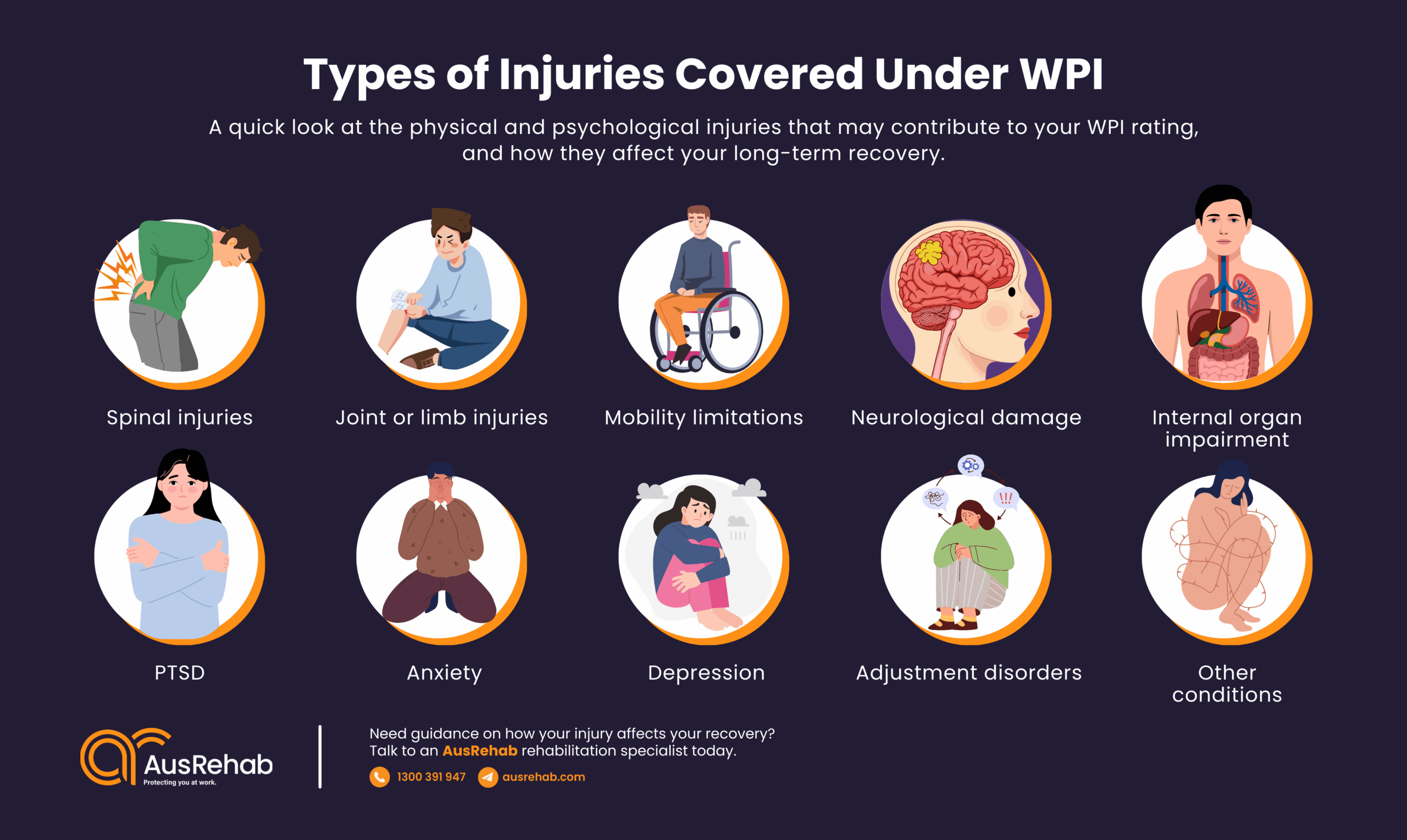
A higher WPI rating can give you access to longer treatment, broader support and structured recovery planning.
AusRehab strengthens your WPI assessment in NSW by providing clear functional evidence and coordinated recovery support. Our team delivers objective assessments, structured rehabilitation and practical independence programs that help workers and motor accident claimants progress safely.
Functional Capacity Evaluation
A Functional Capacity Evaluation measures mobility, strength, endurance and tolerance for daily and work-related tasks. It shows how your injury affects lifting, reaching, walking and repetitive activities. This objective data supports your WPI assessment and helps insurers and specialists understand your real functional limits and capacity for safe duties.
Workplace Rehabilitation Programs
Our workplace rehabilitation programs focus on a safe and meaningful return to work. We create clear plans that match your functional abilities, provide suitable duties and maintain a connection with your employer. Regular communication with your treating practitioners ensures each program remains safe, practical and aligned with recovery goals.
Recovery Support for Motor Accident Claimants
Motor accident claimants can access ADL and independence programs that support personal care, household tasks and safe mobility. These services assist with dressing, showering, meal preparation and everyday routines affected by injury. We also offer functional skills and community re-engagement training to rebuild confidence and independence.
Care coordination supports all services. We collaborate with insurers, doctors, employers and treatment providers to keep the recovery process organised and reduce delays, mixed messages and stress.
How does AusRehab support WPI assessments and recovery?
We provide assessments, workplace rehabilitation and coordinated care that support accurate ratings and a smooth recovery. For instance, a worker with a back injury may complete a Functional Capacity Evaluation that outlines lifting limits and endurance. This information guides both the WPI rating and the return-to-work plan. Meanwhile, a motor accident claimant with a shoulder injury may receive ADL support that helps them manage dressing and household tasks until strength returns.
Your WPI rating can influence your treatment, income support and long-term recovery pathway. You do not need to navigate this process alone. AusRehab provides clear guidance through assessments, functional evaluations and rehabilitation programs that support your return to work and daily independence. Our team works closely with insurers, employers and healthcare providers to make sure your recovery stays on track.
Need help understanding your WPI rating or planning your recovery?
📞 1300 391 947
📧 office@ausrehab.com
🔗 Speak with an AusRehab rehabilitation specialist today.
Whole Person Impairment, or WPI, is the percentage rating that shows how much an injury affects your physical function, psychological health and daily living. It helps determine your long-term needs and your entitlements under NSW workers’ compensation or CTP schemes.
WPI is used to provide a consistent medical rating of how permanent an injury is. This rating helps determine access to lump sums, weekly payments, treatment and long-term support across workers’ compensation and CTP claims.
WPI assessment in NSW is completed by accredited medical assessors. They review medical records, imaging, functional capacity and psychological symptoms. They follow the SIRA Guidelines for Permanent Impairment to produce a final rating.
You need 11% WPI for a physical injury to access lump sum compensation. You need 15% WPI for a psychological injury. Workers with more than 20% WPI may also qualify for extended weekly payments and long-term support.
Under NSW CTP rules, 10% WPI or less is classed as a minor injury. More than 10% WPI is classed as a non-minor injury. A rating above 10% grants access to extended income support, treatment and long-term care.
The assessor submits a formal report to your insurer. The insurer uses this report to confirm your entitlements, including lump sums, weekly benefits and treatment plans. Your rehabilitation provider then adjusts your program to align with your assessed needs.
Only SIRA-accredited medical assessors can complete a WPI assessment in NSW. These assessors include trained doctors, specialists and psychiatrists who follow the official SIRA impairment guidelines
Most assessments take one to two hours, depending on the type of injury and the complexity of your symptoms. Complex physical injuries or psychiatric assessments may take longer.
AusRehab completes Functional Capacity Evaluations, coordinates workplace rehabilitation and supports motor accident claimants through ADL and independence programs. Our team guides you through assessments, works with insurers and helps you plan a safe and sustainable recovery.
Yes. You can claim WPI for both a physical and psychological injury. Each injury type is assessed separately, and the combined rating follows the SIRA rules for whole person impairment calculations.
Don’t forget to share!

Subscribe to stay updated on the latest workplace news.

Resolve your work
place injury today