

Prefer to Listen? Play this quick summary instead!
Remote work is now a standard way of working across Australia. More employees are spending long hours at home workstations. Injury patterns are changing as a result. Remote work injuries now feature heavily in workers’ compensation data. Most claims involve posture, repetitive movement, or mental strain.
Coverage under workers’ compensation for remote work still applies. Compensability is not automatic. Injuries must arise from work duties and approved work hours. Safe Work Australia confirms that working from home does not remove legal protection. It also confirms that claims face closer review. Clear evidence matters. Workers need to understand what counts as a working-from-home injury and what does not.
What Counts as a Work-Related Injury When Working From Home?
A work-from-home injury claim depends on one core test. The injury must arise out of, or in the course of, employment. This means the injury occurs while you are performing approved work duties. It must happen during recognised work hours. It must also be linked to your work tasks or work environment.
For remote work injuries, location still matters. The injury should occur within your designated workspace. This can include a home office, study, or other agreed work area. Injuries caused by poor ergonomics, repetitive computer use, or work-related stress can be covered. Personal activities unrelated to work are usually excluded.
Coverage is not automatic. Insurers look for a clear connection between the injury and your job. Medical evidence, timelines, and consistency all matter. When these elements align, what injuries are covered when working from home becomes clearer and easier to establish.
| Injury Type | Description | Everyday Example | Compensable? |
|---|---|---|---|
| Musculoskeletal strain | Poor posture or prolonged sitting | Working from a dining chair or couch | Yes |
| RSI or wrist strain | Repetitive typing and mouse use | Laptop without external devices | Yes |
| Headaches or migraines | Poor lighting or screen glare | Back-to-back video calls | Usually not standalone |
| Slips, trips, falls | Hazards in the workspace | Tripping on cords | Yes, if during work |
| Psychological injury | Stress, isolation, burnout | Excessive meetings and pressure | Yes, if work-caused |
💡 Did You Know?
Most remote work injuries develop gradually. Poor ergonomics and prolonged sitting drive many claims. Psychological injuries are also increasing, linked to isolation, workload pressure, and blurred work boundaries. These claims face closer scrutiny because home-based incidents are harder to evidence. Workers remain covered under workers’ compensation when an injury clearly arises from work duties.
How Workers' Compensation Applies to Remote Employees
Workers’ compensation remote work coverage applies to remote employees in the same way it applies to on-site workers. Working from home does not remove your right to make a claim. Coverage still depends on whether the injury occurred in the course of employment. This includes approved work hours, assigned duties, and a recognised work setup.
For work-from-home workers’ comp in Australia, the main difference is evidence. Insurers apply closer scrutiny because the injury occurs away from a traditional workplace. The injury must link clearly to a specific work duty. Vague timelines or unclear activities often delay decisions. Employer policies also matter. Agreed-upon work hours, break times, and remote work boundaries help define what constitutes work-related activities.
Claims for home office injury workers’ compensation often involve ergonomic strain or gradual onset injuries. Psychological injuries face stricter tests. Work factors must predominantly cause the condition. Personal stressors are closely examined. Early reporting and medical clarity are critical.
Evidence That Strengthens a Claim
- Photos of your workstation or hazard
- A medical note linking the injury to work tasks
- Time-stamped emails, messages, or system logs
- A signed remote work agreement or policy
- Early reporting to your employer
Clear documentation supports credibility. It also reduces follow-up questions from the insurer. Strong evidence leads to faster decisions and fewer disputes.
Are employees covered by workers' compensation when working remotely?
Yes. Remote employees are covered when the injury occurs during work hours, while performing work duties, and within an approved work arrangement.
Common Misconceptions About Remote Work Injuries
Many workers misunderstand how home office injury workers’ compensation applies. These myths often stop people from reporting injuries early. That delay can affect recovery and claim outcomes.
One common belief is that home injuries are never covered. This is false. Injuries can be compensable when they occur during approved work hours and while performing work duties. Another misconception is that you must have an employer-approved workstation. This is not always required. What matters is whether the setup relates to work tasks and contributes to the injury.
Some workers assume ergonomic discomfort does not qualify as an injury. This is incorrect. Gradual onset conditions like back pain or wrist strain can be compensable when linked to work activities. Break-time injuries are also misunderstood. Some breaks fall within the course of employment. Coverage depends on the activity and its connection to work.
Do workstation approvals affect workers' compensation?
Not always. A formal approval helps, but insurers focus on whether the workstation was used for work and contributed to the injury.
The Most Overlooked Remote Work Injuries
Remote work injuries are often underestimated because they don’t always happen in dramatic ways. Many develop gradually, making workers less likely to report them until symptoms become severe.
Eye strain and migraines are among the most common issues for remote workers, driven by prolonged screen exposure, poor lighting, and infrequent breaks. Over time, this can lead to chronic headaches and reduced work capacity.
Wrist and hand injuries, including repetitive strain injuries (RSI), are also widespread. Improvised home workstations often lack proper keyboard height, mouse positioning, and wrist support, increasing strain on tendons and nerves.
Lower back pain frequently develops from non-ergonomic seating, working from couches or kitchen chairs, and long periods of static posture. These injuries may worsen over months and lead to time off work.
Falls and minor accidents are another overlooked risk. Loose cables, slippery floors, or carrying work equipment at home can still qualify as work-related injuries if they occur during work duties.
Finally, burnout and isolation fatigue are increasingly recognised psychological injuries. Prolonged isolation, blurred work-life boundaries, and excessive workloads can contribute to compensable mental health claims under strict evidentiary tests.
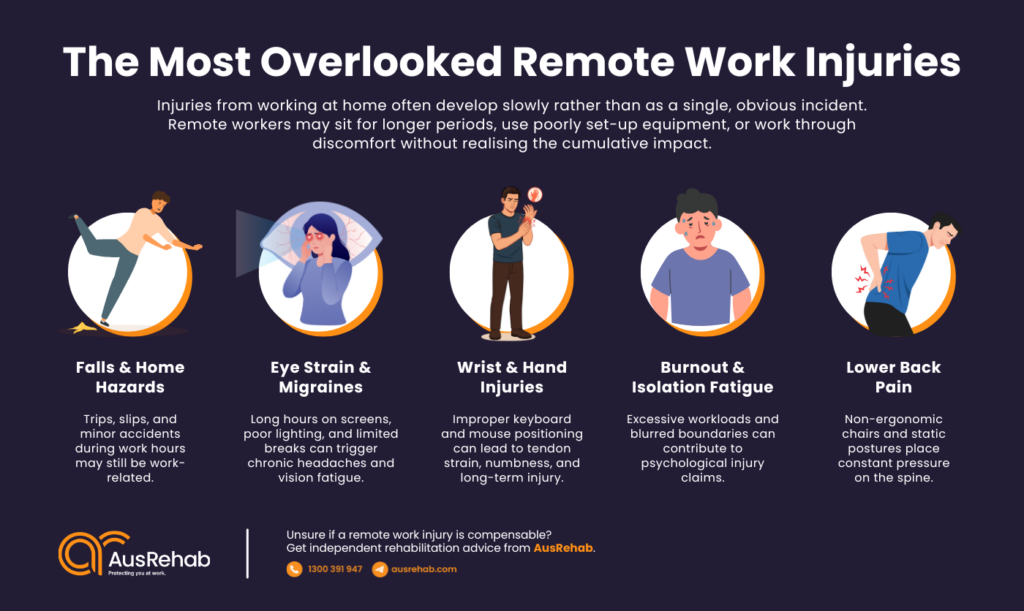
An infographic of the most overlooked remote work injuries across Australia.
What are the most common injuries for remote workers?
Musculoskeletal strain, repetitive use injuries, eye strain, minor home accidents, and work-related psychological injuries are the most frequently reported.
Why Remote Work Injury Claims Are Increasing And Being Challenged
Remote work injuries are rising in Australia, and trends show a clear pattern. Many home setups lack proper ergonomic support. Long hours of sitting are common. Screen time is constant. Early warning signs are often ignored.
Remote workers tend to push through discomfort. Pain feels manageable at first. Symptoms then worsen over time. This delay reduces early intervention. It also weakens the claim’s evidence. Psychological strain is also growing. Psychological injury claims for remote work now form a larger share of applications.
At the same time, more claims are being challenged. The main issue is proof. Home environments are harder to assess, workspaces may not be clearly defined, and daily activities often overlap. Insurers look closely at timing and causation. Personal tasks during work hours raise red flags, and delayed reporting creates doubt. A workers’ comp claim denied decision often follows gaps in evidence.
Psychological claims face additional scrutiny. The injury must be primarily work-related. Non-work stressors can weaken eligibility. Documentation must clearly link symptoms to work duties.
| Reason for Rejection | Explanation | Example | Prevention |
|---|---|---|---|
| Insufficient evidence | No proof injury occurred during work | No photos or medical note | Document early |
| Non-work-related activity | Personal tasks involved | Cleaning or lifting furniture | Set clear boundaries |
| Unsafe workstation | Poor ergonomics cause harm | Working from bed | Use employer checklist |
| Delayed reporting | Injury reported days later | Timeline mismatch | Report immediately |
| Psychological test not met | Injury not work-caused | Stress from home issues | Document work triggers |
Why are remote work injury claims being denied?
Claims are denied when the evidence is weak, the timing is unclear, or the injury cannot be clearly linked to work duties.
What Injured Workers Should Do Immediately
Fast action protects both health and entitlements. Knowing what to do after a remote work injury reduces delays and disputes. Small injuries often worsen when ignored. Early steps create a clear record. That record supports treatment and compensation.
Start by reporting the injury to your manager or HR. Do this as soon as symptoms appear, as timing matters for credibility. Seek medical attention without delay. Ask your doctor to link the injury to specific work tasks. This connection is critical when learning how to prove injury while working from home.
Document the environment where the injury occurred. Take clear photos of your workstation or hazard. Capture lighting, seating, and equipment. Write down symptoms as they develop. Note dates, times, and affected tasks. Keep messages or emails that show work hours and duties.
Provide your remote work agreement if one exists. This helps define approved hours and workspace boundaries. Lodge the claim promptly because delays often weaken outcomes.
Checklist: Steps After a Remote Work Injury
✅ Report the injury to your manager or HR immediately
✅ Seek medical assessment and treatment
✅ Photograph your workstation or hazard
✅ Document symptoms and work activities
✅ Provide your remote work agreement
✅ Lodge your claim as soon as possible
How do you prove a work-from-home injury?
You prove a work-from-home injury by showing it occurred during work hours and resulted from work tasks or the work environment.
Employer Responsibilities for Remote Worker Safety
Remote work does not remove employer duties. Employer responsibilities for remote work apply wherever work is performed. Safety obligations extend into the home office. This includes physical and psychological risk management.
Employers must take reasonable steps to ensure a safe remote working environment. This starts with guidance on workstation setup. Virtual ergonomic checks are acceptable and effective. Simple adjustments reduce many working from home WHS obligations-related injuries.
Clear policies on work hours are essential. Defined start and finish times reduce fatigue and boundary issues. Policies should also outline approved work areas. These details support injury prevention and claim clarity.
Isolation, workload pressure, and digital overload affect remote workers. Employers should monitor these risks through regular check-ins. Early support prevents escalation into psychological injury. Workers need to feel safe raising discomfort or injury. Prompt reporting allows early intervention and better outcomes. Supportive return-to-work processes are also critical. Modified duties and gradual reintegration help recovery and retention.
Remote work succeeds when safety remains visible and intentional.
What are employers responsible for?
Employers are responsible for managing health and safety risks, providing guidance and support, and ensuring fair access to injury reporting and return-to-work support for remote workers.
How AusRehab Helps Remote and Hybrid Workforces
Remote and hybrid work arrangements create different injury risks compared to traditional workplaces. AusRehab supports these workforces through targeted rehabilitation services that focus on early risk identification, practical interventions, and structured recovery aligned with flexible work models and NSW workers’ compensation requirements.
Below is a table outlining how AusRehab addresses common remote work injury risks and the benefits for both workers and employers.
| Risk Area | Service | Worker Benefit | Employer Benefit |
|---|---|---|---|
| Ergonomic strain | Ergonomic Assessment | Reduced pain and better posture | Fewer claims |
| Repetitive Strain Injuries | Physical Examination (Pre-employment Screening) | Early detection | Lower injury costs |
| Psychological risks | Workplace Rehabilitation & Psychological Injury Management | Reduced stress | Fewer psychological claims |
| Lack of reporting | Early Intervention & Injury Management | Awareness and prevention | Higher WHS compliance |
| Complex injuries | Workplace Rehabilitation and Return-To-Work Plans | Tailored recovery | Faster return to work |
Check out our podcast about workplace psychological injury claims to learn more
Safer Remote Work Starts With the Right Support
Remote work is now part of everyday operations. Injuries can still happen at home. With the right approach, remote work does not need to increase injury exposure. It requires structure, education, and timely intervention.
AusRehab supports safer remote work across NSW. Our services focus on prevention, early intervention, and practical return-to-work outcomes. We help employers meet their obligations and help workers recover with confidence.
Learn how AusRehab can support your remote workforce with ergonomic assessments, early intervention, and tailored rehabilitation plans.
Frequently Asked Questions (FAQs)
What should I do after a work-from-home injury?
If you are injured while working from home, act as soon as possible. Report the injury to your manager or HR promptly and seek medical attention, clearly explaining how the injury relates to your work duties. Take photos of your workstation or any hazards involved, and keep notes about your symptoms and when they began.
If you have a remote work agreement, provide a copy to support your claim. Lodging a work-from-home injury claim early helps strengthen evidence and reduces the risk of delays.
What are employers responsible for?
Employers have ongoing WHS obligations for employees working from home. They must take reasonable steps to ensure a safe remote working environment, including providing ergonomic guidance, conducting virtual workstation checks, and setting clear expectations around work hours.
Employers are also responsible for monitoring psychosocial risks such as workload, isolation, and stress. Encouraging early injury reporting and supporting recovery and return-to-work processes are essential parts of these obligations, even when work is performed remotely.
How does AusRehab support remote workers?
AusRehab provides practical remote work rehabilitation support across NSW. Our services include virtual and in-home ergonomic assessments to reduce strain and prevent injury, as well as early intervention support to address symptoms before they escalate. We assess psychosocial risks and support psychological recovery where needed.
For workers requiring ongoing assistance, we develop tailored return-to-work plans that suit remote roles. This structured approach supports safer recovery and helps employers manage claims more effectively.