
Prefer to Listen? Play this quick summary instead!
Near misses happen far more often than formal incident logs suggest. Safe Work Australia’s latest key WHS statistics say 3.5% of people who worked in the previous 12 months experienced a work-related injury or illness. That figure reflects events where harm did occur. It does not capture the many moments when harm was only seconds away. In our view, that gap matters. A workplace that shrugs off close calls often leaves the next worker exposed to the same hazard.
In Australia, that often gets brushed off with either a “nothing happened, so it’s fine” or “she’ll be right” attitude. That response can be risky. A near miss is not just a lucky escape. It is often an early warning that something in the workplace needs attention.
This article explains what a near miss is, gives practical near miss example scenarios, and outlines why near miss reporting matters for safer, more proactive workplaces.
What Is a Near Miss in the Workplace?
A near-miss incident is an unplanned work-related event that did not cause injury, illness, or damage, but could easily have under slightly different circumstances. It is often called a close call at work. The outcome may have been harmless, but the level of risk was still real.
Why a Near Miss Is an Early Warning Sign
A near miss is an early warning because it shows a weakness somewhere in the work system. That weakness may involve:
- equipment that is faulty, poorly maintained, or badly guarded
- an environment with clutter, poor lighting, unstable storage, or slippery surfaces
- a gap in the system of work, such as poor traffic separation or unclear task sequencing
- a behaviour or procedural risk, such as bypassing isolation or taking a shortcut under pressure
💡 A useful analogy is a smoke alarm. The alarm is not the fire, but it is the warning that tells you to act before conditions worsen. A near miss works the same way for workplace safety. It alerts the team to risk before someone gets hurt.
Near Miss Examples Workers Can Recognise
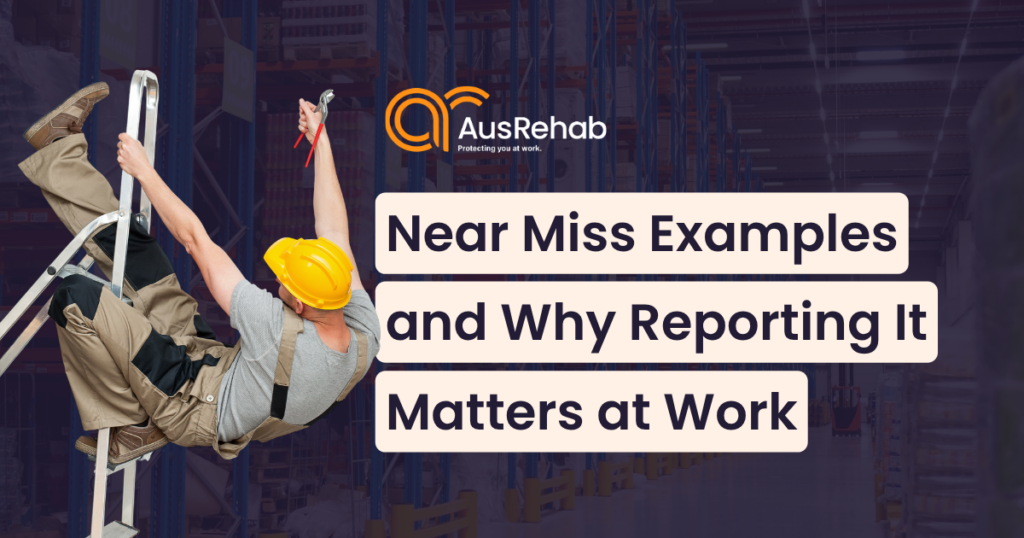
Many workers do not report close calls because they do not realise that the event counts. A practical near-miss example usually involves a situation where a small change in timing or position could have led to harm.
Slips, Trips and Falls
Common examples include:
- tripping over an unsecured cable but catching yourself
- slipping on a wet floor without falling
- missing a step and grabbing the handrail in time
- exiting a vehicle onto uneven ground and stumbling without falling
These events often get dismissed quickly. They should not. A different movement or heavier load could have resulted in injury.
Falling Objects
A clear near-miss example involving falling objects often gets attention because the hazard is so visible.
Examples include:
- a tool falling from height and landing nearby
- overhead materials shifting but not striking anyone
- an item dropping from storage and hitting the ground close to a worker
These events point to storage, exclusion zone, housekeeping, or dropped-object control issues. They are not “nothing happened” moments. They are warnings that a worker was almost in the wrong place at the wrong time.
Machinery and Equipment
Machinery near misses deserve fast review because the energy involved can be significant.
Examples include:
- clothing catching in machinery but tearing free
- equipment malfunctioning without causing injury
- a jammed tool being adjusted without proper isolation
A near miss of this kind often reveals multiple issues at once. It can expose serious gaps in maintenance, guarding, or safe work procedures.
Manual Handling and Movement
This area connects strongly to our work in manual handling and workplace risk reduction.
Examples include:
- workers nearly colliding while carrying a long object
- a forklift braking suddenly near a pedestrian
- a trolley rolling unexpectedly and stopping just short of someone
- a worker losing balance while reaching for an awkward load
These examples are especially relevant in workplaces where poor layout, rushed movement, or manual handling demands increase risk.
Near Miss vs Workplace Incident
Near Miss vs Workplace Incident
| Near Miss | Workplace Incident |
|---|---|
| No injury or damage occurred | Injury, illness, damage, or loss occurred |
| Risk was present | Harm occurred |
| Early warning sign | Consequence of failed controls |
| Gives the team a chance to act before harm | Triggers response after harm has already happened |
💡 Explore our blog article about The Most Common Workplace Injuries in Australia to learn more.
Why Near Miss Reporting Matters
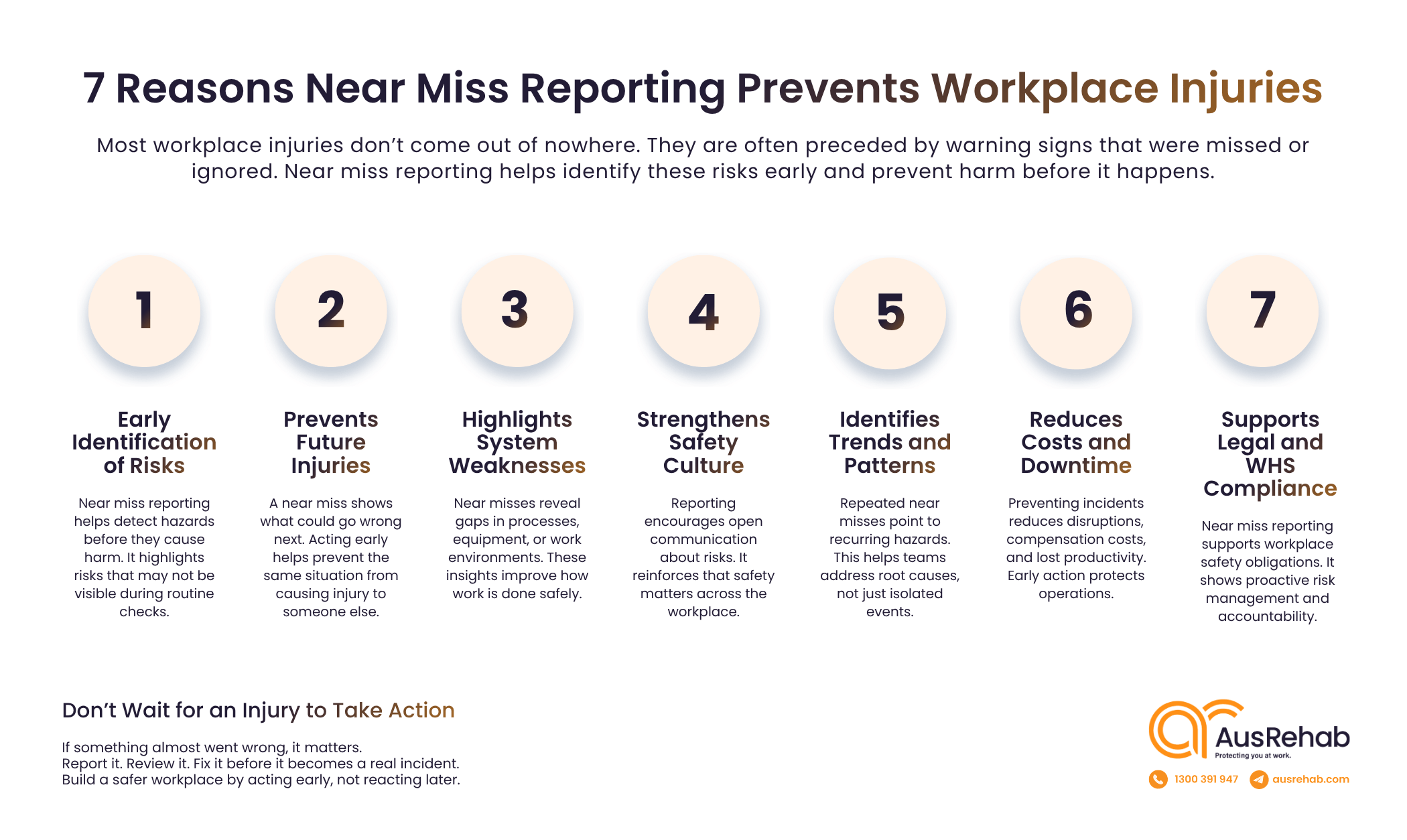
A good safety system does not wait for injury before it pays attention. Near-miss reporting supports both immediate safety and longer-term injury prevention. A body-stressing injury, crush event, fall, or collision may only be one repeat exposure away.
Near Misses Highlight Hidden Hazards
Near misses often reveal hazards that routine checks miss because the risk only becomes visible during real work activity. A worker may notice a blind traffic corner, unstable load, confusing handover, poor line marking, or a repetitive movement problem long before it appears on a formal audit sheet.
Patterns matter too. One report may look minor. Five similar reports tell a very different story. That pattern can reveal failing controls, poor layout, or a system issue that needs a broader fix.
Reporting Prevents Future Injuries
The same hazard that caused one close call may injure the next person. Near-miss safety reporting gives the workplace a chance to act early. That may mean isolating an area, changing storage, refreshing traffic controls, repairing equipment, adjusting the job design, or updating training. Early action is almost always easier and less costly than managing the consequences of an actual incident.
Near Misses Are Leading Safety Indicators
Traditional injury numbers tell you what has already gone wrong. Near misses tell you what could go wrong next. That is why they are often described as leading safety indicators. They help organisations move from reactive safety to preventive safety.
This matters because injury data alone can paint a false picture. A workplace may look safe on paper simply because serious harm has not occurred yet. Near misses bring forward the warning signs. They help leaders see risk before lost time, compensation, and operational disruption arrive.
Reporting Improves Productivity and Costs
Better reporting supports safer operations. It also supports better business performance. When preventable hazards are fixed early, workplaces are more likely to see:
- Fewer injuries
- Less downtime
- Fewer work interruptions
- Less time spent investigating avoidable incidents
- Lower compensation pressure
- Stronger trust in safety systems
Why Near Misses Often Go Unreported
Many workers can describe a close call, but far fewer formally report one. The barriers are usually practical and cultural rather than malicious.
Common reasons include:
- “Nothing happened, so it is not worth reporting.”
This is the most common barrier. The absence of harm creates a false sense that the event was harmless. - Fear of blame or disciplinary action.
If people think a report will trigger fault-finding, silence becomes more likely. - Reporting systems are too complex.
Long forms, clunky software, duplicate approval steps, or unclear responsibilities all discourage action.
Past reports did not lead to visible change.
Workers stop reporting when they feel the process is going nowhere.
Creating a No-Blame Reporting Culture
A healthy no-blame reporting culture focuses on fixing systems, conditions, and controls. That shift matters because people report more often when they believe the workplace is interested in learning rather than punishing.
At AusRehab, we see the strongest prevention outcomes when businesses make reporting easy and visibly useful. A practical workplace hazard reporting culture usually includes four features.
1. Keep reporting simple
A near-miss report should be easy to submit on shift, in the field, or after the task. The process can be digital or paper-based. What matters is access and clarity.
Good options include:
- a short form with essential prompts
- QR code access on site
- supervisor-assisted reporting for workers who need help
- photo upload where safe and appropriate
2. Acknowledge reports quickly
Silence sends the wrong message. Workers should know their report has been seen. A quick acknowledgement helps build confidence in the process.
3. Show visible follow-up
This is where culture becomes real. If a cable hazard is reported and the area is reconfigured, tell the team. If traffic lines are changed, explain why. If a manual handling issue leads to revised equipment or training, close the loop.
4. Focus on learning
Managers and supervisors should ask:
- What made this possible?
- What conditions were present?
- Which control failed or was missing?
- What would stop a repeat?
That line of thinking produces stronger safety action than simply asking who was involved.
Using Near Misses in Toolbox Talks
A toolbox talk is often more useful than a generic reminder poster. Real close calls hold attention because they are recent, concrete, and relevant to the actual work.
A short toolbox talk can use a near miss to:
- identify the hazard clearly
- test if existing controls still make sense
- refresh the safe work method or task sequence
- remind workers what signs to watch for
- prompt workers to share similar close calls
For example, if a worker nearly trips over a charging cable in a workshop, the toolbox talk can cover housekeeping, temporary set-ups, charging station layout, pedestrian routes, and responsibility for end-of-shift checks. That turns one event into a broader learning point.
If a forklift brakes suddenly near a pedestrian, the discussion can shift to line marking, visibility, horn use, speed, crossing points, and load sightlines.
These conversations do not need to be long. In fact, short discussions often work better. They stay focused and feel relevant. They build ongoing awareness without becoming background noise.
What Should Be Included in a Near Miss Report?
A near-miss report does not need to be long. They need to be accurate enough to support action.
What to Include in a Near-Miss Report
| Include | Why It Matters |
|---|---|
| What happened | Identifies the hazard or failure point |
| Where and when | Helps detect patterns by area, shift, or task |
| What could have happened | Shows potential severity |
| Immediate actions taken | Documents the first response |
| Worker suggestions | Encourages practical engagement from the people doing the task |
Here is a simple format workers can follow:
-
Describe the event in one sentence.
Example: “I tripped on a loose extension cord near the packing bench and caught myself on the table.” -
Record location and time.
Example: “Warehouse packing area, 2:15 pm, Tuesday shift.” -
State the possible outcome.
Example: “I could have fallen forward while carrying stock.” -
Note immediate action.
Example: “Moved the cord away from the walkway and told the supervisor.” -
Suggest a fix.
Example: “Install a dedicated power point closer to the bench or secure cords overhead.”
What Happens After a Near Miss Is Reported?
People are more likely to participate in near-miss reporting when they know what happens next. A good post-report process usually includes the following steps:
Review the report
The report should be checked promptly by the relevant supervisor, safety lead, or manager. Urgent risks should be controlled straight away.
Identify hazards and root causes
The team should look beyond the event itself. Ask what allowed it to happen. Was the issue poor maintenance, layout, visibility, fatigue, training, workload, storage, supervision, communication, or something else?
Implement controls or changes
Controls may include:
- repair or maintenance
- isolation or guarding
- changes to layout
- revised traffic routes
- updated storage arrangements
- clearer procedures
- refresher training
- equipment changes
- ergonomic review or workplace assessment
This is where a practical prevention partner can help. AusRehab provides workplace assessments, ergonomic assessments, and manual handling training that support safer systems and lower risk exposure across different work environments.
Share the learning with the team
The value of one report grows when the lesson is communicated. This can happen through toolbox talks, supervisor briefings, noticeboards, team meetings, or training updates.
Monitor for repeat risks
The final step is follow-through. If similar reports keep appearing, the control may be weak, inconsistently applied, or poorly matched to the task. Monitoring helps the business see if the fix is working.
Practical Signs Your Reporting System Needs Attention
Sometimes the issue is not worker awareness, but the reporting system itself.
Warning signs include:
- workers talk about close calls but few reports are logged
- reports contain the same hazard again and again
- reports are submitted but actions are not visible
- supervisors handle issues informally with no record
- workers think reporting creates trouble rather than improvement
- incident trends appear “quiet” despite obvious day-to-day risk exposure
If those signs are present, it is worth reviewing both the process and the culture around it.
Support That Strengthens Workplace Safety
Near misses are not minor events. They are chances to prevent injury before harm occurs. A workplace that treats close calls seriously is better placed to improve safety, reduce disruption, and strengthen its reporting culture.
At AusRehab, we support businesses through manual handling training, ergonomic assessments, workplace assessments, and workplace rehabilitation services that help reduce risk and support safer work.
If something nearly went wrong at your workplace, it is worth speaking up. Early reporting protects everyone.
Frequently Asked Questions (FAQs)
Should near misses be reported even if no one was injured?
Yes. A near miss shows that a hazard was present and could have caused harm under slightly different circumstances. Reporting it gives the workplace a chance to fix the issue before someone is injured.
How can near-miss reporting improve workplace safety culture?
Near miss reporting helps create a culture where workers speak up about risks early. It also shows that safety is about learning and prevention, not blame, especially when reports lead to visible action.
How do near misses help prevent injuries?
Near misses highlight hazards before they lead to an actual incident. When they are reported and reviewed, workplaces can improve controls, correct unsafe conditions, and reduce the chance of someone getting hurt later.