
Prefer to Listen? Play this quick summary instead!
Many people in NSW hear the term “CTP payout” after a motor vehicle accident and assume it refers to a single lump-sum payment. In reality, a Compulsory Third Party (CTP) claim payout often includes several forms of support that assist recovery over time.
A CTP claim may provide weekly income payments if you cannot work. It may also cover medical treatment and rehabilitation. Some people may receive care and domestic support if their injury affects daily activities. In certain cases, lump sum compensation may apply.
What you receive depends on several factors. These include the severity of your injury, fault in the accident, your work capacity, and when the claim is lodged.
Understanding how a CTP claim payout works can help you recognise what support may be available during your recovery.
💡 To also help you better understand how the CTP system works from start to finish, read our blog on Your Essential Guide to Navigating CTP Claims.
What Is a CTP Payout?
A CTP payout in NSW refers to the financial support provided through the insurer of the vehicle involved in a motor vehicle accident. The scheme is designed to support people who are injured, not to cover damage to vehicles or property.
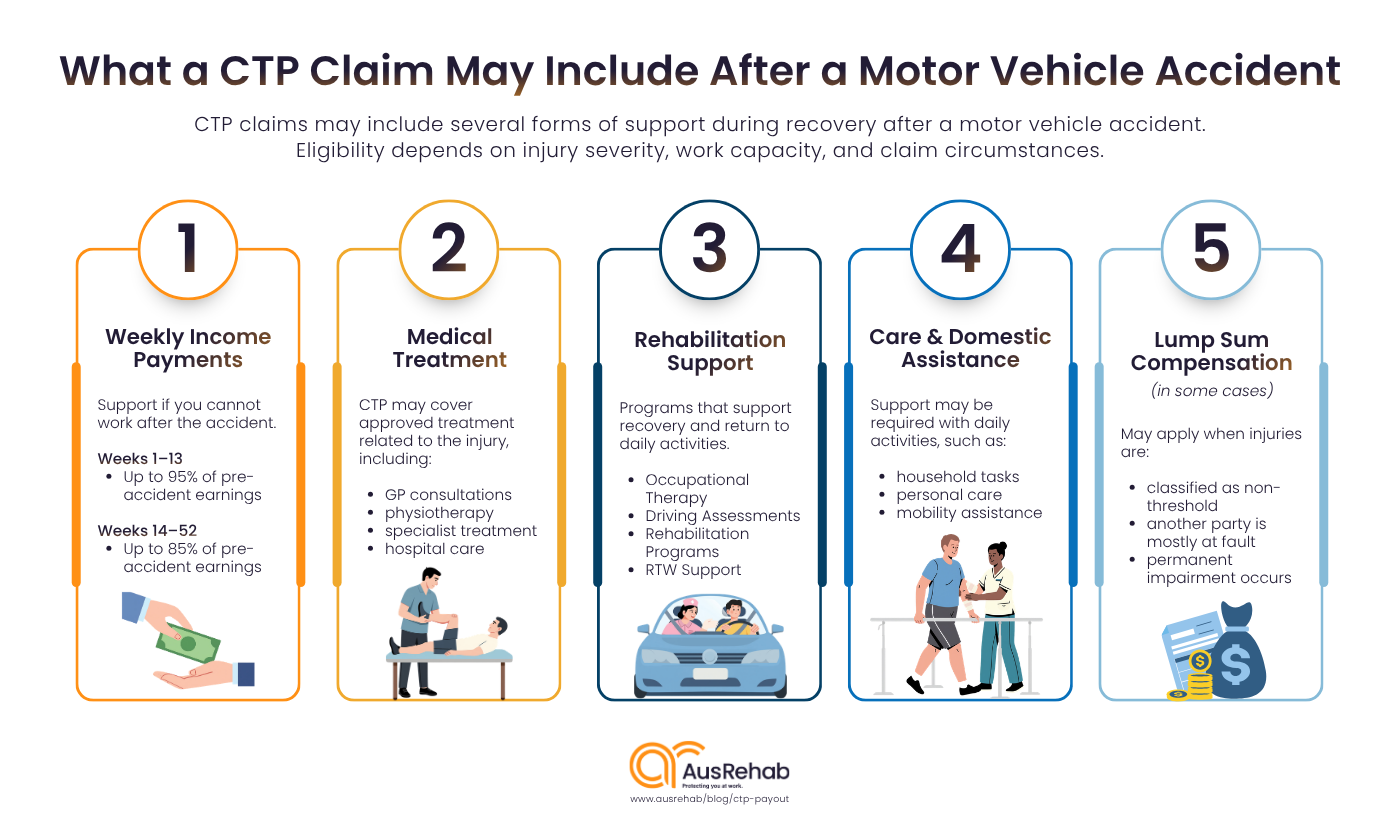
A CTP claim may include weekly payments if you cannot work due to your injury. It may also cover approved medical treatment and rehabilitation. Some people may receive care and domestic assistance if their injury affects daily living. In certain cases, lump sum damages may apply.
It is important to understand that a CTP payout in NSW is not always a single payment. A large part of motor accident compensation is delivered through treatment and rehabilitation services that support recovery over time.
What does CTP cover after a motor vehicle accident?
CTP may cover medical treatment, rehabilitation, income support if you cannot work, and care or domestic assistance. Coverage depends on your injury, work capacity, and claim circumstances.
Weekly Income Payments
CTP weekly payments in NSW provide income support if you are unable to work after a motor vehicle accident. These payments are designed to replace a portion of your pre-accident income while you recover.
In the early stages of a claim, support is typically higher to help stabilise your financial situation. Over time, payments may adjust based on your recovery, work capacity, and claim status.
According to the NSW CTP scheme, income support generally follows this structure:
CTP Weekly Income Support
Typical Income Support Across Claim Timeframes
| Time Period | Income Support |
|---|---|
| Weeks 1–13 | Up to 95% of pre-accident earnings |
| Weeks 14–52 | Up to 85% of pre-accident earnings |
| Beyond 52 weeks | Depends on injury classification and work capacity |
Eligibility beyond 52 weeks may depend on the severity of your injury, your ability to return to work, and fault in the accident.
💡 To understand how to access these payments, read our guide on Injured in a Car Accident? Here’s How to Lodge a CTP Claim in NSW.
Care and Domestic Assistance
Some injuries can affect your ability to manage everyday tasks. A CTP claim payout may include care and domestic assistance when your independence is impacted.
This support can help with household tasks such as cleaning, cooking, and basic home management. It may also include personal care, such as assistance with bathing, dressing, or mobility. In some cases, support may extend to daily living activities that are essential to maintaining routine and well-being.
These services are usually funded when your injury limits your ability to perform tasks on your own. The level of support depends on your condition, medical recommendations, and your assessed needs during recovery.
Care and domestic assistance aim to reduce strain during recovery and help you maintain a safe and stable daily routine.
Lump Sum Compensation (In Some Cases)
A CTP claim payout may include lump sum compensation in certain situations. This usually applies when the injury is classified as non-threshold, which means it is more serious, and another party was mostly at fault for the accident.
Lump sum damages are different from weekly payments or treatment support. They are assessed based on the long-term impact of the injury and the circumstances of the claim.
Compensation may relate to past income loss if the injury affected your ability to work. It may also include future income loss if your earning capacity is reduced over time. In cases involving permanent impairment, damages for pain and suffering may also be considered.
Eligibility for lump sum compensation depends on medical assessment, legal criteria, and the details of the accident. Understanding how injuries are classified can help clarify whether this type of compensation may apply.
Threshold vs Above-Threshold Injuries
In the NSW CTP scheme, injuries are classified to determine the type and duration of support you may receive under a CTP claim payout.
Threshold Injuries
Threshold injuries are generally less severe. These may include soft tissue injuries, muscle strains, whiplash, and minor psychological conditions.
People with threshold injuries may receive benefits for a limited period, which is usually up to 12 months. Support often focuses on treatment, recovery, and return to normal activities.
Non-Threshold Injuries
Non-threshold injuries are more serious and may have a longer impact on daily life and work capacity. These may include fractures, nerve damage, injuries that require surgery, and significant psychiatric conditions.
Support for non-threshold injuries may continue beyond 24 months. In some cases, people with these injuries may be eligible to pursue lump sum compensation.
This classification plays a key role in how long benefits continue and what type of support may be available during recovery.
How long do CTP benefits last?
The duration depends on your injury classification and circumstances. Threshold injuries may receive support for up to 12 months, while non-threshold injuries may receive support for a longer period.
CTP Claim Deadlines
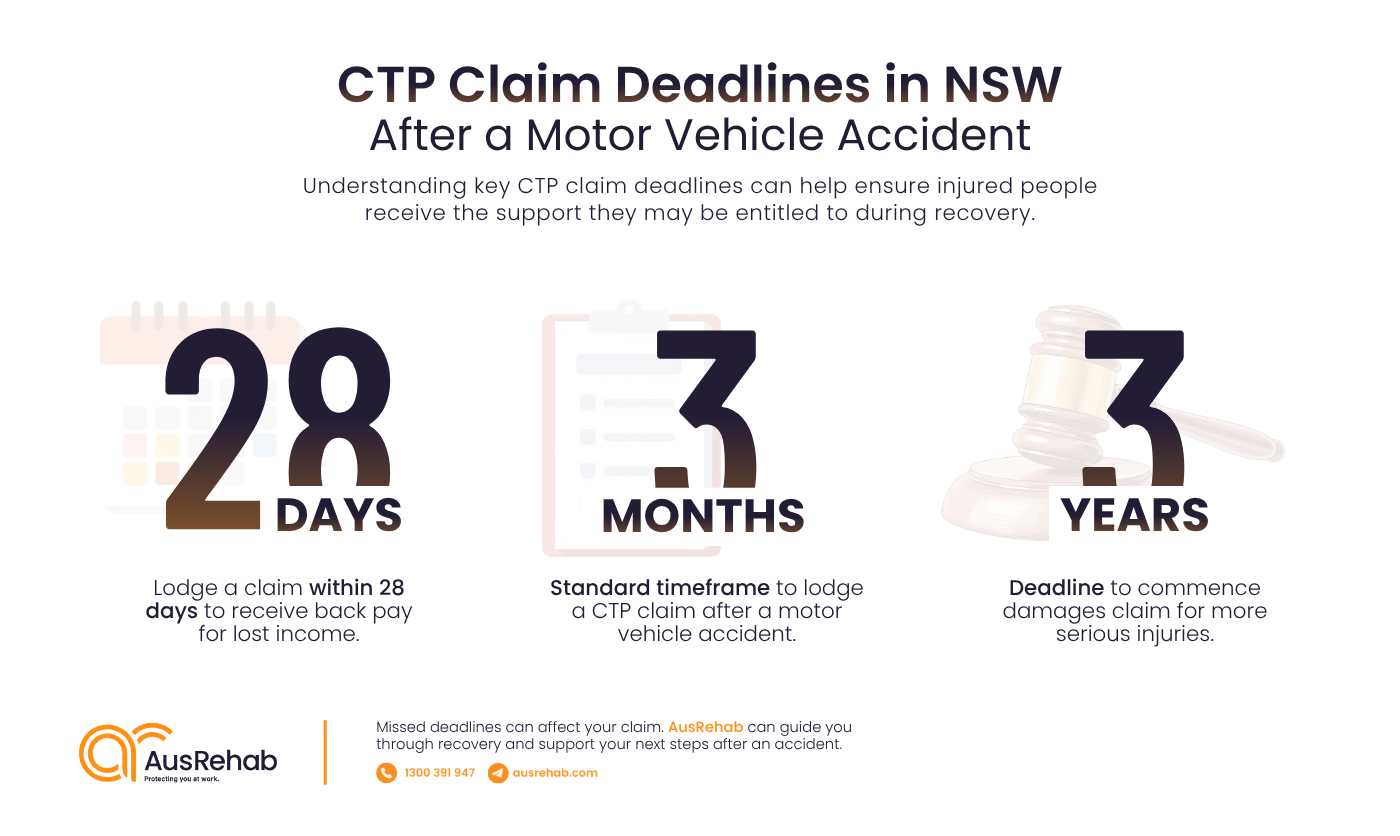
CTP claims follow specific timeframes. Meeting these deadlines can affect what support you receive under a CTP payout in NSW.
Key timeframes include:
Key Timeframes for Lodging a CTP Claim
| Time Period | Income Support |
|---|---|
| 28 Days | Lodge your claim within 28 days to receive back pay for lost income |
| 3 Months | This is the standard deadline to lodge a CTP claim |
| 3 Years | This is the limitation period to start a damages claim for more serious injuries |
Acting early can help protect your entitlements and ensure access to the support you may need during recovery.
Can You Receive a CTP Payout if You Were At Fault?
Yes. You may still receive a CTP payout in NSW even if you were at fault in the accident. The scheme provides statutory benefits to support recovery, regardless of who caused the incident.
These benefits may include approved medical treatment, rehabilitation support, and income support if you are unable to work. The focus is on helping you recover and return to daily activities safely.
However, a fault can affect how long benefits continue. It may also impact eligibility for lump sum compensation. In most cases, lump sum damages are only available if another party was mostly at fault and the injury meets the required criteria.
Understanding how fault affects your CTP payout in NSW can help set clear expectations about the support you may receive.
Why Some People Miss Part of Their CTP Entitlements
Not all injuries are obvious straight after an accident. Some symptoms develop over time and may not be recognised early in a CTP claim payout.
These may include psychological symptoms, fatigue, reduced concentration, difficulty driving, or challenges with daily activities. Because these issues can appear gradually, they are sometimes overlooked during the early stages of a claim.
When symptoms are not identified, the full impact of the injury may not be reflected in the support provided. This can affect access to treatment, rehabilitation, and other benefits.
Proper assessment is important. Early identification of symptoms helps ensure that all relevant conditions are considered and included in the claim. Rehabilitation support can also help monitor changes over time and guide appropriate treatment.
💡 Access to the right medical support is essential. Learn more about connecting with a CTP doctor via telehealth across Australia.
How AusRehab Supports People with CTP Claims
Recovery after a motor vehicle accident often involves more than medical treatment. A CTP claim payout may include rehabilitation services that support daily function and long-term recovery.
AusRehab provides practical support that focuses on safe and sustainable outcomes. This may include occupational therapy driving assessments to determine readiness to return to driving. Driving rehabilitation programs can help rebuild confidence and functional capacity.
Support may also include vehicle ergonomics and modifications to improve safety and comfort. Activities of daily living support can assist with routine tasks during recovery. Coordinated care through medical case conferences helps align treatment, rehabilitation, and return-to-work planning.
These services aim to support independence, improve function, and help people return to work and everyday activities safely.
💡 To learn more about how rehabilitation support fits into your claim, read How can AusRehab assist with my CTP claim?
Support After a Motor Vehicle Accident
Recovery after a motor vehicle accident often involves more than one type of support. It may include medical treatment, rehabilitation, and assistance with daily activities.
Understanding how a CTP payout in NSW works can help you access the support you need at the right time. Clear guidance can make the process easier and help you focus on recovery.
AusRehab supports people recovering from motor vehicle accidents through rehabilitation programs, driving assessments, and coordinated care that focuses on restoring independence and returning to daily life.
If you need support with your recovery or your CTP claim, help is available.
Frequently Asked Questions (FAQs)
What is a CTP payout?
A CTP payout in NSW refers to the financial support provided through the insurer of the vehicle involved in a motor vehicle accident. It may include income payments, medical treatment, rehabilitation, and in some cases, lump sum compensation.
Do you receive weekly payments after a motor accident?
Yes. CTP weekly payments in NSW may be provided if you are unable to work due to your injury. These payments help replace part of your pre-accident income during recovery.
How much income support does CTP pay?
Income support may be up to 95% of your pre-accident earnings in the first 13 weeks and up to 85% from weeks 14 to 52. Ongoing payments depend on your injury, work capacity, and eligibility.
What is a threshold injury in CTP claims?
A threshold injury is a less severe injury, such as a soft tissue injury or minor psychological condition. Benefits are usually available for a limited period, often up to 12 months.
What is a non-threshold injury?
A non-threshold injury is more serious, such as fractures or injuries requiring surgery. These injuries may allow access to extended benefits and, in some cases, lump sum compensation.
What are the deadlines for lodging a CTP claim?
You should lodge your claim within 28 days to receive back pay for lost income. The standard deadline is 3 months, and you generally have up to 3 years to start a damages claim.
Can you receive CTP benefits if you were at fault?
Yes. You may still receive statutory benefits such as medical treatment, rehabilitation, and income support even if you were at fault. However, a fault may affect how long benefits continue and eligibility for lump sum damages.
Does CTP cover rehabilitation and treatment?
Yes. CTP covers approved medical treatment and rehabilitation services that support recovery and return to daily activities.
Can you receive lump sum compensation from CTP?
Yes, in some cases. Lump sum compensation may apply if the injury is non-threshold and another party was mostly at fault. It may cover income loss and, in some cases, pain and suffering.
What rehabilitation services are available after a motor accident?
Rehabilitation may include occupational therapy, driving assessments, return-to-work planning, and support with daily activities. AusRehab provides these services to help people recover safely and regain independence after a motor vehicle accident.