
Prefer to Listen? Play this quick summary instead!
What Happens During a WorkCover Factual Investigation?
A WorkCover factual investigation is a structured process used in workers’ compensation investigations in NSW. It exists to confirm facts, not to assign blame. Insurers use this step to understand what happened, when it happened, and who was involved.
A factual investigation as part of the workers’ compensation process is regulated under SIRA Standard 24. This standard limits when investigations can be used and how they must be conducted. It also protects injured workers through clear notice, defined scope, and procedural fairness.
These investigations are procedural in nature and not personal. They are not a signal that a claim is at risk. They support informed decision-making when information cannot be confirmed through documents alone. Workers retain rights throughout the process, including choice, support, and access to their own records.
WorkCover Factual Investigation – Key Facts
A factual investigation is used only when it is genuinely required under SIRA Standard 24. It is not a surveillance activity, and it is not a medical or psychological assessment. The investigation is carried out by an independent third party with no role in deciding claim outcomes.
Investigators collect objective information through records and interviews. They do not assess fault, intent, or credibility. Decisions remain with the insurer. Workers are protected by clear rights, defined timeframes, and transparent communication at every stage.
What Is a WorkCover Factual Investigation (and What Isn’t It)?
A WorkCover factual investigation is used in workers’ compensation claims when important details are unclear, incomplete, or disputed. Insurers rely on this process to build an accurate record of events.
The investigation focuses on facts drawn from records and conversations. This may include interviews with the injured worker, the employer, or relevant witnesses. It may also involve reviewing claim forms, timesheets, WHS documentation, and medical certificates. In some cases, a site inspection may occur to understand the work environment or task context.
It is equally important to understand what this process is not. A factual investigation is not surveillance. It is not a medical or psychological assessment. It is not a test of honesty or character. It is also not a signal that a claim will be declined.
The investigator’s role is limited and clearly defined. They gather objective information about what happened, when it happened, and who was involved. They do not assess intent, credibility, or liability. Decisions about the claim remain with the insurer under workers’ compensation legislation.
When and Why Do Insurers Request a Factual Investigation?
Under SIRA Standard 24 factual investigation guidelines, insurers can only request a factual investigation when it is genuinely necessary. The standard requires insurers to first attempt to obtain the required information through less intrusive means. This protects worker rights and limits unnecessary investigation activity.
Before approving a factual investigation, insurers must consider options such as employer statements, medical documentation, phone discussions, and internal claim file reviews. A factual investigation is only justified when these steps cannot resolve the uncertainty.
The most common reason why a factual investigation is requested is unclear or disputed injury circumstances. This can include conflicting versions of events between parties. It may also involve gaps in timelines or uncertainty around how the injury occurred. In some cases, insurers need clarification on whether the injured person meets the legal definition of a worker. Investigations may also look at whether another party, not the employer, could be responsible.
SIRA Standard 24 places a clear obligation on insurers. They must document the specific reason for requesting the investigation. This requirement supports transparency and accountability within the workers’ compensation process.
Worker Rights During a WorkCover Factual Investigation (S24.2)
Under factual investigation, S24.2 expectations and benchmarks, workers have clear rights throughout the investigation process. These safeguards exist to ensure fairness, transparency, and procedural balance. A factual investigation must not place unnecessary pressure on an injured worker.
Workers must receive written notice at least five working days before the investigation begins, unless all parties agree to a shorter timeframe. This notice supports informed participation and reduces stress. It must clearly explain the purpose of the investigation. It must include the investigator’s contact details. It must also outline the expected interview duration, which is generally no more than two hours.
These requirements reflect the worker rights factual investigation standards under SIRA. Investigations must be conducted respectfully and within defined limits. Workers are not expected to guess what the investigation involves. They are entitled to clarity before any interview takes place.
Worker Rights Checklist
✅ Choose the interview location
✅ Have a support person present, such as a friend, colleague, or union representative
✅ Request an interpreter who is separate from the support person
✅ Ask for breaks or clarification during the interview
✅ Receive a copy of the interview transcript or statement within 10 working days
✅ Nominate relevant witnesses
✅ Decline participation, noting decisions may still be made using available information
These rights apply regardless of claim status. Exercising them does not imply fault or non-cooperation. They exist to protect worker wellbeing during a formal information gathering process.
What rights do workers have during a factual investigation?
Workers have the right to notice, choice, support, and access to their own statements. These protections ensure the investigation remains fair, proportionate, and compliant with SIRA requirements.
What Actually Happens During a Factual Investigation?
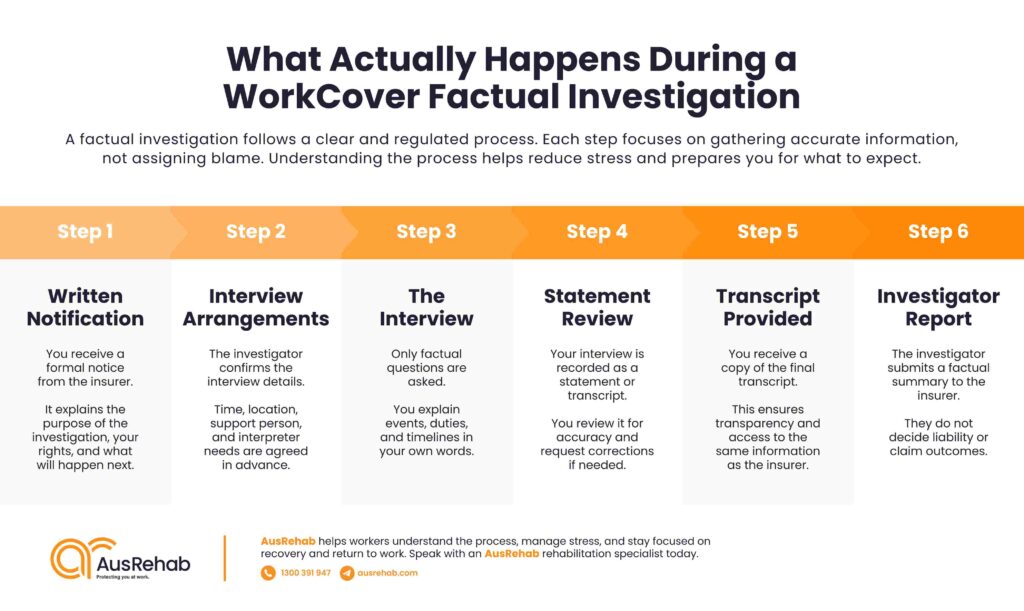
Understanding what happens during a factual investigation can reduce anxiety and help workers prepare. The WorkCover investigation process follows a clear and regulated sequence.
The process usually begins with a written notice from the insurer. This notice explains why the investigation is happening, what information is being sought, and what rights the worker has during the process.
An interview is then arranged with practical details confirmed in advance. Workers can choose the location, bring a support person, or request an interpreter if needed. During the interview, the investigator asks factual questions only. The worker explains what happened, when it happened, and what duties were involved, using their own words.
After the interview, a statement or transcript is prepared. Workers are allowed to review this document and request corrections if needed. A copy of the final transcript is then provided for the worker’s records.
The investigator completes a factual report and submits it to the insurer. This report summarises the information collected. It does not include opinions about liability or claim decisions.
💡 Factual investigations are proportionate and time-limited. Interviews are generally capped at two hours unless exceptional circumstances apply.
What Investigators Can and Cannot Do
Understanding what investigators cannot do helps workers feel more confident during the process. A factual investigation has clear limits. It is not an open-ended inquiry. It follows defined rules and boundaries.
Investigators cannot provide medical opinions. They cannot diagnose injury or comment on capacity for work. They cannot pressure a worker to participate. Participation remains a choice. Consent must be informed and voluntary. They cannot coerce a worker into signing a statement.
Workers are entitled to receive a copy within the required timeframe. They cannot withhold transcripts. Interviews are generally time-limited. They cannot extend interviews beyond reasonable timeframes without justification. They cannot conduct surveillance as part of a factual investigation. They cannot make recommendations about claim acceptance or liability. Those decisions sit with the insurer only.
Investigators can ask factual questions. These questions focus on events, duties, and timelines. They can interview relevant parties such as employers or witnesses. They can review documents like claim forms and WHS records. They can conduct site inspections where appropriate and relevant to the facts.
Factual investigation vs surveillance is an important distinction. Surveillance is a separate process. It is governed by a different SIRA standard. It should not be confused with factual investigations.
Is a factual investigation the same as surveillance?
No. A factual investigation gathers information through interviews and records. Surveillance is separate and subject to different rules.
Common Misconceptions About Factual Investigations
Many workers worry when they hear the words factual investigation. These concerns are common. Most are based on misunderstanding rather than reality.
A factual investigation does not mean your claim will be denied. Insurers use this process to clarify information. It is not a signal of rejection. Participation is also not mandatory. You have the right to decline. Investigators are not trying to catch you out. Their role is limited to collecting facts about what happened and when it happened.
The process is not the same as surveillance. Surveillance is governed by a separate SIRA standard and follows different rules. Declining participation does not automatically result in claim rejection. Insurers can still assess claims using existing records and statements.
It helps to understand how decisions are made. While participation is voluntary, insurers may still rely on the information they already have. This is why knowing your rights matters. Support can also help you feel more prepared and confident throughout the process.
Does a factual investigation mean my claim will be denied?
No. A factual investigation is a procedural step. It is used to clarify facts. It does not determine the outcome of your claim.
How Workers Should Prepare and Respond
Preparing for a factual investigation helps you stay calm and confident. It also helps you protect your rights. Start by reading the written notice carefully. This document explains the purpose, scope, and process. It also confirms whether participation is voluntary. Understanding this early sets clear expectations for what will follow.
You are not required to rush. Choose an interview location where you feel comfortable. A quiet and familiar space supports clear recall. You may bring a support person if that feels helpful. This can be a colleague, friend, or union representative. The investigator’s role is limited. They gather facts only. Focus on what happened, when it happened, and what duties you were performing. Stick to clear timelines and direct answers.
Take your time when responding. Ask for clarification if a question feels unclear. Review your statement carefully before signing. This step matters. The statement becomes part of the factual investigation for the workers’ compensation record. Preparation helps you engage with the process without pressure. It also supports fairness during a workcover factual investigation.
Checklist: How Workers Can Prepare
✅ Read the written notice carefully
✅ Understand your rights
✅ Choose a comfortable interview location
✅ Bring a support person if helpful
✅ Be factual and take your time
✅ Ask for clarification if unsure
✅ Carefully review the statement before signing
Do I have to participate in a factual investigation?
No. Participation is voluntary. Insurers may still make decisions using available information. Understanding your rights helps you decide what is best for you.
Employer and Insurer Responsibilities During the Process
A factual investigation works best when employers and insurers act with care and clarity. Each party has defined responsibilities under workers’ compensation law. These responsibilities protect the worker and support a fair outcome.
Employers play a practical role. They must provide accurate and timely information. This includes Work Health and Safety (WHS) records, employment details, and incident documentation. Records should reflect normal business practices. Employers should support worker participation without pressure or influence. Communication should remain transparent and in good faith throughout the process. This approach helps avoid confusion during an employer’s workers’ comp review.
Insurers carry a higher duty of care. A factual investigation must be used sparingly and only when necessary. The insurer must clearly explain why the investigation is required and how it will be conducted. The process should be proportionate, time-limited, and respectful. Insurers must act transparently and fairly at every stage. They must also avoid unnecessary delay or distress for the worker. These expectations sit at the core of insurer obligations and factual investigation standards.
When employers and insurers follow these responsibilities, investigations stay focused on facts. The process remains procedural rather than to argue or blame. This protects trust and supports better decision-making.
How Rehabilitation Providers Support Workers During Factual Investigations
A factual investigation can feel disruptive when a worker is already managing injury and recovery. This is where workplace rehabilitation support claims play an important stabilising role. Rehabilitation providers help workers stay focused on recovery while the investigation runs its course.
Providers like AusRehab support workers with clear explanations of the investigation process. This reduces uncertainty and stress. When workers understand what is happening and why, they are more likely to engage calmly and confidently. Reduced anxiety supports clearer communication and better outcomes.
Rehabilitation providers also help maintain momentum in recovery. Return-to-work planning does not pause during an investigation. Rehabilitation continues in line with medical advice and capacity. This keeps the structure in place and prevents unnecessary delays. Ongoing engagement supports physical and psychological stability.
Communication is another key role. Rehabilitation providers liaise with insurers and employers to clarify work capacity and rehabilitation progress. This supports transparency and reduces misunderstandings. Objective functional insights also complement the factual findings by providing context around work ability without influencing liability decisions.
| Support Area | How AusRehab Helps | Worker Benefit | Claim Benefit |
|---|---|---|---|
| Worker stress and anxiety | Education and reassurance | Reduced fear | Better engagement |
| Understanding the process | Clear explanations | Confidence | Fewer misunderstandings |
| RTW planning | Aligns rehab with claim stage | Structure | Continuity |
| Communication | Liaison with insurer and employer | Support | Transparency |
| Functional insights | Objective work capacity input | Clarity | Complements factual findings |
Understanding the Process and Your Rights
A WorkCover factual investigation is a regulated and procedural step within the NSW workers’ compensation system. It exists to clarify facts, not to assign blame or assess credibility. Clear rules under SIRA standards protect workers through transparency, fairness, and defined rights. Knowing what to expect can reduce stress and help you stay focused on recovery.
Support matters during complex claim stages. Clear guidance, structured rehabilitation, and steady communication can make the process feel more manageable. This is where experienced rehabilitation support adds real value.
If you are feeling uncertain during a WorkCover claim, AusRehab can support your recovery, wellbeing, and return to work throughout the process.
Frequently Asked Questions (FAQs)
What is a WorkCover factual investigation?
It is a formal fact-finding process used to clarify key details in a workers’ compensation claim. It exists to ensure decisions are made using accurate and complete information.
What happens during a WorkCover factual investigation?
A factual investigation involves notice, an interview, documentation, and a report. The process is structured to gather facts only and protect worker rights throughout.
What should I do if I feel stressed or unsure about the investigation?
Review the written notice carefully and ask for clarification if anything is unclear. You may bring a support person, request an interpreter, take breaks, and respond at your own pace. If stress affects your recovery, speak with your doctor or rehabilitation provider early.
Why has my insurer requested a factual investigation?
Your insurer needs additional factual information that could not be confirmed through documents or standard claim reviews. The request must meet SIRA Standard 24 requirements and be clearly justified in the claim file.
What are employers and insurers required to do during the process?
Review the written notice carefully and ask for clarification if anything is unclear. You may bring a support person, request an interpreter, take breaks, and respond at your own pace. If stress affects your recovery, speak with your doctor or rehabilitation provider early.
How do rehabilitation providers like AusRehab support workers during investigations?
Rehabilitation providers help workers understand the process, manage stress, and stay focused on recovery. AusRehab supports communication, return-to-work planning, and coordination with insurers and employers while the investigation is underway.