
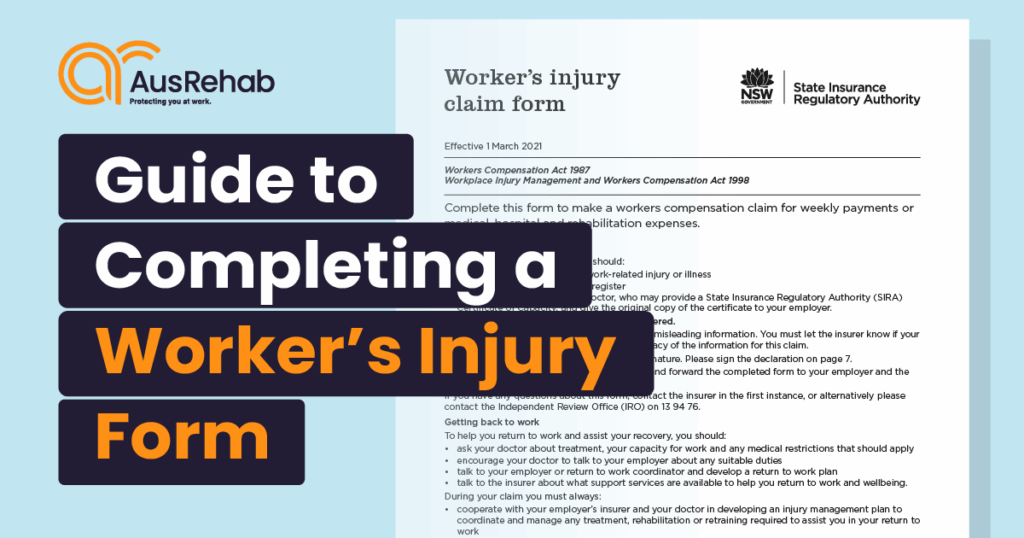
To access weekly compensation payments and medical treatment under the NSW workers’ compensation system, you must complete the Worker’s Injury Claim Form. For many workers, this process can feel overwhelming, so this guide is designed to walk you through each section and highlight other important details you should know.
Completing the form accurately helps confirm how your injury occurred, ensures the insurer can approve treatment, calculate payments, and plan your return to work without unnecessary delays.
At AusRehab, we provide early intervention and support for both workers and employers throughout the recovery process. Our team helps you understand claim requirements, coordinates with doctors, and assists in planning suitable duties to make your return to work as smooth as possible.
What the NSW Worker’s Injury Claim Form Is Used For
The NSW Worker’s Injury Claim Form gives the insurer the information they need to approve support under the workers’ compensation scheme. The form confirms how the injury happened, what body parts were affected, and how the injury impacts your work capacity.
Insurers use the details to decide if you are eligible for weekly payments, medical treatment, and rehabilitation services. The form also helps insurers plan your potential return to work based on your doctor’s recommendations.
All information must be truthful and accurate because SIRA requires clear injury evidence before benefits can be approved.
Purpose of the Worker’s Injury Claim Form
Purpose | What the Insurer Checks |
Weekly payments | Injury impact, capacity for work, PIAWE accuracy |
Medical treatment | Diagnosis, mechanism of injury |
Rehabilitation | Functional impact and return-to-work suitability |
Injury evidence | Time, date, circumstances, witnesses |
Table 1: How Insurers Use the Worker’s Injury Claim Form to Make Decisions.
What to Do Before Filling Out the Claim Form
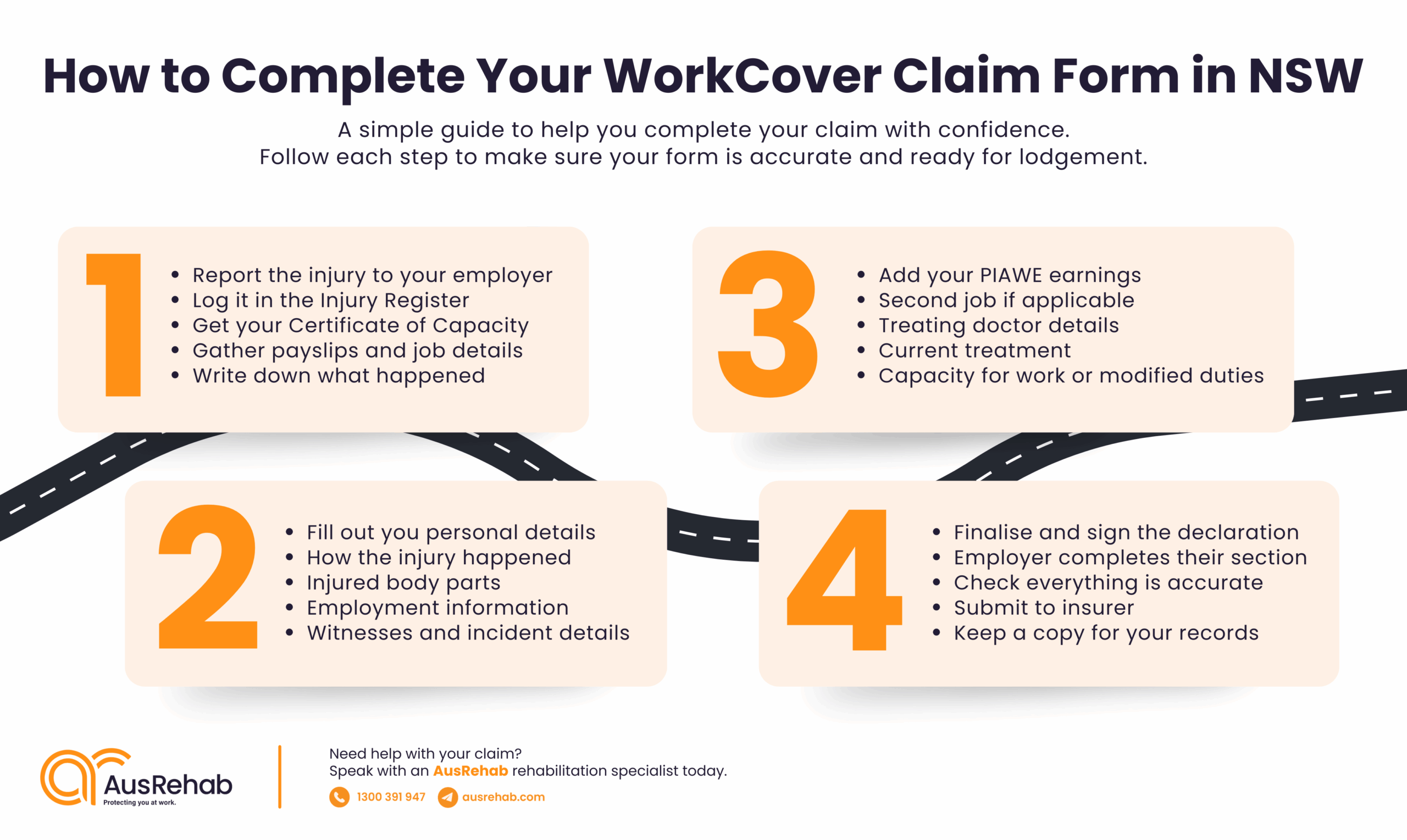
Before completing the NSW Worker’s Injury Claim Form, workers need to prepare a few important documents.
Start by reporting the injury to your employer so it can be recorded in the Workplace Injury Register. Visit your doctor as soon as possible and get a SIRA Certificate of Capacity, as insurers need this to confirm your diagnosis and work capacity.
Gather your payslips, employment records and job description because these support your earnings and role information. Record the incident details while they are still fresh, including what happened, where it happened and who saw it.
Checklist Before You Start
Step | Description |
Notify employer | Report injury and ensure it is entered into the Injury Register |
Visit doctor | Get the SIRA Certificate of Capacity |
Gather documents | Payslips, contracts, and job roles |
Treatment details | Clinic name and provider details |
Witness information | Collect names and statements if possible |
Table 2. Essential steps required before completing the claim form.
What documents do I need before completing my Worker’s Injury Claim Form?
You need your Certificate of Capacity, recent payslips, your employment details, your position description, any witness information, and basic treatment details like clinic names and provider contacts.
Do I need a Certificate of Capacity to lodge a WorkCover claim?
Yes. NSW workers need a SIRA Certificate of Capacity from their doctor. It confirms diagnosis, treatment and capacity for work. Insurers cannot process most claims without it.
Step-by-Step Guide to Completing the Worker’s Injury Claim Form
The NSW Worker’s Injury Claim Form has seven sections. Each one helps the insurer understand who was injured, how the incident happened and what support is needed. Completing every section clearly and accurately reduces delays and ensures the insurer can contact you, confirm the injury and approve treatment.
Section 1. Worker Details
Write your full legal name, date of birth, home address, and all contact details. Include your phone number and email because insurers rely on these to contact you quickly. Add interpreter needs if English is not your preferred language. Some workers may also need to list dependents, depending on their job type or award.
Section 2. Incident and Injury Details
Insurers use this information to confirm how the injury occurred, what task you were performing, and which body parts were affected. Include the exact time, date, location, and any witness details. If a motor vehicle was involved, include the registration and vehicle information. Clear descriptions help the insurer understand the mechanism of injury and approve treatment without delay.
Example Injury Description
Field | Example |
Task | Lifting a 15 kg box during warehouse work |
What happened | Felt a sharp pain in the lower back while lifting |
Injury | Acute lumbar strain |
Location | Warehouse loading bay, Parramatta NSW |
Witness | John Smith, co-worker |
Table 3: Example of a clear and accurate injury description.
💡 Did You Know? Common mistakes that delay claims are vague descriptions, wrong dates, missing location, no witness details, and/or body parts not listed. If you are unsure how to describe your injury, seek guidance from your doctor or rehabilitation provider.
What do I write in the injury description section?
Describe the task you were doing, how the injury happened, the body parts affected, the location, the date and time, and any witness details. Keep it factual and specific. Avoid vague statements.
Section 3. Employment Details
Write your employer’s legal business name, business address, job type, and start date. Declare any secondary employment if you have another job. If you work through labour hire, list the labour hire company as your employer and the host site as your work location.
Labour Hire vs Host Employer
Term | Meaning | What to Enter |
Labour hire employer | Your legal employer | Enter this in the employer field |
Host employer | The worksite | Enter in Work Location |
Table 4. How to complete employment details if working through labour hire.
Section 4. Your Primary Earnings (PIAWE)
PIAWE Components
Earnings Type | Included | Notes |
Base wage | Yes | Standard hours |
Allowances | Yes | Travel, meal, shift loadings |
Overtime | Yes | If regular |
Bonuses | Yes | If consistent |
Second job | Yes | Must be declared if applicable |
Table 5. What earnings count towards PIAWE calculations.
Do I need to include second jobs in the earnings section?
Yes. You must declare all secondary employment. Insurers use this information to calculate your PIAWE accurately.
Section 5. Treatment and Return-to-Work Details
List your treating doctor, clinic or hospital, and any programs you attend. Add modified duties recommended by your doctor and any barriers to returning to work, such as pain, mobility issues or restricted capacity. Clear information helps the insurer support your treatment and return-to-work plan.
Return-to-Work Plan Example
Capacity | Duties | Notes |
Week 1 | Light duties | Doctor approved |
Week 2 to 4 | Up to 5 kg lifting | Gradually increased |
Week 5 | Normal duties | If cleared |
Table 6. Example of a graduated return-to-work plan.
Section 6. Authority and Declaration
It confirms that everything in the form is truthful and accurate. You must notify the insurer if your employment changes or if you start a second job. False or incomplete information can delay or affect your claim.
Section 7. Employer Section
The employer provides the policy number, wage details, days lost, and the date they received the form. The insurer uses this to verify employment and confirm payment calculations. Employers must lodge the form with the insurer. They are not allowed to refuse or block a claim.
Employer Fields
Field | Completed By |
Policy number | Employer |
Days lost | Employer |
Wage details | Employer |
Date form received | Employer |
Table 7. Fields that must be completed by the employer.
Does my employer need to complete part of the Worker’s Injury Claim Form?
Yes. Employers must complete the section that covers policy numbers, wage details, days lost, and the date the form was received. They must then submit the form to the insurer.
What Happens After You Lodge Your WorkCover Claim
Lodging a WorkCover claim is only the first step. Once the insurer receives your form and Certificate of Capacity, a structured assessment process begins. Understanding what happens next helps workers manage expectations and avoid unnecessary stress during an already difficult time.
- The Insurer Reviews Your Claim
The insurer will examine your claim form, medical certificate, incident details, and any supporting evidence. Their immediate task is to confirm that:
- an injury occurred
- it is work-related
- the claim includes the minimum required information
- The Insurer May Contact You, Your Employer, or Your Treating Doctor
To verify details and clarify inconsistencies, the insurer may reach out to:
- you — to confirm circumstances, symptoms, or your work duties
- your employer — to discuss the incident, roster, and job requirements
- your doctor — to clarify diagnosis, treatment, and capacity for work
- Additional Documents May Be Requested
If any information is missing, unclear, or needs stronger evidence, the insurer may ask for:
- updated Certificates of Capacity
- treatment notes
- payslips or employment contracts
- incident reports
- witness statements
- Understanding the Timeframes
NSW insurers are expected to make a provisional liability decision within 7 days, allowing you to access early payments while the investigation continues. A formal claim decision typically follows after further review. This can take longer depending on the nature and complexity of the injury.
- If the Claim Is Approved
Workers may receive:
- weekly payments (income support based on pre-injury earnings)
- treatment approvals (GP visits, physio, imaging, surgery recommendations)
- return-to-work support through your insurer and/or workplace rehabilitation provider
- If the Claim Is Denied
A rejection does not mean the end of your case. Workers can:
- request a review by the insurer
- seek assistance from an independent support service
- lodge a dispute with the Personal Injury Commission
Why Accuracy Matters
Accurate information keeps your WorkCover claim moving. It reduces delays, avoids confusion, and helps the insurer make fast decisions that support your recovery.
✅ It prevents insurer delays
Incomplete or inconsistent details slow down the assessment. Insurers need clear information to confirm what happened, when it happened, and how the injury affects your work.
✅ It reduces follow-up questions
A complete form limits back-and-forth requests. Fewer clarification calls mean a smoother process for you, your employer, and your doctor.
✅ It avoids PIAWE underpayments
Incorrect income details can affect your Pre-Injury Average Weekly Earnings. Missing allowances or outdated payslips often lead to lower weekly payments.
✅ It speeds up medical treatment approvals
Consistent injury and treatment information helps insurers approve physiotherapy, diagnostics, and specialist care without delays.
✅ It prevents disputes
Clear documentation lowers the chance of disagreements about your injury, your capacity, or your earnings. Strong paperwork supports a straightforward claim.
💡 Did You Know? Rehabilitation specialists often see missing dates, vague injury descriptions, incomplete job information, and gaps in treatment history. These issues slow recovery planning and delay insurer decisions.
What mistakes delay WorkCover claims?
Common delays come from vague injury descriptions, missing dates, incorrect earnings details, no Certificate of Capacity, no witness information, and unsigned or incomplete sections. Read our blog about the Do’s and Don’ts of Workers’ Comp to learn more.
How AusRehab Supports Workers During Their Claim
AusRehab helps workers stay informed, supported, and on track throughout their WorkCover claim. Our focus is on early action, clear communication, and practical guidance that lifts recovery and return-to-work outcomes.
Early intervention
We act as soon as a referral arrives. Early intervention reduces risks, identifies barriers, and helps workers access the right treatment and support from the start.
Return-to-work planning
We create simple and realistic return-to-work plans that match the worker’s capacity. These plans guide the transition back to work and help insurers and employers understand what duties are safe.
Suitable duties
We help employers design suitable duties that match medical restrictions. Clear duties prevent reinjury and support consistent progress.
Workplace assessments
We visit the worksite to understand the job, the environment, and any risks. Workplace assessments help confirm safe duties and support long-term recovery.
Functional Capacity Assessments
We use Functional Capacity Evaluation to measure strength, mobility, endurance, and task tolerance. These assessments provide objective evidence for insurers and treating providers.
Communication support
We coordinate discussions between the insurer, employer, and doctor via a Medical Case Conference. Clear communication keeps everyone aligned and reduces delays in treatment and approvals.
Final Tips for a Smooth Claim Process
A clear and complete Worker’s Injury Claim Form prevents delays and helps insurers process your claim faster. Use this checklist before submitting your documents to make sure everything is accurate and consistent with your Certificate of Capacity and incident details.
Final Submission Checklist
Step | Completed |
All sections completed | Yes or No |
Injury description clear | Yes or No |
Certificate of Capacity attached | Yes or No |
Copies saved | Yes or No |
Employer notified | Yes or No |
Table 8. Final review checklist before submitting your Worker’s Injury Claim Form.
Filing Your Claim With Confidence
The Worker’s Injury Claim Form sets the foundation for your recovery and return to work. Accurate details support faster approvals, fewer delays and smoother communication with your doctor, employer and insurer. Every section matters. Clear information protects your weekly payments, medical treatment and long-term support.
If you feel unsure about any part of the process, you are never expected to navigate it alone. AusRehab guides workers from the first report of injury to the final return-to-work plan. Reliable support at the point you need it the most.
Get support from a team that understands WorkCover, WPI, and return to work requirements in NSW. Speak with a qualified rehabilitation specialist and move forward with confidence.
📞 1300 391 947
📧 office@ausrehab.com
🔗 Contact AusRehab for your claim or recovery plan today.
Frequently Asked Questions (FAQs)
What if my employer refuses to lodge my claim?
You can still start your WorkCover claim even if your employer does not submit the form. Lodge it directly with the insurer listed on your workplace’s Certificate of Currency, which your employer is required to display or provide to you. You can also call SIRA’s Workers Compensation Assistance Line for guidance. Employers cannot block or delay a claim under NSW law.
Can someone help me complete my Worker’s Injury Claim Form?
Yes. You can get help from your treating doctor, your employer’s Return-to-Work Coordinator, or a workplace rehabilitation provider. AusRehab guides workers through complex sections, checks accuracy and supports clear injury descriptions to avoid insurer delays.
What happens after I submit my Worker’s Injury Claim Form?
The insurer reviews your injury details and may contact you, your doctor or your employer. They may request extra documents. Approval leads to weekly payments and treatment. If the claim is denied, you can request a review.
How long does a WorkCover claim take to be approved in NSW?
Insurers usually make an initial decision within a short review period. They may approve provisional payments earlier while they review the claim. Timeframes vary based on injury complexity and document completeness.
How does AusRehab support workers during their WorkCover claim?
AusRehab provides early intervention, return-to-work planning, functional capacity assessments, suitable duties planning and communication support with your insurer, employer and doctor. We help workers stay informed, complete documentation correctly, and progress safely through recovery and return to work.