
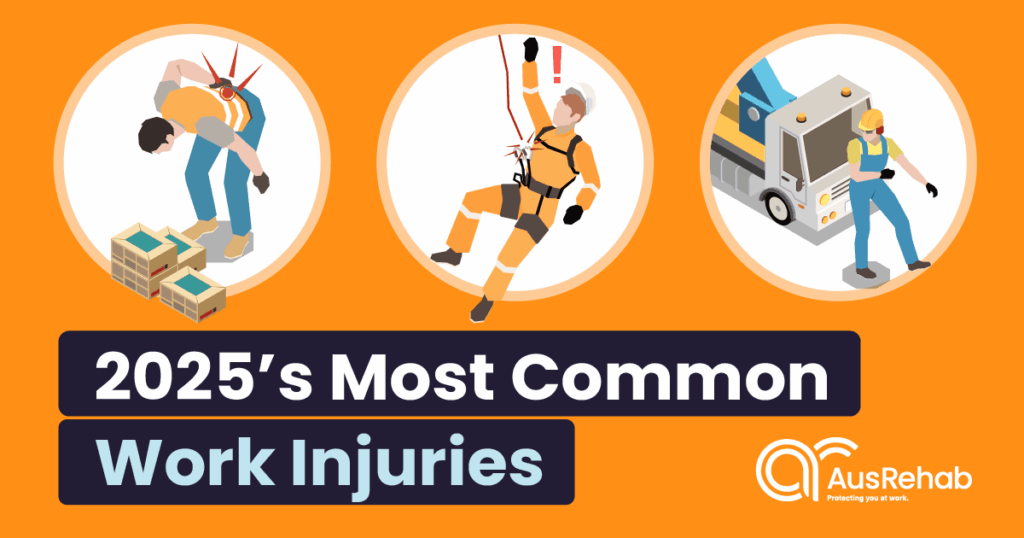
Workplace injuries remain a major issue across Australia in 2025. The latest Safe Work Australia data shows that thousands of workers are seriously injured each year. Some injuries are sudden and physical. Others build slowly through repetition, stress, or poor job design. Mental health conditions now sit alongside musculoskeletal injuries as one of the leading causes of time off work.
Risk is not shared evenly. Certain industries carry a far heavier burden due to physical demands, exposure to hazards, and high job pressure. Construction, healthcare, manufacturing, and transport continue to report high claim numbers. At the same time, psychological injury claims are rising across professional and service-based roles.
This guide breaks down the latest workplace injury statistics Australia relies on. It explains how people are getting hurt, who is most at risk, and what employers and workers can do next.
What Are the Most Common Workplace Injuries in 2025
In 2025, the most common work injuries continue to follow clear patterns across Australian workplaces. Safe Work Australia data shows that five injury categories account for nearly 90% of serious claims.
Most injuries develop through physical strain, repetitive work, sudden incidents, or prolonged psychological stress. While some injuries happen in a single moment, many build slowly over time through poor ergonomics, high workloads, or unsafe systems of work.
These categories help employers focus prevention efforts and help workers recognise risks early, before injuries become severe or long-term. The rise in musculoskeletal injuries and mental health claims in 2025 also highlights how modern work pressures affect both the body and the mind.
Most Common Injury Types in Australia
Nature of injury | What it means | Approx share | Examples |
Joint and ligament injuries | Sprains and soft tissue damage from overexertion or sudden movement | ~30% | Ankle sprains, knee ligament tears, shoulder strains |
Musculoskeletal diseases | Gradual degeneration from repetitive tasks or sustained postures | ~25% | Chronic back pain, neck strain, shoulder impingement |
Wounds and lacerations | Cuts, crushes, and puncture injuries | ~15% | Hand lacerations, finger crush injuries |
Fractures | Broken bones from impact or falls | ~10% | Wrist fractures, lower limb fractures |
Mental health conditions | Psychological injury linked to work stress or trauma | ~8–10% | Anxiety, depression, PTSD, burnout |
Table 1. Overview of the injury types that dominate serious claims in Australia (based on Safe Work Australia Statistics).
💡 Did You Know? In 2025, Safe Work Australia recorded 188 workplace fatalities and 146,700 serious injury claims nationwide. That equals around 400 serious claims every single day. Across the workforce, 3.5% of workers experienced a work-related injury, showing that harm at work remains common and unevenly distributed across industries. (Source: Australian Bureau of Statistics)
How People Are Getting Hurt — Main Injury Mechanisms
Most workplace injuries occur through a small number of repeat patterns. Data shows that body-stressing injuries remain the leading cause of serious claims. These injuries develop through lifting, pushing, pulling, or repetitive tasks. Many occur without a single incident. The damage builds over time through poor posture, fatigue, or excessive workloads.
Falls, slips, and trips are the next major cause. These often happen on level surfaces, not from heights. Wet floors, uneven ground, cluttered walkways, and poor lighting increase risk across all industries.
Being hit by moving objects at work is another common mechanism. This includes tools, equipment, vehicles, or falling materials. These occur in construction, manufacturing, transport, and warehousing settings.
Mental stress injuries continue to rise. These claims are linked to workload pressure, poor role clarity, bullying, exposure to violence, and traumatic events. Unlike physical injuries, mental stress injuries often develop gradually and last longer.
Understanding how injuries occur helps employers focus on controls that reduce risk at the source. It also helps workers recognise early warning signs before injuries become severe or long-term.
Main Ways Workers Are Injured and What Employers Can Control
Mechanism | Everyday example | % of claims | Prevention focus |
Body stressing | Lifting boxes or repetitive manual tasks | ~40% | Manual handling training, ergonomic design, task rotation |
Falls slips trips | Slipping on wet floors or uneven surfaces | ~20% | Housekeeping, flooring controls, clear walkways |
Moving objects | Hit by tools, vehicles, or falling items | ~15% | Equipment guarding, traffic management, load security |
Mental stress | Work pressure, bullying, exposure to trauma | ~10% | Psychosocial risk management, early support, role clarity |
Table 2. How most work injuries occur and the controls that help prevent them.
How do most work injuries happen?
Most work injuries happen through body stressing, falls, slips, trips, contact with moving objects, and mental stress. These account for the majority of serious workers’ compensation claims across Australian workplaces.
Which Body Parts Are Most Commonly Injured
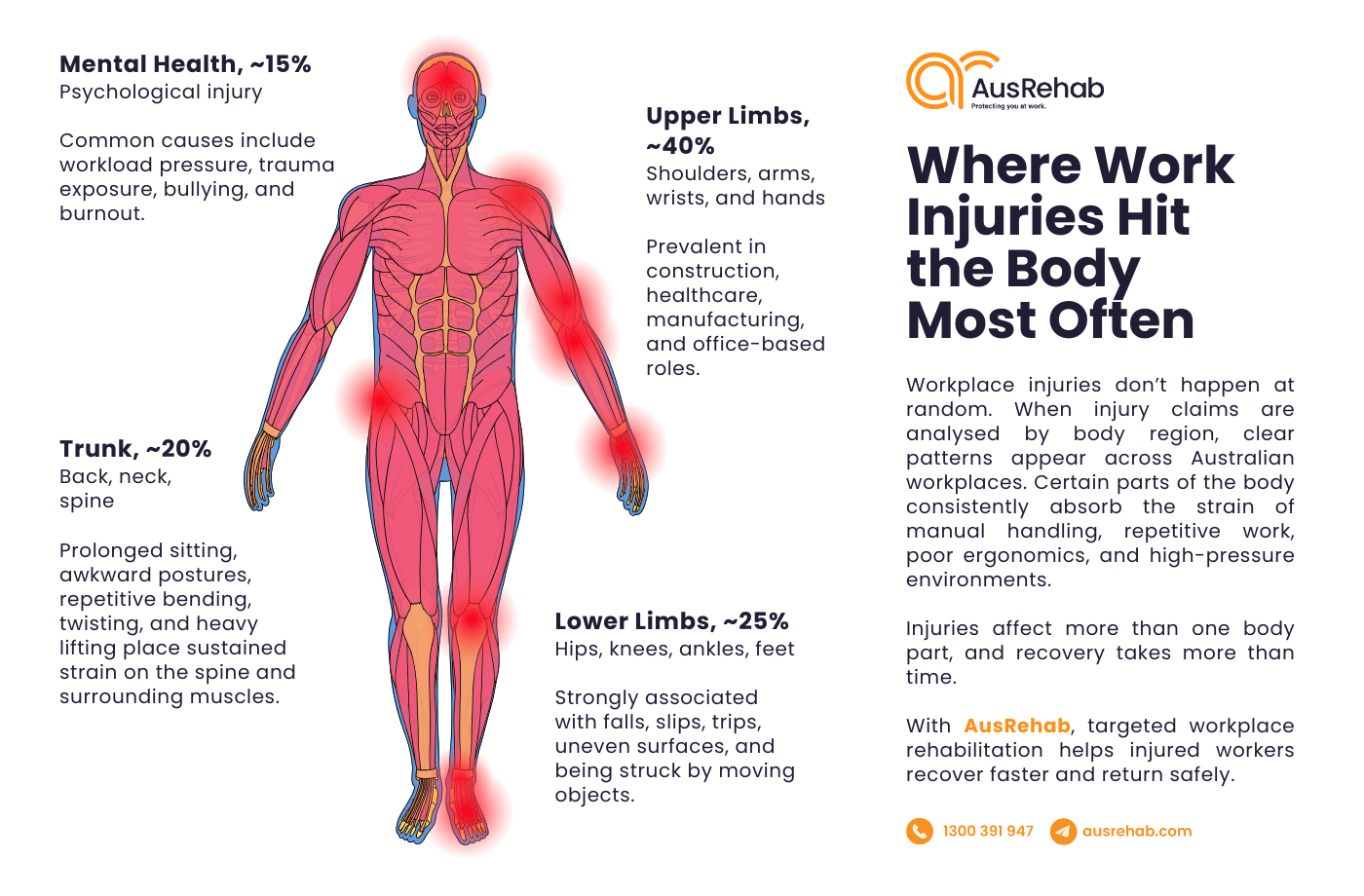
When workplace injury data is grouped by body region, clear patterns emerge. In Australia, upper limb injuries account for the largest share of serious claims. These include shoulders, arms, wrists, and hands, injured during lifting, repetitive tasks, tool use, or manual handling. They’re common across construction, healthcare, manufacturing, and office-based roles with poor ergonomics.
Lower limb injuries follow closely, affecting knees, ankles, and feet. These are frequently linked to falls, slips, and trips, uneven surfaces, or being struck by moving objects. They can significantly impact mobility and delay return-to-work timelines.
The trunk, including the back, neck, and spine, is another high-risk area. Trunk injuries are strongly associated with body stressing, prolonged sitting, awkward postures, and repetitive bending or twisting.
Mental health injuries are also a growing category. While not visible on a body outline, psychological injuries affect overall function and recovery. Stress, burnout, trauma, and workplace conflict can impair concentration, resilience, and physical health.
Mental Health Conditions — Fastest Growing and Costliest Injury
Mental health conditions are now the fastest-growing category of work-related injury in Australia. Psychological injury claims, such as anxiety, depression, post-traumatic stress, and adjustment disorders, have increased steadily over the past decade, with sharp rises following the COVID-19 period. These represent a significant and growing portion of serious WorkCover cases nationwide.
Unlike physical injuries, mental health work injuries often develop gradually. High workloads, prolonged stress, workplace conflict, exposure to trauma, bullying, and poor organisational support all contribute to psychological harm. Once symptoms emerge, recovery is rarely linear. Mental health injuries commonly affect concentration, decision-making, emotional regulation, and social functioning, factors that directly impact a worker’s ability to safely return to their role.
From a cost perspective, psychological injury claims are the most expensive for employers and insurers. They typically involve longer time off work, higher medical and treatment costs, and more complex return-to-work planning. Without early, coordinated rehabilitation support, these claims are also more likely to escalate into long-term incapacity.
🔍 Did You Know? Mental health claims last almost five times longer than other workplace injuries, making early intervention critical for recovery, cost control, and sustainable return to work. (Source: Australian Institute of Health and Safety)
Why are mental health work injuries increasing?
Mental health work injuries are increasing due to higher job demands, greater awareness and reporting, reduced stigma, and more complex psychosocial risks in modern workplaces.
Which Industries Are Most at Risk in 2025
Workplace injuries do not occur evenly across the economy. In 2025, a small group of sectors continues to account for the most serious claims. These are industries with physical demands, high exposure to hazards, or sustained psychosocial pressure. Data trends consistently show higher injury frequency where work is manual, fast-paced, or poorly controlled.
High-risk industries’ work injuries are most common in healthcare, construction, manufacturing, transport, and education. Healthcare remains a leading contributor due to patient handling, fatigue, and rising psychological injury claims. Construction follows closely, driven by falls, moving objects, and body stress from repetitive or forceful tasks. Manufacturing and transport show high frequency rates due to machinery use, manual handling, and long work hours. Education appears lower risk at first glance, but mental health and assault-related claims are increasing year on year.
Looking at serious claims by the industry, frequency rate matters as much as volume. Some sectors employ fewer workers but record more injuries per hour worked. This signals gaps in safety systems, training, or early intervention. Where risks are predictable, injuries are often preventable with the right controls.
Understanding industry risk helps workers recognise exposure early. It also helps employers prioritise prevention, rehabilitation, and return-to-work planning before injuries escalate. Learn more about employer responsibilities and obligations in our blog Responding to Workplace Injuries: Employer Guide.
Industries with the Highest Work Injury Burden in 2025
Industry | Share of Claims | Frequency Rate | Main Risks |
Healthcare and Social Assistance | ~22% | High | Manual handling, violence, mental stress |
Construction | ~18% | Very High | Falls, moving objects, body stressing |
Manufacturing | ~14% | High | Machinery, repetitive tasks, manual handling |
Transport and Warehousing | ~12% | Very High | Fatigue, vehicle incidents, loading tasks |
Education and Training | ~8% | Moderate | Mental stress, occupational violence |
Table 3. Industries with the largest number of serious injury claims and highest risk per hour worked.
Who Is Most at Risk by Job Type, Age and Sex
Injury risk is shaped by what people do, how long they have been working, and the pressures they face at work. Dangerous jobs data for 2025 in Australia shows that manual and frontline roles continue to carry the highest physical risk, while professional and care-based roles now carry growing psychological risk.
Labourers, machinery operators, and trades workers record the highest injury rates. The labourer injury risk remains elevated due to heavy lifting, repetitive tasks, awkward postures, and exposure to moving equipment. Transport workers also sit high on the risk scale due to fatigue, long shifts, and vehicle-related incidents. In healthcare and social assistance, injury risk is driven by patient handling, workplace violence, and mental strain rather than a single physical hazard.
Older workers are more likely to experience severe injuries and longer recovery times. Degenerative conditions, slower healing, and cumulative strain increase both claim duration and cost. Younger workers experience fewer serious injuries but are more vulnerable to acute incidents linked to inexperience, poor supervision, or unsafe task allocation.
Sex differences are also visible in claim patterns. Men account for most traumatic injuries due to higher representation in construction, manufacturing, and transport. Women lodge fewer physical injury claims but make up a larger share of mental health claims gender data. Psychological injuries among women are common in healthcare, education, and administrative roles, often linked to workload pressure, bullying, and occupational violence.
Recognising who is most at risk helps workplaces tailor prevention strategies, training, and early intervention. Injury prevention is strongest when risk is addressed before harm occurs.
Which jobs have the highest injury risk?
Labourers, trades workers, machinery operators, transport workers, and healthcare staff consistently record the highest injury risk due to physical demands and psychosocial exposure.
Turning 2025 Statistics into Prevention and Better RTW
Most injuries are predictable, preventable, and manageable with the right systems in place. Effective workplace injury prevention focuses on early action, safe design, and consistent support. Strong injury reduction strategies also shorten recovery time and improve return to work outcomes.
Employers who reduce injuries do not rely on reactive fixes. They build prevention into daily operations and respond early when issues appear. Small changes, applied consistently, deliver the greatest impact across high-risk roles and industries.
Checklist: Four actions that reduce most workplace injuries
- Identify risk early. Use task analysis, injury data, and worker feedback to spot high-risk activities before injuries occur.
- Improve job design and ergonomics. Adjust tasks, tools, and workstations to reduce body stress and repetitive strain.
- Act early after injury. Support workers immediately with suitable duties, medical guidance, and clear communication.
- Strengthen return to work planning. Create tailored plans that match recovery capacity and adjust as the worker progresses.
When prevention and recovery work together, injuries resolve faster, and workers stay engaged. Employers also see fewer lost time claims, lower costs, and better workforce stability. Prevention is not about eliminating risk entirely. It is about managing risk intelligently and responding early when control measures fail.
Read our blog about Cost-Effective Workplace Rehab Services That Help Employers Lower Premiums to learn more.
How can employers reduce the most common workplace injuries?
Employers reduce injuries by identifying high-risk tasks early, improving ergonomics, acting quickly after injury, and supporting structured, flexible return-to-work plans.
How AusRehab Helps High-Risk Industries Reduce Injuries
High-risk industries face predictable injury patterns. These include body stress, repetitive strain, falls, and psychological strain. AusRehab’s workplace rehabilitation focuses on early action and practical controls that fit real workplaces. Support is targeted, timely, and aligned with recovery goals.
Our team works across construction, healthcare, manufacturing, transport, and community services. Programs are tailored to job demands and workforce risk. The goal is safe recovery and sustainable work.
How AusRehab Services Address Common 2025 Injury Risks
Risk Pattern | AusRehab Service | Worker Benefit | Employer Benefit |
Body-stressing and repetitive tasks | Ergonomic assessment and task redesign | Reduced pain and strain | Fewer repeat injuries |
Manual handling and physical overload | Clear work capacity guidance | Safer duty matching | |
Falls and physical trauma | Workplace rehabilitation planning | Supported recovery | Faster return to work |
Psychological strain and stress | Early intervention and case coordination | Improved confidence and coping | Reduced claim duration |
Complex claims | Communication support with insurer and GP | Clear expectations | Smoother claim management |
Table 4. Rehabilitation services tailored to reduce the most common work injuries.
How does AusRehab help high-risk industries?
AusRehab identifies risk early, delivers targeted rehabilitation, improves job design, and supports structured return-to-work plans that reduce the impact of injuries and claim duration.
Support That Gets You Back to Work Safely
Workplace injuries in 2025 follow clear patterns. Some industries face a higher risk, some injuries take longer to recover, and mental health claims continue to rise. These trends illustrate why early action and the right support are crucial.
Recovery works best with clear guidance. Outcomes improve with timely treatment and structured planning. A trusted workplace rehabilitation provider in NSW helps workers recover with confidence, while also assisting employers in managing risk with clarity.
AusRehab supports injured workers from the first referral to a safe return to work. Care is practical and goal-focused. Communication stays clear across insurers, employers, and treating doctors. Recovery stays on track.
If you need support during a WorkCover claim, help is available. Early support leads to better recovery and safer work.
Frequently Asked Questions (FAQs)
What are the most common workplace injuries in 2025?
In 2025, most workplace injuries in Australia fall into five main categories that make up almost 90% of serious claims. These include joint and ligament injuries, musculoskeletal conditions from repetitive or physically demanding work, cuts and lacerations, fractures from falls or impacts, and a growing number of work-related mental health conditions. Many injuries develop over time due to poor ergonomics, high workloads, or unsafe work practices, rather than from a single incident.
Which body parts are most often injured at work?
The most commonly injured body parts at work are the upper limbs, including the shoulders, arms, wrists, and hands, often due to manual handling, repetitive tasks, or tool use. Lower limb injuries to the knees, ankles, and feet are also common and are usually linked to slips, trips, falls, or impact incidents.
Injuries to the back, neck, and spine frequently occur from body stressing, poor posture, or prolonged sitting. Work-related mental health injuries are also increasing, affecting overall function and recovery even though they are not visible physical injuries.
How long do serious work injuries usually last?
Most serious work injuries require weeks to several months of recovery, depending on the injury type and job demands. Physical injuries like sprains or fractures often resolve faster with early treatment and suitable duties. Mental health claims usually last much longer, often several times the duration of physical injuries. Early intervention and structured return-to-work plans help reduce recovery time.
Which industries are most at risk in 2025?
In 2025, workplace injury risk remains highest in healthcare, construction, manufacturing, transport, and education. Healthcare leads due to patient handling, fatigue, and increasing mental health claims. Construction has high injury rates from falls, moving objects, and physical strain. Manufacturing and transport face risks from machinery, manual handling, and long or irregular hours. Education shows rising risk as well, particularly from work-related stress, psychological injuries, and incident-related claims.