
Prefer to Listen? Play this quick summary instead!
A poor hiring fit can create workplace injury risk before a new employee finishes their first week. For employers, that can mean workers compensation claims, staff shortages, disrupted rosters, and higher compliance pressure.
Safe Work Australia reported 146,700 serious workers’ compensation claims from 2023 to 2024, which involved at least one week of lost working time. This makes pre-employment screening a practical step for workplace injury prevention, safer hiring, and WHS compliance.
Screening helps employers assess if a candidate is medically and physically suited to a role. Some checks are risk-based. AusRehab provides pre-employment screening services that may include a pre-employment medical assessment, pre-employment functional assessment, audiometry, spirometry, visual acuity, skin checks, silicosis testing, and drug and alcohol screening.
The 7 FAQs below answer the key questions employers, HR teams, and candidates should understand before booking a screening.
Quick employer checklist before hiring
✅ Does the role involve manual handling or heavy lifting?
✅ Are workers exposed to loud noise levels above 85 dB?
✅ Is drug and alcohol screening required for this role?
✅ Are there respiratory or dust hazards in the workplace?
✅ Does the role require sustained physical endurance or fitness?
✅ Are there vision requirements linked to machinery, driving, or safety tasks?
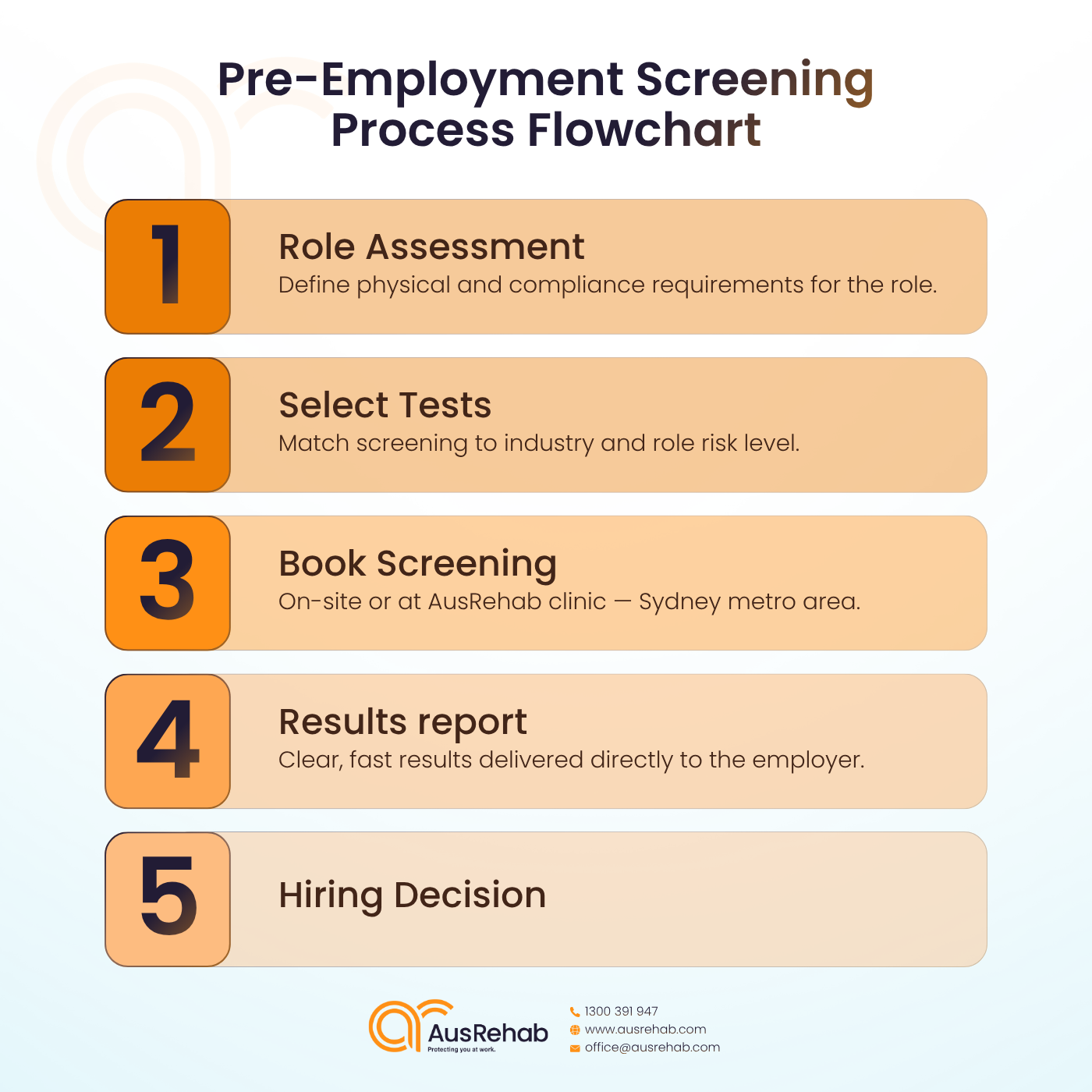
What Is a Pre-Employment Functional Assessment?
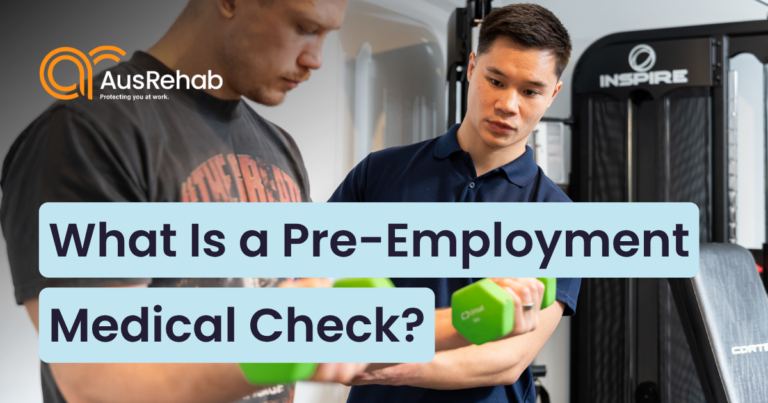
A Pre-Employment Functional Assessment checks if a candidate can safely perform the physical duties of a specific role. It may assess lifting, carrying, pushing, pulling, bending, squatting, grip strength, posture tolerance, and movement capacity.
A PEFA is different from a general medical examination. A general medical exam looks at broader health factors. A PEFA focuses on real job tasks. This makes it useful for roles in construction, warehousing, healthcare, aged care, manufacturing, transport, logistics, and mining.
A well-designed PEFA should match genuine job demands. This keeps the process fair, practical, and aligned with WHS duties.
FAQ 1. Why Do Employers Use Pre-Employment Screening?
Employers use pre-employment screening to check if a candidate can safely meet the health and physical demands of a role.
Screening can identify role-related risks such as reduced lifting capacity, hearing concerns, respiratory issues, vision problems, or substance-related safety risks. It also creates a baseline health record for future health monitoring, injury management, or return-to-work planning.
Employers often use screening to:
- Reduce workplace injury risk
- Support WHS compliance
- Check physical job readiness
- Improve hiring consistency
- Reduce avoidable absenteeism
- Support fair and defensible decisions
💡 Did you know?
Poor hiring decisions and unmanaged workplace health risks can contribute to higher injury rates, increased absenteeism, and long-term workers compensation costs. These costs affect workforce planning and business performance.
FAQ 2. What Tests Are Included in Pre-Employment Screening?
Pre-employment screening can include physical, medical, hearing, lung function, vision, skin, drug, alcohol, and silica-related checks. The right mix depends on the role, industry, workplace hazards, and compliance duties. There is no single package that suits every job, so employers should select tests based on actual risk.
Common Pre-Employment Screening Tests
| Test | Purpose | Common Industries | Approx. Duration | Why Employers Use It |
|---|---|---|---|---|
| Physical Examination | Assess movement, strength, range of motion, and lifting capacity | Construction, warehousing, manufacturing | 45 to 60 min | Reduce manual handling injuries |
| Audiometry | Assess hearing ability | Manufacturing, construction, mining | 10 min | WHS compliance and hearing risk management |
| Spirometry | Assess lung capacity and function | Mining, construction, dusty environments | 15 min | Respiratory risk management |
| Instant Drug & Alcohol Screen | Detect substance use through instant or laboratory testing | Transport, logistics, construction | 10 to 15 min | Safety-sensitive role compliance |
| Visual Acuity | Assess vision and colour blindness | Transport, heavy machinery, healthcare | 5 to 10 min | Role-specific safety requirements |
| Skin Check | Identify skin conditions or abnormalities | Healthcare, outdoor industries | 5 to 10 min | Baseline health documentation |
| Silicosis Test | Assess possible silica-related lung disease | Mining, construction, stonemasonry | 30 to 60 min | Regulatory and exposure risk management |
How Much Does Pre-Employment Screening Cost?
The cost of pre-employment medical checks depends on the selected tests. Employers can review individual pricing on AusRehab’s pre-employment screening services page. Mobile screening within the Sydney metro area is also available for a flat travel fee.
Pre-Employment Screening Pricing Guide
| Type of Test | Pricing |
|---|---|
|
Physical examination
*Additional cost of $80 if a doctor is required for the examination |
$215 |
| Audiometry test | $75 |
| Spirometry test | $80 |
| Visual acuity test | $50 |
| Skin check | $50 |
| Instant drug & alcohol screen | $75 |
| Laboratory drug & alcohol screen | $150 |
| Silicosis test | $770 |
| Flat travel fee | $275 |
FAQ 3. Which Pre-Employment Tests Does My Business Need?
Your business needs tests that match the actual risks of the role. A desk-based role may need a few checks. A safety-sensitive role may need a physical assessment, audiometry, spirometry, visual acuity, and drug and alcohol screening. The best screening plan connects each test to a clear job demand or hazard.
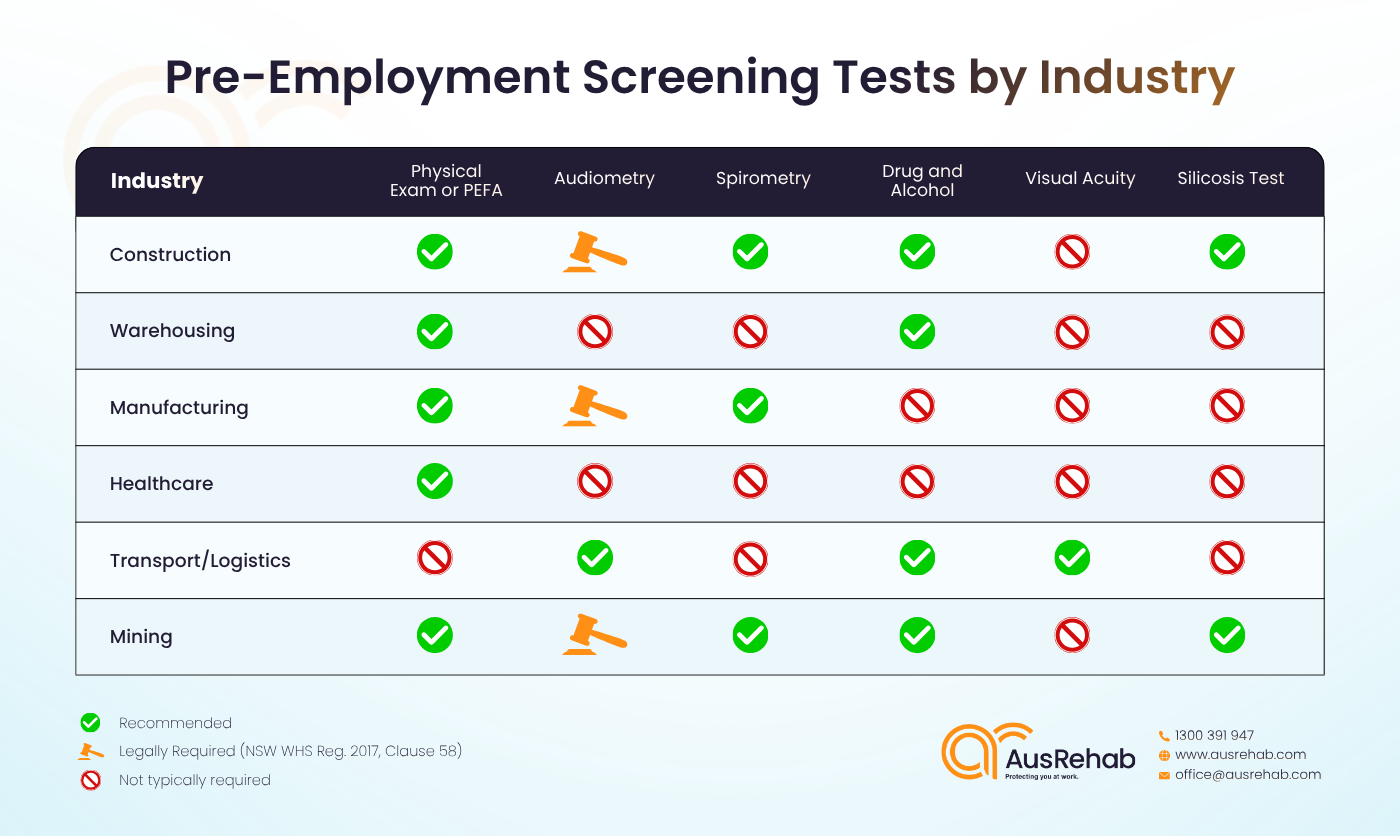
The table below outlines common workplace screening tests used across Australian industries. It also shows what each assessment measures and why employers request it.
Common Pre-Employment Medical Tests by Industry
| Industry | Recommended Tests | Key Risk Managed |
|---|---|---|
| Construction | Physical assessment, audiometry, drug and alcohol screening, spirometry | Manual handling injuries, noise exposure, substance impairment |
| Warehousing | Physical assessment, drug and alcohol screening | Manual handling, forklift safety |
| Manufacturing | Audiometry, spirometry, physical assessment | Noise exposure, respiratory hazards |
| Healthcare | Physical assessment, vaccination checks, skin check | Physical demands, infection risk |
| Transport and Logistics | Drug and alcohol screening, visual acuity, hearing checks | Road safety, substance impairment |
| Mining | Physical assessment, spirometry, audiometry, silicosis test | Physical demands, dust exposure, noise exposure |
How to Choose the Right Screening Provider
A strong provider should offer qualified assessors, clear reporting, secure information handling, fast scheduling, and practical industry knowledge. Mobile or on-site capability is also valuable when employers need to screen several candidates with less disruption.
AusRehab provides workplace screening for employers across Sydney and NSW. Our team can help employers choose relevant checks based on industry risks, role demands, and compliance needs.
Not sure which tests your business needs?
Our team can help you build a custom screening package for your industry.
Watch: How Pre-Employment Screening Works at AusRehab
Key takeaways from this video:
✅ Pre-employment screening helps employers reduce workplace injury risk from day one.
✅ Assessments should reflect the physical demands of specific roles and industries.
✅ AusRehab’s accredited team can travel to workplaces within the Sydney metro area.
✅ Results are delivered clearly and quickly to support faster, safer hiring decisions.
FAQ 4. Does Pre-Employment Screening Only Apply Before Hiring?
No. Pre-employment screening is common before hiring, but workplace medical monitoring can also apply during employment. Ongoing checks may be needed when workers face recurring risks such as hazardous noise, dust exposure, manual handling, or return-to-work duties after injury.
For example, a manufacturing business with ongoing noise exposure may conduct baseline audiometry for new floor staff, then schedule repeat hearing checks for existing workers. This supports compliance and helps detect hearing changes early.
Screening needs should be reviewed when job demands change. New machinery, work processes, chemicals, shifts, or exposure levels can all affect health risk.
FAQ 5. Is Pre-Employment Screening Mandatory in Australia?
Not all pre-employment screening is mandatory for every role in Australia. Employers often use it to manage risk. Some checks become mandatory when specific hazards are present. In NSW, audiometric testing is required for certain workers exposed to hazardous noise under Clause 58 requirements.
For noise-exposed workers, workplace hearing tests must occur within 3 months of employment commencement. Follow-up tests are required at least once every 2 years. Workers employed before 1 January 2024 needed a baseline test by 1 January 2026.
Testing does not replace risk controls. Employers still need to manage noise exposure, provide suitable hearing protection, train workers, and monitor workplace hazards as part of broader WHS planning.
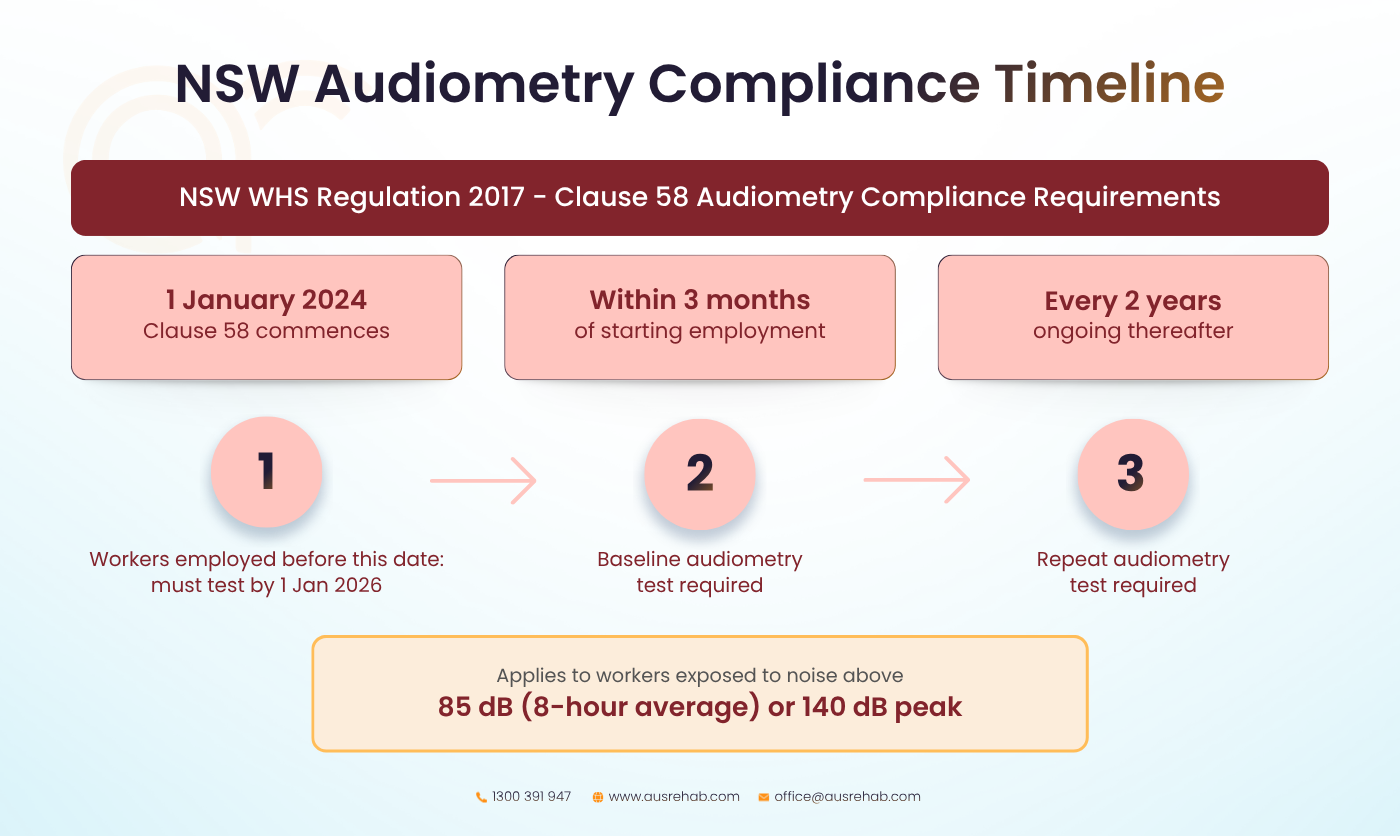
⚠️ NSW audiometry compliance reminder
Under NSW WHS requirements, businesses that expose workers to hazardous noise may be required to provide and fund audiometry testing.
- Testing must occur within 3 months of a worker starting employment.
- Repeat testing is required at least once every 2 years.
- Workers employed before 1 January 2024 must have completed baseline testing by 1 January 2026.
- Records should be handled as confidential health information.
Not sure if your business is affected? Contact AusRehab for a compliance review.
How Candidates Can Prepare for Pre-Employment Screening
✅ Avoid alcohol for at least 24 hours before testing.
✅ Get a full night’s sleep beforehand.
✅ Avoid heavy exercise the day before.
✅ Stay away from loud noise before an audiometry test.
✅ Wear comfortable, non-restrictive clothing suitable for movement.
✅ Bring relevant medical documents or referral letters if requested.
✅ Disclose existing injuries or medical conditions to the assessor.
FAQ 6. What Should Candidates Know Before Their Pre-Employment Screening?
Candidates should know that pre-employment screening assesses fitness for the specific role. It is not a general judgement of personal health. The assessor checks relevant job demands, records the findings, and shares required results with the employer according to consent, privacy requirements, and the screening process.
Candidates should arrive prepared. This helps the assessment run smoothly and improves the quality of the result.
Before testing, candidates should:
- Read the instructions from the employer or screening provider.
- Bring photo identification.
- Wear comfortable clothing that allows movement.
- Bring glasses, hearing aids, or other supports used for work.
- Bring relevant medical documents when requested.
- Fill in our Pre-employment Questionnaire to disclose existing injuries or medical conditions to the assessor before testing begins
- Ask questions if they do not understand a test.
- Tell the assessor if they feel unsafe or unwell during testing.
Candidates should also understand consent. Screening providers may need to share results with the employer. The information shared should relate to job fitness and role requirements. Candidates should ask what information will be shared before the assessment begins.
How Long Does Screening Take?
Most individual tests take between 15 and 60 minutes. A standard physical examination usually takes 45 to 60 minutes. Employers booking multiple tests for the same candidate should allow around 1.5 to 2 hours, depending on the selected checks.
FAQ 7. What Happens If a Candidate Refuses Pre-Employment Testing?
Employers should communicate screening policies before candidates attend an assessment. This includes explaining the purpose of testing, the tests required for the role, and the possible effect of non-participation on the hiring decision. Clear communication reduces confusion and supports fair recruitment.
A candidate may refuse testing for personal, medical, religious, privacy, or safety reasons. Employers should follow a documented process rather than making an informal decision on the day.
How Employers Should Handle Screening Refusals
Employers should:
- Explain the screening requirements in the job advertisement or offer letter
- Connect each test to a genuine role requirement
- Respect a candidate’s right to stop testing if they feel unsafe or unwell
- Record the refusal and any reason provided
- Apply the same policy to all candidates for the same role
- Check that policies align with privacy and anti-discrimination obligations
Why Clear Screening Policies Protect Your Business
Clear screening policies reduce candidate anxiety. They also help managers avoid rushed decisions. A written policy can explain the purpose of screening, the role connection, privacy handling, refusal process, and next steps after results are received.
📝 EMPLOYER TIP
Clear communication before testing helps candidates understand the purpose of pre-employment screening. It also reduces avoidable refusals during recruitment. AusRehab assessors explain testing procedures to candidates in a professional and calm way.
📌 IMPORTANT NOTE: LEGAL AWARENESS
Screening policies must be applied consistently across all candidates for a given role. They must not be used in a way that discriminates unlawfully. Seek independent legal advice if your business needs guidance about employment law obligations.
Make Confident Hiring Decisions With AusRehab
Need help choosing the right checks for your next hire?
We offer pre-employment screening for employers across Sydney and NSW, including physical assessments, audiometry, spirometry, visual acuity, silicosis checks, and drug and alcohol screening.
Book a free consultation with AusRehab to review your role requirements and screening options.
Frequently Asked Questions (FAQs)
What is a Pre-Employment Functional Assessment?
A Pre-Employment Functional Assessment, or PEFA, measures a candidate’s physical capability against the demands of a specific role. It focuses on job-related tasks such as lifting, bending, carrying, pushing, pulling, and manual handling. It is different from a general medical examination because it assesses functional work capacity.
How long does pre-employment screening take?
Most individual pre-employment screening tests take between 10 and 15 minutes. A standard physical examination usually takes 45 to 60 minutes. When a candidate completes several tests in one session, employers should allow around 1 to 1.5 hours, depending on the screening package.
Is pre-employment screening mandatory in Australia?
Most pre-employment screening assessments are not legally mandatory for every role in Australia. Employers often use them to manage hiring and workplace safety risks. In NSW, audiometry testing is required under WHS Regulation 2017 Clause 58 for certain workers regularly exposed to hazardous noise above 85 dB.
Can an employer withdraw a job offer if a candidate refuses screening?
An employer may withdraw a job offer if screening is a genuine requirement of the role, has been communicated clearly, and is applied consistently. Employers should ensure the policy is role-related, documented, and compliant with privacy and anti-discrimination obligations before making a hiring decision.
What is the difference between a pre-employment medical and a PEFA?
A pre-employment medical assessment reviews broader health factors that may affect job safety. A pre-employment functional assessment focuses on the physical demands of a role. It may test strength, mobility, lifting capacity, endurance, posture tolerance, and other functional tasks that relate directly to the job.
Does AusRehab offer on-site pre-employment screening?
Yes. AusRehab can provide on-site pre-employment screening within the Sydney metro area for a flat travel fee. This can reduce the logistical burden of sending multiple candidates off-site and help employers complete screening with less disruption to recruitment timelines.
What industries require pre-employment screening in Australia?
Pre-employment screening is common in construction, manufacturing, warehousing, transport, healthcare, aged care, logistics, and mining. It is most useful in industries with physical job demands, hazardous noise, dust exposure, machinery use, driving requirements, or other safety-sensitive work.
How do I know which pre-employment tests my business needs?
The right tests depend on your industry, job demands, workplace hazards, and regulatory requirements. A physical role may need PEFA testing. A noisy workplace may need audiometry. Safety-sensitive roles may need drug and alcohol screening. AusRehab can help build a custom screening package for your business.